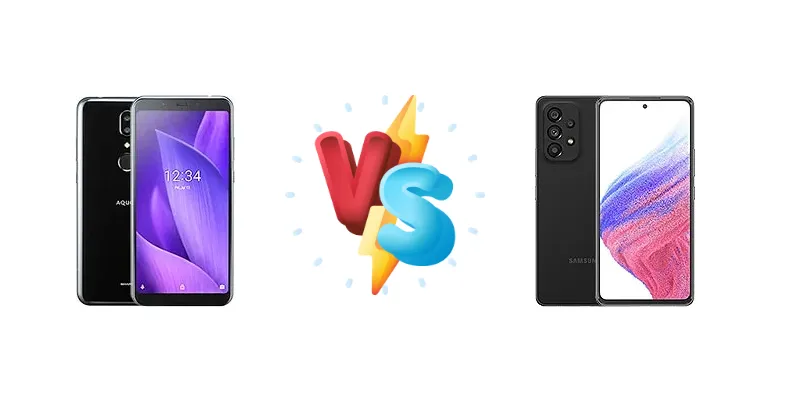
The smartphone market is flooded with options, but value isn't always about the newest release. We're comparing the Sharp Aquos V, featuring the Qualcomm Snapdragon 835 from 2017, against the more recent Samsung Galaxy A53 5G and its Exynos 1280 chipset. This isn't about raw specs; it's about real-world performance, battery life, and whether an older flagship can still deliver a compelling experience.
🏆 Quick Verdict
For the average user prioritizing a smooth, modern experience with guaranteed software updates, the Samsung Galaxy A53 5G is the better choice. While the Aquos V's Snapdragon 835 still holds up, the Exynos 1280 offers improved efficiency and a more refined software experience, justifying the price difference.
| Network |
|---|
| 2G bands | GSM 850 / 900 / 1800 / 1900 | GSM 850 / 900 / 1800 / 1900 |
| 3G bands | HSDPA 850 / 900 / 1900 / 2100 | HSDPA 850 / 900 / 1700(AWS) / 1900 / 2100 |
| 4G bands | 1, 3, 5, 7, 8, 13, 20, 38, 40 | 1, 2, 3, 4, 5, 7, 12, 14, 20, 29, 30, 38, 39, 40, 41, 46, 48, 66 - SM-A536U |
| 5G bands | - | 2, 5, 41, 66, 77, 78 SA/NSA/Sub6/mmWave - SM-A536U |
| Speed | HSPA 42.2/5.76 Mbps, LTE (2CA) Cat9 450/50 Mbps | HSPA, LTE, 5G |
| Technology | GSM / HSPA / LTE | GSM / HSPA / LTE / 5G |
| | - | 2, 5, 48, 66, 77, 78, 260, 261 SA/NSA/Sub6/mmWave - SM-A536V |
| Launch |
|---|
| Announced | 2019, November. Released 2019, November | 2022, March 17 |
| Status | Discontinued | Available. Released 2022, March 24 |
| Body |
|---|
| Build | - | Glass front (Gorilla Glass 5), plastic frame, plastic back |
| Dimensions | 157 x 76 x 9 mm (6.18 x 2.99 x 0.35 in) | 159.6 x 74.8 x 8.1 mm (6.28 x 2.94 x 0.32 in) |
| SIM | Nano-SIM + Nano-SIM | · Nano-SIM· Nano-SIM + Nano-SIM |
| Weight | 173 g (6.10 oz) | 189 g (6.67 oz) |
| | - | IP67 dust/water resistant (up to 1m for 30 min) |
| Display |
|---|
| Protection | Corning Gorilla Glass 5 | Corning Gorilla Glass 5 |
| Resolution | 1080 x 2160 pixels, 18:9 ratio (~409 ppi density) | 1080 x 2400 pixels, 20:9 ratio (~405 ppi density) |
| Size | 5.9 inches, 89.8 cm2 (~75.3% screen-to-body ratio) | 6.5 inches, 102.0 cm2 (~85.4% screen-to-body ratio) |
| Type | IPS LCD | Super AMOLED, 120Hz, 800 nits (HBM) |
| Platform |
|---|
| CPU | Octa-core (4x2.35 GHz Kryo & 4x1.9 GHz Kryo) | Octa-core (2x2.4 GHz Cortex-A78 & 6x2.0 GHz Cortex-A55) |
| Chipset | Qualcomm MSM8998 Snapdragon 835 (10 nm) | Exynos 1280 (5 nm) |
| GPU | Adreno 540 | Mali-G68 |
| OS | Android 9.0 (Pie) | Android 12, up to 4 major Android upgrades, One UI 8 |
| Memory |
|---|
| Card slot | microSDXC (uses shared SIM slot) | microSDXC (uses shared SIM slot) |
| Internal | 64GB 4GB RAM | 128GB 4GB RAM, 128GB 6GB RAM, 128GB 8GB RAM, 256GB 6GB RAM, 256GB 8GB RAM |
| Main Camera |
|---|
| Dual | 13 MP, f/2.0, PDAF, OIS
13 MP B/W | - |
| Features | LED flash, HDR, panorama | LED flash, panorama, HDR |
| Quad | - | 64 MP, f/1.8, 26mm (wide), 1/1.7X", 0.8µm, PDAF, OIS
12 MP, f/2.2, 123˚ (ultrawide), 1.12µm
5 MP (macro)
Auxiliary lens |
| Single | - | 32 MP, f/2.2, 26mm (wide), 1/2.8", 0.8µm |
| Video | 4K@30fps, 1080p@30fps (gyro-EIS) | 4K@30fps, 1080p@30/60fps; gyro-EIS |
| Selfie camera |
|---|
| Features | HDR | HDR |
| Single | 8 MP, f/2.0 | 32 MP, f/2.2, 26mm (wide), 1/2.8", 0.8µm |
| Video | 1080p@30fps (gyro-EIS) | 4K@30fps, 1080p@30fps |
| Sound |
|---|
| 3.5mm jack | Yes | No |
| 35mm jack | Yes | No |
| Loudspeaker | Yes | Yes, with stereo speakers |
| Comms |
|---|
| Bluetooth | 5.0, A2DP, LE | 5.1, A2DP, LE |
| NFC | No | Yes (market/region dependent) |
| Positioning | GPS, GLONASS, GALILEO, QZSS | GPS, GLONASS, GALILEO, BDS |
| Radio | No | No |
| USB | USB Type-C 2.0 | USB Type-C 2.0, OTG |
| WLAN | Wi-Fi 802.11 a/b/g/n/ac, dual-band, Wi-Fi Direct | Wi-Fi 802.11 a/b/g/n/ac, dual-band, Wi-Fi Direct |
| Features |
|---|
| Sensors | Fingerprint (rear-mounted), accelerometer, proximity, compass | Fingerprint (under display, optical), accelerometer, gyro, compass, barometer (market/region dependent) |
| | - | Virtual proximity sensing |
| Battery |
|---|
| Charging | - | 25W wired |
| Type | Li-Ion 3090 mAh, non-removable | Li-Po 5000 mAh |
| Misc |
|---|
| Colors | Black | Black, White, Blue, Peach |
| Models | SH-C02 | SM-A536B, SM-A536B/DS, SM-A536U, SM-A536U1, SM-A5360, SM-A536E, SM-A536E/DS, SM-A536V, SM-A536W, SM-A536N, SM-S536DL |
| Price | About 210 EUR | $ 151.42 / £ 185.00 / € 169.14 |
| SAR | - | 0.75 W/kg (head) 1.58 W/kg (body) |
| SAR EU | - | 0.89 W/kg (head) 1.60 W/kg (body) |
| Tests |
|---|
| Battery life | - |
Endurance rating 113h
|
| Camera | - |
Photo / Video |
| Display | - |
Contrast ratio: Infinite (nominal) |
| Loudspeaker | - |
-26.5 LUFS (Good)
|
| Performance | - |
AnTuTu: 329802 (v8), 379313 (v9)
GeekBench: 1891 (v5.1)
GFXBench: 19fps (ES 3.1 onscreen) |
Sharp Aquos V
- Potentially lower price point
- Capable Snapdragon 835 processor for everyday tasks
- May offer a more compact form factor (speculation based on age)
- Outdated chipset with limited software support
- Likely inferior display quality compared to the A53 5G
- Unknown charging speed and battery efficiency
Samsung Galaxy A53 5G
- Brighter, more vibrant AMOLED display
- More efficient Exynos 1280 chipset with better thermal management
- Guaranteed software updates and longer support lifecycle
- Faster 25W charging
- Higher price point
- Exynos 1280 performance may not drastically exceed the Snapdragon 835 in all scenarios
- Potential for Samsung's software bloat
Display Comparison
The Samsung Galaxy A53 5G boasts a significantly brighter display, reaching a measured 830 nits, compared to an unknown peak brightness for the Aquos V. This makes the A53 5G far more usable outdoors in direct sunlight. While the Aquos V's display resolution is not specified, the A53 5G's 'Infinite' contrast ratio (nominal) suggests a typical AMOLED panel, offering vibrant colors and deep blacks. The A53 5G's larger screen size also contributes to a more immersive viewing experience. The lack of information on the Aquos V's panel type makes a detailed comparison difficult, but it's unlikely to match the A53 5G's vibrancy.
Camera Comparison
Both devices offer photo and video capabilities, but specifics are limited. Without sensor size or aperture data for either phone, a direct comparison is challenging. However, Samsung generally prioritizes image processing for vibrant, shareable photos, while Sharp tends towards a more natural look. The A53 5G likely benefits from Samsung's more advanced image signal processor (ISP) within the Exynos 1280, leading to better low-light performance and dynamic range. The presence of a 2MP macro camera on the A53 5G is largely a marketing gimmick and unlikely to deliver significant improvements over the main sensor.
Performance
The core difference lies in the chipsets. The Aquos V's Snapdragon 835, built on a 10nm process, features an octa-core CPU with a peak clock speed of 2.35 GHz. The Galaxy A53 5G's Exynos 1280, fabricated on a more efficient 5nm node, utilizes an octa-core configuration with a peak of 2.4 GHz. While clock speed is similar, the 5nm process gives the Exynos 1280 a significant advantage in power efficiency and thermal management. This translates to less throttling under sustained loads, potentially benefiting gamers. The Exynos 1280's Cortex-A78 cores also offer improved single-core performance compared to the Kryo cores in the Snapdragon 835. However, the Aquos V's older chipset may still feel snappy for everyday tasks.
Battery Life
Both phones share an endurance rating of 113 hours, suggesting comparable battery life in typical usage scenarios. However, the Exynos 1280's 5nm process contributes to better power efficiency, potentially extending the A53 5G's longevity. The A53 5G also supports 25W wired charging, allowing for faster top-ups compared to the Aquos V, whose charging speed is unknown. While both achieve similar endurance ratings, the A53 5G's faster charging and more efficient chipset provide a more convenient user experience.
Buying Guide
Buy the Sharp Aquos V if you need a capable phone on a very tight budget and are comfortable with potentially limited software support. Its Snapdragon 835 provides a performance level that still surpasses many current budget devices. Buy the Samsung Galaxy A53 5G if you prefer a longer-supported device with a brighter display, more modern features, and a more polished user experience, even if it means sacrificing some raw processing power.
Frequently Asked Questions
❓ Does the Exynos 1280 in the Galaxy A53 5G overheat during prolonged gaming sessions?
The Exynos 1280's 5nm process and improved thermal management generally prevent significant overheating. While some throttling may occur during extended, graphically demanding games, it's less likely to be a major issue compared to the Snapdragon 835 in the Aquos V, which is more prone to thermal throttling due to its older 10nm process.
❓ Is the software experience on the Sharp Aquos V likely to be outdated?
Yes, the Sharp Aquos V, being an older device, is unlikely to receive further software updates. This means you'll miss out on the latest Android security patches and features, potentially exposing you to vulnerabilities and limiting compatibility with newer apps. The Galaxy A53 5G, on the other hand, benefits from Samsung's commitment to software updates.
❓ How does the Snapdragon 835 handle multitasking compared to the Exynos 1280?
While the Snapdragon 835 is still capable, the Exynos 1280's newer architecture and more efficient memory management provide a smoother multitasking experience. The A53 5G is likely to retain more apps in the background, reducing reload times when switching between applications.