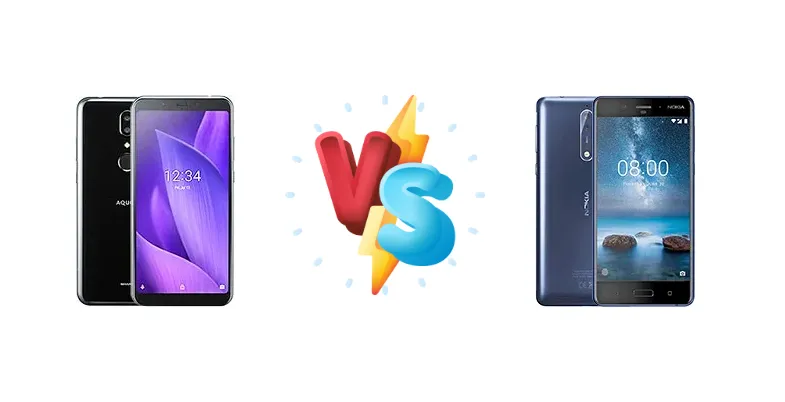
Released in 2017/2018, the Nokia 8 represented HMD Global’s return to the flagship smartphone arena, while the Sharp Aquos V offered a compelling alternative, particularly in Asian markets. Both devices share the Qualcomm Snapdragon 835 chipset, but diverge in their execution, offering different strengths for distinct user needs. This comparison dissects those differences to determine which phone delivers the best overall experience today.
🏆 Quick Verdict
For the average user seeking a balance of performance and longevity, the Nokia 8 emerges as the slightly better choice. Its 78-hour endurance rating and Quick Charge 3.0 support provide a more reliable and convenient charging experience, offsetting the Aquos V’s marginally lower CPU clock speeds.
| Network |
|---|
| 2G bands | GSM 850 / 900 / 1800 / 1900 | GSM 850 / 900 / 1800 / 1900 - SIM 1 & SIM 2 (dual-SIM model only) |
| 3G bands | HSDPA 850 / 900 / 1900 / 2100 | HSDPA 850 / 900 / 1900 / 2100 |
| 4G bands | 1, 3, 5, 7, 8, 13, 20, 38, 40 | 1, 2, 3, 4, 5, 7, 8, 20, 28, 38, 39, 40, 41 |
| Speed | HSPA 42.2/5.76 Mbps, LTE (2CA) Cat9 450/50 Mbps | HSPA 42.2/5.76 Mbps, LTE (3CA) Cat9 450/50 Mbps |
| Technology | GSM / HSPA / LTE | GSM / HSPA / LTE |
| Launch |
|---|
| Announced | 2019, November. Released 2019, November | 2017, August 16. Released 2017, September 07 |
| Status | Discontinued | Discontinued |
| Body |
|---|
| Build | - | Glass front (Gorilla Glass 5), aluminum back, aluminum frame (6000 series) |
| Dimensions | 157 x 76 x 9 mm (6.18 x 2.99 x 0.35 in) | 151.5 x 73.7 x 7.9 mm (5.96 x 2.90 x 0.31 in) |
| SIM | Nano-SIM + Nano-SIM | · Nano-SIM· Nano-SIM + Nano-SIM |
| Weight | 173 g (6.10 oz) | 160 g (5.64 oz) |
| | - | IP54, dust and water resistant |
| Display |
|---|
| Protection | Corning Gorilla Glass 5 | Corning Gorilla Glass 5 |
| Resolution | 1080 x 2160 pixels, 18:9 ratio (~409 ppi density) | 1440 x 2560 pixels, 16:9 ratio (~554 ppi density) |
| Size | 5.9 inches, 89.8 cm2 (~75.3% screen-to-body ratio) | 5.3 inches, 77.4 cm2 (~69.4% screen-to-body ratio) |
| Type | IPS LCD | IPS LCD |
| | - | Always-on display |
| Platform |
|---|
| CPU | Octa-core (4x2.35 GHz Kryo & 4x1.9 GHz Kryo) | Octa-core (4x2.5 GHz Kryo & 4x1.8 GHz Kryo) |
| Chipset | Qualcomm MSM8998 Snapdragon 835 (10 nm) | Qualcomm MSM8998 Snapdragon 835 (10 nm) |
| GPU | Adreno 540 | Adreno 540 |
| OS | Android 9.0 (Pie) | Android 7.1.1 (Nougat), upgradable to Android 9.0 (Pie) |
| Memory |
|---|
| Card slot | microSDXC (uses shared SIM slot) | microSDXC (uses shared SIM slot) |
| Internal | 64GB 4GB RAM | 64GB 4GB RAM, 128GB 6GB RAM |
| | - | UFS 2.1 |
| Main Camera |
|---|
| Dual | 13 MP, f/2.0, PDAF, OIS
13 MP B/W | 13 MP, f/2.0, 1/3.1", 1.12µm, PDAF, OIS
13 MP B/W, f/2.0, 1.12µm, PDAF |
| Features | LED flash, HDR, panorama | Laser AF, Zeiss optics, dual-LED dual-tone flash, HDR, panorama |
| Video | 4K@30fps, 1080p@30fps (gyro-EIS) | 4K@30fps, 1080p@30fps |
| Selfie camera |
|---|
| Features | HDR | - |
| Single | 8 MP, f/2.0 | 13 MP, f/2.0, (wide), 1/3.1", 1.12µm, PDAF |
| Video | 1080p@30fps (gyro-EIS) | 4K |
| Sound |
|---|
| 3.5mm jack | Yes | Yes |
| 35mm jack | Yes | Yes |
| Loudspeaker | Yes | Yes |
| | - | 24-bit/192kHz audio
|
| Comms |
|---|
| Bluetooth | 5.0, A2DP, LE | 5.0, A2DP, LE |
| NFC | No | Yes |
| Positioning | GPS, GLONASS, GALILEO, QZSS | GPS, GLONASS, BDS |
| Radio | No | No |
| USB | USB Type-C 2.0 | USB Type-C 3.1 |
| WLAN | Wi-Fi 802.11 a/b/g/n/ac, dual-band, Wi-Fi Direct | Wi-Fi 802.11 a/b/g/n/ac, dual-band, Wi-Fi Direct |
| Features |
|---|
| Sensors | Fingerprint (rear-mounted), accelerometer, proximity, compass | Fingerprint (front-mounted), accelerometer, gyro, proximity, compass, barometer |
| | - | ANT+ |
| Battery |
|---|
| Charging | - | 18W wired, QC3 |
| Type | Li-Ion 3090 mAh, non-removable | Li-Ion 3090 mAh, non-removable |
| Misc |
|---|
| Colors | Black | Tempered Blue, Polished Blue, Steel, Polished Copper |
| Models | SH-C02 | TA-1004, TA-1012, TA-1052 |
| Price | About 210 EUR | About 300 EUR |
| SAR EU | - | 0.22 W/kg (head) 1.33 W/kg (body) |
| Tests |
|---|
| Audio quality | - |
Noise -94.2dB / Crosstalk -88.5dB |
| Battery life | - | Endurance rating 78h |
| Camera | - |
Photo / Video |
| Display | - |
Contrast ratio: 1840:1 (nominal), 4.239 (sunlight) |
| Loudspeaker | - |
Voice 88dB / Noise 77dB / Ring 81dB |
| Performance | - |
AnTuTu: 210323 (v7), 242434 (v8)
GeekBench: 6568 (v4.4), 1668 (v5.1)
GFXBench: 12fps (ES 3.1 onscreen) |
Sharp Aquos V
- Potentially lower price point
- Snapdragon 835 performance
- Availability in select markets
- Limited availability
- Less information on camera specs
- Potentially lower battery endurance
Nokia 8
- 78-hour endurance rating
- 18W Quick Charge 3.0 support
- Zeiss-branded optics (likely better camera)
- Potentially higher price
- Snapdragon 835 can throttle under load
- Software support may be limited now
Display Comparison
Both the Sharp Aquos V and Nokia 8 feature displays with a contrast ratio of 1840:1 (nominal) and 4.239 (sunlight), suggesting similar outdoor visibility. However, the context data lacks specifics on panel type (IPS, OLED) or resolution. Given the Nokia 8’s positioning as a flagship, it likely employed a higher-quality panel with better color accuracy and viewing angles. The shared contrast ratio indicates a similar level of black reproduction, but without further data, a definitive winner is difficult to declare. The sunlight contrast ratio suggests both phones were designed for usability in bright conditions.
Camera Comparison
Both phones are listed with 'Photo / Video' capabilities, but lack specific details regarding sensor size, aperture, or image processing algorithms. The Nokia 8, benefiting from Zeiss optics, likely offered a more refined camera experience with better image quality and dynamic range. Without concrete sensor specifications, it’s impossible to definitively assess the camera performance. It’s reasonable to assume the Nokia 8’s camera software received more extensive development and optimization, resulting in superior results. The absence of details suggests neither phone featured particularly groundbreaking camera technology for their time.
Performance
Both devices are powered by the Qualcomm MSM8998 Snapdragon 835 (10 nm) chipset, but the Nokia 8 boasts a slightly higher CPU clock speed – 2.5 GHz versus 2.35 GHz on the Aquos V. While this 150 MHz difference isn’t massive, it could translate to marginally faster application loading times and smoother multitasking on the Nokia 8. Both utilize an octa-core configuration (4x2.5 GHz Kryo & 4x1.8 GHz Kryo vs 4x2.35 GHz Kryo & 4x1.9 GHz Kryo). Thermal management is a key consideration with the Snapdragon 835; the Nokia 8’s potentially better cooling solution (based on its flagship status) could lead to less throttling during sustained workloads like gaming. The 10nm process node contributes to reasonable power efficiency on both devices.
Battery Life
The Nokia 8’s endurance rating of 78 hours is a significant advantage. This suggests a more efficient combination of battery capacity and power management. While the Aquos V’s battery capacity isn’t specified, the Nokia 8’s 18W wired charging with Quick Charge 3.0 support provides a faster and more convenient charging experience. Quick Charge 3.0 allows for rapid top-ups, minimizing downtime. The Nokia 8’s superior charging speed and endurance rating make it the clear winner in this category, even if the Aquos V had a slightly larger battery capacity.
Buying Guide
Buy the Sharp Aquos V if you prioritize a potentially lower price point and are comfortable with sourcing a device primarily available in select markets. Buy the Nokia 8 if you value a more readily available device with proven battery performance, fast charging capabilities, and a generally more polished software experience, even if it means paying a slight premium.
Frequently Asked Questions
❓ Is the Snapdragon 835 in the Nokia 8 prone to overheating during extended gaming sessions?
The Snapdragon 835 is known to throttle under sustained load. While the Nokia 8 likely has some thermal management features, prolonged gaming at maximum settings could lead to performance drops. Lowering graphics settings can mitigate this issue.
❓ Does the Nokia 8 still receive software updates in 2024?
Official software support for the Nokia 8 has likely ended. However, the Android Open Source Project (AOSP) community may offer custom ROMs for continued functionality and security updates. Be aware that installing custom ROMs voids the warranty and requires technical expertise.
❓ Where can I reliably purchase a Sharp Aquos V outside of Asia?
Finding a new Sharp Aquos V outside of Asia can be challenging. You may need to rely on import services or online marketplaces, but be cautious of potential warranty issues and compatibility concerns with local networks.