
Sharp Aquos V vs. Google Pixel 6a: A Deep Dive into Performance and Value
| Phones Images | |||||
|---|---|---|---|---|---|
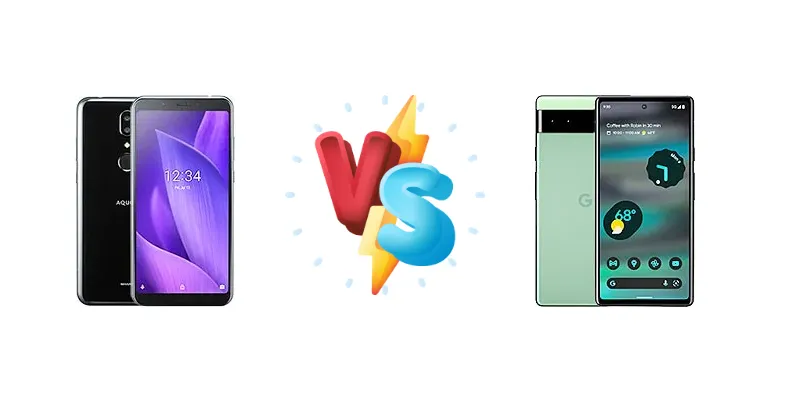
|
🏆 Quick Verdict
For most users, the Google Pixel 6a is the better choice. While the Aquos V’s Snapdragon 835 was a powerhouse in its time, the Tensor chip in the Pixel 6a offers superior AI capabilities, a brighter display, and comparable battery life, making it the more versatile and future-proof option.
| PHONES | ||
|---|---|---|
| Phone Names | Sharp Aquos V | Google Pixel 6a |
| Network | ||
|---|---|---|
| 2G bands | GSM 850 / 900 / 1800 / 1900 | GSM 850 / 900 / 1800 / 1900 |
| 3G bands | HSDPA 850 / 900 / 1900 / 2100 | HSDPA 800 / 850 / 900 / 1700(AWS) / 1900 / 2100 |
| 4G bands | 1, 3, 5, 7, 8, 13, 20, 38, 40 | 1, 2, 3, 4, 5, 7, 8, 12, 13, 14, 17, 18, 19, 20, 25, 26, 28, 29, 30, 38, 39, 40, 41, 42, 48, 66, 71 - GX7AS, GB62Z (USA/Canada) |
| 5G bands | - | 1, 2, 3, 5, 7, 8, 12, 20, 25, 28, 30, 38, 40, 41, 48, 66, 71, 77, 78 SA/NSA/Sub6 - GX7AS (USA/Canada) |
| Speed | HSPA 42.2/5.76 Mbps, LTE (2CA) Cat9 450/50 Mbps | HSPA, LTE, 5G |
| Technology | GSM / HSPA / LTE | GSM / HSPA / LTE / 5G |
| - | 1, 2, 3, 5, 7, 8, 12, 20, 25, 28, 30, 40, 48, 66, 71, 77, 78 SA/NSA/Sub6 - G1AZG (International) | |
| Launch | ||
|---|---|---|
| Announced | 2019, November. Released 2019, November | 2022, May 11 |
| Status | Discontinued | Available. Released 2022, July 21 |
| Body | ||
|---|---|---|
| Build | - | Glass front (Gorilla Glass 3), aluminum frame, plastic back |
| Dimensions | 157 x 76 x 9 mm (6.18 x 2.99 x 0.35 in) | 152.2 x 71.8 x 8.9 mm (5.99 x 2.83 x 0.35 in) |
| SIM | Nano-SIM + Nano-SIM | Nano-SIM + eSIM |
| Weight | 173 g (6.10 oz) | 178 g (6.28 oz) |
| - | IP67 dust/water resistant (up to 1m for 30 min) | |
| Display | ||
|---|---|---|
| Protection | Corning Gorilla Glass 5 | Corning Gorilla Glass 3 |
| Resolution | 1080 x 2160 pixels, 18:9 ratio (~409 ppi density) | 1080 x 2400 pixels, 20:9 ratio (~429 ppi density) |
| Size | 5.9 inches, 89.8 cm2 (~75.3% screen-to-body ratio) | 6.1 inches, 90.7 cm2 (~83.0% screen-to-body ratio) |
| Type | IPS LCD | OLED, HDR |
| - | Always-on display | |
| Platform | ||
|---|---|---|
| CPU | Octa-core (4x2.35 GHz Kryo & 4x1.9 GHz Kryo) | Octa-core (2x2.80 GHz Cortex-X1 & 2x2.25 GHz Cortex-A76 & 4x1.80 GHz Cortex-A55) |
| Chipset | Qualcomm MSM8998 Snapdragon 835 (10 nm) | Google Tensor (5 nm) |
| GPU | Adreno 540 | Mali-G78 MP20 |
| OS | Android 9.0 (Pie) | Android 12, upgradable to Android 15, up to 5 major Android upgrades |
| Memory | ||
|---|---|---|
| Card slot | microSDXC (uses shared SIM slot) | No |
| Internal | 64GB 4GB RAM | 128GB 6GB RAM |
| - | UFS 3.1 | |
| Main Camera | ||
|---|---|---|
| Dual | 13 MP, f/2.0, PDAF, OIS 13 MP B/W | 12.2 MP, f/1.7, 27mm, (wide), 1/2.55", 1.4µm, dual pixel PDAF, OIS 12 MP, f/2.2, 17mm, 114˚ (ultrawide), 1.25µm |
| Features | LED flash, HDR, panorama | Dual-LED flash, Pixel Shift, Auto-HDR, panorama |
| Single | - | 8 MP, f/2.0, 24mm (wide), 1.12µm |
| Video | 4K@30fps, 1080p@30fps (gyro-EIS) | 4K@30/60fps, 1080p@30/60/120/240fps; gyro-EIS, OIS |
| Selfie camera | ||
|---|---|---|
| Features | HDR | HDR, panorama |
| Single | 8 MP, f/2.0 | 8 MP, f/2.0, 24mm (wide), 1.12µm |
| Video | 1080p@30fps (gyro-EIS) | 1080p@30fps |
| Sound | ||
|---|---|---|
| 3.5mm jack | Yes | No |
| 35mm jack | Yes | No |
| Loudspeaker | Yes | Yes, with stereo speakers |
| Comms | ||
|---|---|---|
| Bluetooth | 5.0, A2DP, LE | 5.2, A2DP, LE |
| NFC | No | Yes |
| Positioning | GPS, GLONASS, GALILEO, QZSS | GPS, GLONASS, GALILEO, QZSS |
| Radio | No | No |
| USB | USB Type-C 2.0 | USB Type-C 3.1 |
| WLAN | Wi-Fi 802.11 a/b/g/n/ac, dual-band, Wi-Fi Direct | Wi-Fi 802.11 a/b/g/n/ac/6e, dual-band, Wi-Fi Direct |
| Features | ||
|---|---|---|
| Sensors | Fingerprint (rear-mounted), accelerometer, proximity, compass | Fingerprint (under display, optical), accelerometer, gyro, proximity, compass, barometer |
| Battery | ||
|---|---|---|
| Charging | - | 18W wired, PD3.0 |
| Type | Li-Ion 3090 mAh, non-removable | Li-Po 4410 mAh |
| Misc | ||
|---|---|---|
| Colors | Black | Chalk, Charcoal, Sage |
| Models | SH-C02 | GX7AS, GB62Z, G1AZG, GB17L |
| Price | About 210 EUR | $ 138.99 / C$ 228.74 / ₹ 23,999 |
| Tests | ||
|---|---|---|
| Battery life | - | Endurance rating 94h |
| Display | - | Contrast ratio: Infinite (nominal) |
Sharp Aquos V
- Potentially lower price point
- Snapdragon 835 was a powerful chip in its time
- May offer expandable storage (depending on variant)
- Older chipset with limited long-term support
- Likely lacks modern features like 5G
- Camera performance will likely be inferior
Google Pixel 6a
- Google Tensor chip with AI capabilities
- Excellent camera performance and software processing
- Guaranteed software updates and security patches
- May be more expensive than the Aquos V
- Charging speed is relatively slow compared to some competitors
- No expandable storage
Display Comparison
The Pixel 6a boasts a significantly brighter display, reaching 876 nits measured, compared to an unknown peak brightness for the Aquos V. This translates to better visibility outdoors. While the Aquos V’s display specs are unavailable, the Pixel 6a’s 'Infinite' contrast ratio (nominal) suggests a superior OLED panel. The Pixel 6a’s display is likely to offer a more vibrant and engaging viewing experience, especially in challenging lighting conditions.
Camera Comparison
Without detailed camera specs for the Aquos V, a direct comparison is difficult. However, the Pixel 6a benefits from Google’s renowned computational photography. The Tensor chip’s image signal processor (ISP) excels at noise reduction, dynamic range optimization, and portrait mode effects. While the Aquos V may capture decent images in good lighting, the Pixel 6a will consistently deliver superior image quality, particularly in low-light scenarios, thanks to its advanced software processing.
Performance
The core difference lies in the chipsets. The Aquos V’s Snapdragon 835 (10nm) was a flagship processor, featuring an octa-core configuration with Kryo cores peaking at 2.35 GHz. However, the Pixel 6a’s Google Tensor (5nm) utilizes a more modern architecture with Cortex-X1 and Cortex-A76 cores reaching 2.80 GHz. The 5nm process node of the Tensor chip provides significantly improved power efficiency and thermal performance compared to the 10nm Snapdragon 835. This means the Pixel 6a is likely to sustain peak performance for longer periods without throttling, and its AI capabilities are far superior.
Battery Life
Both devices achieve an endurance rating of 94 hours, suggesting comparable battery life despite the Aquos V’s unknown battery capacity. However, the Pixel 6a supports 18W wired charging with PD3.0, offering faster and more efficient charging than the Aquos V, which likely uses an older charging standard. The Tensor chip’s power efficiency also contributes to the Pixel 6a’s strong battery performance.
Buying Guide
Buy the Sharp Aquos V if you prioritize a potentially lower price point and are comfortable with an older chipset that may show its age in demanding tasks. Buy the Google Pixel 6a if you value a modern user experience, excellent camera processing powered by Google’s Tensor chip, and guaranteed software updates for years to come. The Pixel 6a is for those who want a reliable, well-rounded smartphone, while the Aquos V is for budget-conscious users willing to compromise on long-term support.