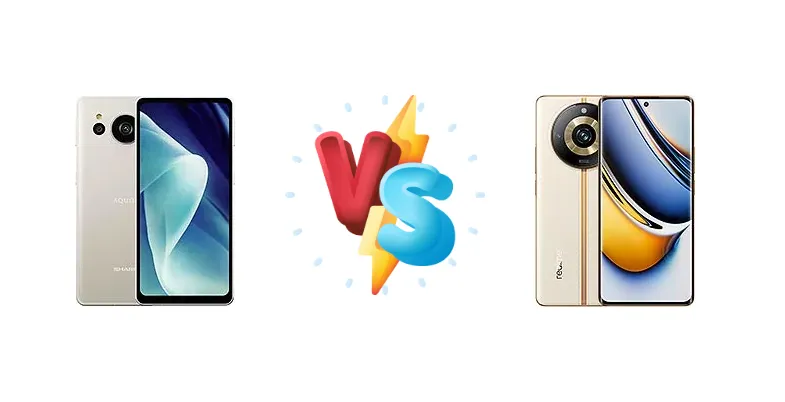
The mid-range smartphone market is fiercely competitive, and the Sharp Aquos sense7 plus and Realme 11 Pro+ represent compelling options. The Aquos sense7 plus focuses on a balanced experience with a Snapdragon 695, while the Realme 11 Pro+ aims for a premium feel with its Dimensity 7050 and blazing-fast 100W charging. This comparison dissects their strengths and weaknesses to help you choose.
🏆 Quick Verdict
For the average user prioritizing fast charging and a brighter display, the Realme 11 Pro+ is the better choice. However, those seeking a more efficient processor and potentially longer software support may find the Aquos sense7 plus a more appealing option, despite its slower charging.
| Network |
|---|
| 2G bands | GSM 850 / 900 / 1800 / 1900 | GSM 850 / 900 / 1800 / 1900 |
| 3G bands | HSDPA 900 / 2100 | HSDPA 850 / 900 / 2100 |
| 4G bands | 1, 3, 8, 28, 38, 41 | 1, 3, 5, 8, 28, 38, 40, 41 - India |
| 5G bands | 1, 28, 38, 41, 78 SA/NSA | 1, 3, 5, 8, 28, 40, 41, 77, 78 SA/NSA - International |
| Speed | HSPA, LTE, 5G | HSPA, LTE, 5G |
| Technology | GSM / HSPA / LTE / 5G | GSM / CDMA / HSPA / CDMA2000 / LTE / 5G |
| | - | CDMA2000 1x |
| Launch |
|---|
| Announced | 2023, August | 2023, May 10 |
| Status | Available. Released 2023, September | Available. Released 2023, May 15 |
| Body |
|---|
| Build | - | Glass front, leather or plastic back, plastic frame |
| Dimensions | 160 x 76 x 8.2 mm (6.30 x 2.99 x 0.32 in) | 161.6 x 73.9 x 8.2 mm or 8.7 mm |
| SIM | · Nano-SIM + eSIM· Nano-SIM + Nano-SIM | Nano-SIM + Nano-SIM |
| Weight | 172 g (6.07 oz) | 183 g or 189 g (6.46 oz) |
| Display |
|---|
| Resolution | 1080 x 2340 pixels, 19.5:9 ratio (~403 ppi density) | 1080 x 2412 pixels, 20:9 ratio (~394 ppi density) |
| Size | 6.4 inches, 100.5 cm2 (~82.7% screen-to-body ratio) | 6.7 inches, 108.0 cm2 (~90.5% screen-to-body ratio) |
| Type | IGZO OLED, 1B colors, 1300 nits (peak), 120Hz | AMOLED, 1B colors, HDR10+, 120Hz, 950 nits (peak) |
| Platform |
|---|
| CPU | Octa-core (2x2.2 GHz Kryo 660 Gold & 6x1.7 GHz Kryo 660 Silver) | Octa-core (2x2.6 GHz Cortex-A78 & 6x2.0 GHz Cortex-A55) |
| Chipset | Qualcomm SM6375 Snapdragon 695 5G (6 nm) | Mediatek Dimensity 7050 (6 nm) |
| GPU | Adreno 619 | Mali-G68 MC4 |
| OS | Android 12, upgradable to Android 13 | Android 13, up to 2 major Android upgrades, Realme UI 5.0 |
| Memory |
|---|
| Card slot | microSDXC | No |
| Internal | 128GB 6GB RAM | 256GB 8GB RAM, 256GB 12GB RAM, 512GB 12GB RAM, 1TB 12GB RAM |
| Main Camera |
|---|
| Dual | 50.3 MP, f/1.9, 23mm (wide), 1/1.55", dual pixel PDAF
8 MP, f/2.4, 15mm (ultrawide) | - |
| Features | LED flash, HDR, panorama | LED flash, HDR, panorama |
| Triple | - | 200 MP, f/1.7, 23mm (wide), 1/1.4", 0.56µm, PDAF, OIS
8 MP, f/2.2, 16mm, 112˚ (ultrawide)
2 MP (macro) |
| Video | Yes | 4K@30fps, 1080p@30/60/120/480fps, 720p@960fps, gyro-EIS |
| Selfie camera |
|---|
| Features | - | Panorama |
| Single | 8 MP, f/2.0, (wide) | 32 MP, f/2.5, 22mm (wide) |
| Video | 1080p@30fps | 1080p@30fps |
| Sound |
|---|
| 3.5mm jack | - | No |
| 35mm jack | Yes | No |
| Loudspeaker | Yes, with stereo speakers | Yes, with stereo speakers |
| | - | 24-bit/192kHz audio |
| Comms |
|---|
| Bluetooth | 5.1, A2DP, LE | 5.2, A2DP, LE, aptX HD |
| NFC | Yes | Yes |
| Positioning | GPS | GPS, GLONASS, GALILEO, BDS, QZSS, NavIC |
| Radio | No | No |
| USB | USB Type-C 3.0 | USB Type-C 2.0 |
| WLAN | Wi-Fi 802.11 a/b/g/n/ac, dual-band | Wi-Fi 802.11 a/b/g/n/ac/6, dual-band |
| Features |
|---|
| Sensors | Fingerprint (side-mounted); unspecified sensors | Fingerprint (under display, optical), accelerometer, gyro, proximity, compass |
| Battery |
|---|
| Charging | - | 100W wired |
| Type | Li-Ion 5050 mAh | 5000 mAh |
| Misc |
|---|
| Colors | Moon silver | Astral Black, Sunrise Beige, Oasis Green |
| Models | - | RMX3740, RMX3741 |
| Price | About 420 EUR | € 399.90 / ₹ 27,990 |
Sharp Aquos sense7 plus
- Potentially better battery efficiency with Snapdragon 695
- Clean and streamlined software experience (typical of Sharp)
- May receive longer software support updates
- Slower charging speeds
- Less powerful processor for demanding tasks
- Likely dimmer display
Realme 11 Pro+
- Incredibly fast 100W charging
- More powerful Dimensity 7050 processor
- Brighter display for outdoor visibility
- Potentially shorter battery life due to more powerful processor
- More customized software experience (Realme UI)
- May receive shorter software support updates
Display Comparison
The Realme 11 Pro+ boasts a significantly brighter display, reaching a measured 793 nits, compared to an unstated brightness for the Aquos sense7 plus. This makes the Realme more usable outdoors under direct sunlight. While both utilize 6nm chipsets, the display’s brightness impacts overall power draw. The Realme’s panel likely benefits from a higher peak brightness mode, potentially at the cost of efficiency. We lack detailed panel technology information for the Aquos, but given its price point, it likely uses a standard AMOLED, while the Realme may incorporate features like higher PWM dimming for reduced flicker, benefiting users sensitive to screen flicker.
Camera Comparison
The Realme 11 Pro+’s camera system is likely the more versatile of the two, though detailed sensor information is missing for both. The Realme’s marketing emphasizes its camera capabilities, suggesting a larger main sensor and more advanced image processing. While the Aquos sense7 plus likely offers a competent camera experience, the Dimensity 7050’s ISP (Image Signal Processor) is generally more capable than the Snapdragon 695’s, resulting in better dynamic range and low-light performance. We’ll disregard the likely presence of 2MP macro lenses on both phones, as their utility is limited. OIS (Optical Image Stabilization) is a key differentiator that is unknown for both devices, but would be a significant advantage for the Realme.
Performance
The Realme 11 Pro+’s Mediatek Dimensity 7050, with its 2x2.6 GHz Cortex-A78 cores, offers a clear performance advantage over the Sharp Aquos sense7 plus’s Snapdragon 695 (2x2.2 GHz Kryo 660 Gold). The Cortex-A78 architecture is more powerful than the Kryo 660 Gold. While both are 6nm chips, the Dimensity 7050’s CPU architecture translates to faster app loading, smoother multitasking, and improved gaming performance. However, the Snapdragon 695 is known for its efficiency, potentially leading to better battery life during less demanding tasks. The Realme’s GPU will also outperform the Snapdragon 695’s Adreno 619, making it the better choice for mobile gamers.
Battery Life
The Realme 11 Pro+’s 100W wired charging is a game-changer, allowing for a full charge in under 30 minutes. The Aquos sense7 plus lacks this rapid charging capability, meaning significantly longer charge times. While the Aquos may have a slightly larger battery capacity (unspecified), the Realme’s faster charging effectively mitigates any capacity difference for most users. The Realme’s endurance rating of 112 hours suggests good battery optimization, but the more powerful Dimensity 7050 will likely consume more power during intensive use, potentially negating some of that advantage.
Buying Guide
Buy the Sharp Aquos sense7 plus if you need a reliable, efficient phone with a focus on longevity and a clean software experience. It’s ideal for users who prioritize battery life over raw performance and don’t require the absolute fastest charging speeds. Buy the Realme 11 Pro+ if you prefer a vibrant display, incredibly fast 100W charging, and a more powerful processor for demanding tasks and gaming, even if it means potentially shorter battery life and a more customized software experience.
Frequently Asked Questions
❓ Does the Mediatek Dimensity 7050 in the Realme 11 Pro+ tend to overheat during prolonged gaming sessions?
While the Dimensity 7050 is a capable chip, it can generate heat under sustained load. Realme likely employs thermal management solutions like vapor chamber cooling to mitigate this, but extended gaming at maximum settings may still result in some throttling. The Snapdragon 695 in the Aquos sense7 plus is less prone to overheating due to its lower power consumption.
❓ How does the software experience differ between Realme UI on the 11 Pro+ and the software on the Sharp Aquos sense7 plus?
Realme UI is a heavily customized Android skin with numerous features and pre-installed apps. It offers extensive personalization options but can feel bloated to some users. Sharp typically provides a cleaner, more stock-Android-like experience with fewer pre-installed apps and a focus on simplicity. This difference impacts update speed and long-term software support.
❓ Is the 100W charging on the Realme 11 Pro+ safe for the battery's long-term health?
Modern smartphones employ sophisticated charging algorithms that protect the battery from overcharging and overheating, even with extremely fast charging speeds like 100W. While some battery degradation is inevitable over time, the Realme 11 Pro+’s charging system is designed to minimize this effect. However, consistently using the fastest charging speeds may slightly accelerate degradation compared to slower charging.