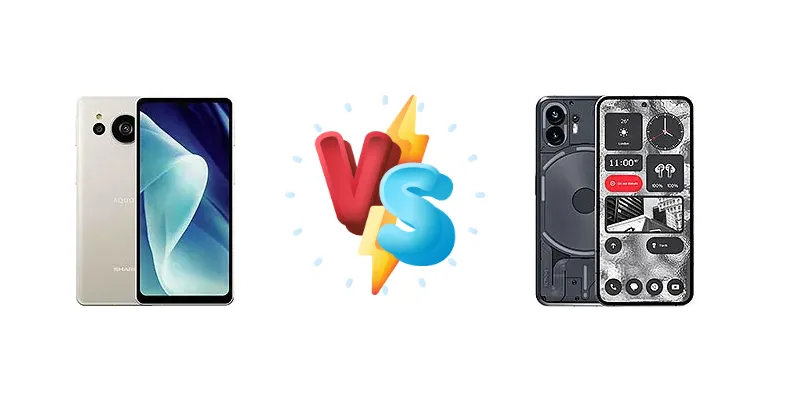
The Sharp Aquos sense7 plus and the Nothing Phone (2) represent distinct approaches to the Android market. The Aquos focuses on delivering a solid, reliable experience at a competitive price point, while the Nothing Phone (2) aims to disrupt with a unique design and a more powerful chipset. This comparison dissects their key differences to determine which phone best suits your needs.
🏆 Quick Verdict
For the average user prioritizing performance and future-proofing, the Nothing Phone (2) is the clear winner. Its Snapdragon 8+ Gen 1 chipset offers a substantial leap in processing power compared to the Aquos sense7 plus’s Snapdragon 695, translating to smoother multitasking, faster app loading, and a better gaming experience. However, the Aquos remains a viable option for budget-conscious users.
| Network |
|---|
| 2G bands | GSM 850 / 900 / 1800 / 1900 | GSM 850 / 900 / 1800 / 1900 |
| 3G bands | HSDPA 900 / 2100 | HSDPA 800 / 850 / 900 / 1700(AWS) / 1900 / 2100 |
| 4G bands | 1, 3, 8, 28, 38, 41 | 1, 2, 3, 4, 5, 7, 8, 12, 17, 18, 19, 20, 25, 26, 28, 30, 32, 34, 38, 39, 40, 41, 42, 48, 66, 71 |
| 5G bands | 1, 28, 38, 41, 78 SA/NSA | 1, 2, 3, 5, 7, 8, 12, 20, 25, 28, 30, 38, 40, 41, 66, 71, 75, 77, 78 SA/NSA |
| Speed | HSPA, LTE, 5G | HSPA, LTE, 5G |
| Technology | GSM / HSPA / LTE / 5G | GSM / HSPA / LTE / 5G |
| Launch |
|---|
| Announced | 2023, August | 2023, July 11 |
| Status | Available. Released 2023, September | Available. Released 2023, July 17 |
| Body |
|---|
| Build | - | Glass front (Gorilla Glass 5), glass back (Gorilla Glass 5), aluminum frame |
| Dimensions | 160 x 76 x 8.2 mm (6.30 x 2.99 x 0.32 in) | 162.1 x 76.4 x 8.6 mm (6.38 x 3.01 x 0.34 in) |
| SIM | · Nano-SIM + eSIM· Nano-SIM + Nano-SIM | Nano-SIM + Nano-SIM |
| Weight | 172 g (6.07 oz) | 201.2 g (7.09 oz) |
| Display |
|---|
| Protection | - | Corning Gorilla Glass 5 |
| Resolution | 1080 x 2340 pixels, 19.5:9 ratio (~403 ppi density) | 1080 x 2412 pixels, 20:9 ratio (~394 ppi density) |
| Size | 6.4 inches, 100.5 cm2 (~82.7% screen-to-body ratio) | 6.7 inches, 108.0 cm2 (~87.2% screen-to-body ratio) |
| Type | IGZO OLED, 1B colors, 1300 nits (peak), 120Hz | LTPO OLED, 1B colors, 120Hz, 1920Hz PWM, HDR10+, 1600 nits (HBM), 1600 nits (peak) |
| Platform |
|---|
| CPU | Octa-core (2x2.2 GHz Kryo 660 Gold & 6x1.7 GHz Kryo 660 Silver) | Octa-core (1x3.0 GHz Cortex-X2 & 3x2.5 GHz Cortex-A710 & 4x1.80 GHz Cortex-A510) |
| Chipset | Qualcomm SM6375 Snapdragon 695 5G (6 nm) | Qualcomm SM8475 Snapdragon 8+ Gen 1 (4 nm) |
| GPU | Adreno 619 | Adreno 730 |
| OS | Android 12, upgradable to Android 13 | Android 13, upgradable to Android 15, up to 3 major Android upgrades, Nothing OS 3.0 |
| Memory |
|---|
| Card slot | microSDXC | No |
| Internal | 128GB 6GB RAM | 128GB 8GB RAM, 256GB 12GB RAM, 512GB 12GB RAM |
| Main Camera |
|---|
| Dual | 50.3 MP, f/1.9, 23mm (wide), 1/1.55", dual pixel PDAF
8 MP, f/2.4, 15mm (ultrawide) | 50 MP, f/1.9, 24mm (wide), 1/1.56", 1.0µm, PDAF, OIS
50 MP, f/2.2, 114˚ (ultrawide), 1/2.76", 0.64µm, AF |
| Features | LED flash, HDR, panorama | LED flash, panorama, HDR |
| Video | Yes | 4K@30/60fps, 1080p@30/60fps, gyro-EIS, live HDR, OIS |
| Selfie camera |
|---|
| Features | - | HDR |
| Single | 8 MP, f/2.0, (wide) | 32 MP, f/2.5, (wide), 1/2.74", 0.8µm |
| Video | 1080p@30fps | 1080p@30fps |
| Sound |
|---|
| 35mm jack | Yes | No |
| Loudspeaker | Yes, with stereo speakers | Yes, with stereo speakers |
| Comms |
|---|
| Bluetooth | 5.1, A2DP, LE | 5.3, A2DP, LE, aptX HD, aptX Adaptive |
| NFC | Yes | Yes |
| Positioning | GPS | GPS (L1+L5), GLONASS (L1), BDS (B1I+B1c), GALILEO (E1), QZSS (L1), NavIC |
| Radio | No | No |
| USB | USB Type-C 3.0 | USB Type-C 2.0, OTG |
| WLAN | Wi-Fi 802.11 a/b/g/n/ac, dual-band | Wi-Fi 802.11 a/b/g/n/ac/6, dual-band, Wi-Fi Direct |
| Features |
|---|
| Sensors | Fingerprint (side-mounted); unspecified sensors | Fingerprint (under display, optical), accelerometer, proximity, gyro, compass |
| Battery |
|---|
| Charging | - | 45W wired, PD3.0, PPS, QC4, 100% in 55 min
15W wireless, 100% in 130 min
5W reverse wireless |
| Type | Li-Ion 5050 mAh | Li-Ion 4700 mAh |
| Misc |
|---|
| Colors | Moon silver | White, Dark Gray |
| Models | - | A065 |
| Price | About 420 EUR | $ 379.99 / £ 370.00 |
Sharp Aquos sense7 plus
- Likely more affordable price point
- Potentially better battery efficiency due to less powerful chipset
- Reliable and dependable performance for basic tasks
- Significantly slower performance compared to the Nothing Phone (2)
- Likely lacks advanced camera features
- May have a less vibrant display
Nothing Phone (2)
- Flagship-level performance with Snapdragon 8+ Gen 1
- Fast 45W wired and 15W wireless charging
- Excellent display brightness and likely color accuracy
- Higher price tag
- Potentially shorter battery life under heavy load
- Unique design may not appeal to everyone
Display Comparison
While specific display details for the Aquos sense7 plus are missing, the Nothing Phone (2) boasts a display capable of reaching 998 nits of peak brightness, ensuring excellent visibility even in direct sunlight. The absence of LTPO technology in the Aquos (assumed based on its price point) likely means a less adaptive refresh rate, potentially impacting battery life. The Nothing Phone (2)'s display is likely to offer superior color accuracy and viewing angles due to its higher-end panel.
Camera Comparison
The Nothing Phone (2) is expected to have a more versatile and capable camera system, though specific details are missing. The Aquos sense7 plus’s camera capabilities are unknown, but its positioning suggests a focus on practicality rather than cutting-edge features. The Snapdragon 8+ Gen 1’s image signal processor (ISP) in the Nothing Phone (2) will offer superior image processing capabilities, resulting in better dynamic range, noise reduction, and overall image quality. The absence of details on OIS for the Aquos suggests it may lack this feature, impacting low-light performance.
Performance
The core difference lies in the chipsets. The Nothing Phone (2)'s Snapdragon 8+ Gen 1 (4nm) is a flagship-level processor, featuring an octa-core configuration with a Cortex-X2 prime core clocked at 3.0 GHz. This contrasts sharply with the Aquos sense7 plus’s Snapdragon 695 5G (6nm), which utilizes a more modest octa-core setup with lower clock speeds (2.2 GHz Kryo 660 Gold & 1.7 GHz Kryo 660 Silver). The 4nm process node of the Snapdragon 8+ Gen 1 provides significantly better power efficiency and thermal performance, minimizing throttling during sustained workloads. This translates to a dramatically faster and smoother user experience on the Nothing Phone (2).
Battery Life
The Nothing Phone (2) demonstrates impressive battery endurance, achieving an active use score of 14:21 hours and an endurance rating of 103 hours. Its 45W wired charging (with PD3.0, PPS, and QC4 support) allows for a full charge in just 55 minutes, while 15W wireless charging provides added convenience. The Aquos sense7 plus’s battery capacity and charging speed are unknown, but given its focus on affordability, it likely offers slower charging and potentially shorter battery life compared to the Nothing Phone (2).
Buying Guide
Buy the Sharp Aquos sense7 plus if you need a dependable daily driver with a focus on efficiency and a lower price tag. It’s ideal for users who primarily browse the web, use social media, and make calls. Buy the Nothing Phone (2) if you prioritize performance, enjoy demanding mobile games, value fast charging, and appreciate a distinctive design with a focus on software experience.
Frequently Asked Questions
❓ Is the Snapdragon 695 in the Aquos sense7 plus sufficient for playing demanding games like Genshin Impact?
The Snapdragon 695 is a capable chipset for casual gaming, but it will struggle with graphically intensive titles like Genshin Impact. Expect lower frame rates and potentially noticeable lag, even on lower settings. The Nothing Phone (2)'s Snapdragon 8+ Gen 1 is far better suited for demanding games, offering a smooth and enjoyable gaming experience.
❓ How does the Nothing Phone (2)'s charging compare to other phones in its price range?
The Nothing Phone (2)'s 45W wired charging is relatively fast for its price range, offering a full charge in approximately 55 minutes. Many competitors offer 33W or 25W charging. The inclusion of wireless charging (15W) and reverse wireless charging (5W) further enhances its charging versatility.
❓ Does the Nothing Phone (2) get hot during extended gaming sessions?
The Snapdragon 8+ Gen 1 is known for its thermal efficiency, and the Nothing Phone (2) incorporates a vapor chamber cooling system. While some heat is inevitable during prolonged gaming, the phone is designed to manage temperatures effectively and prevent significant throttling, maintaining consistent performance.