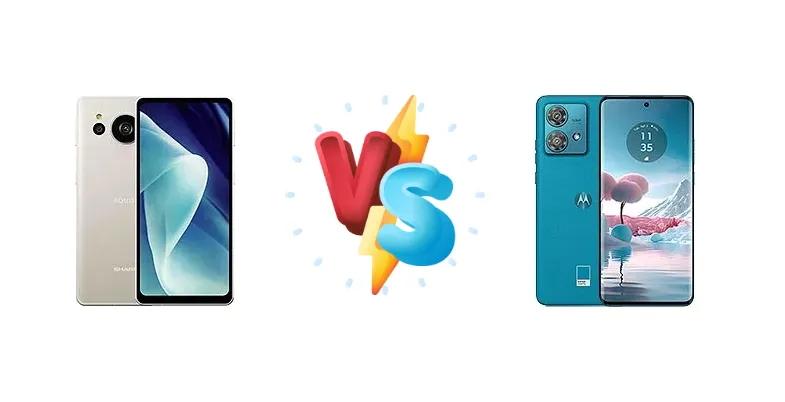
The mid-range smartphone market is fiercely competitive, and the Sharp Aquos sense7 plus and Motorola Edge 40 Neo represent compelling options. The Aquos sense7 plus focuses on a streamlined Android experience with a dependable Qualcomm chipset, while the Edge 40 Neo aims to deliver a more premium feel with a faster-charging battery and a MediaTek Dimensity processor. This comparison dives deep into the specifics to determine which phone best suits your needs.
🏆 Quick Verdict
For the average user prioritizing fast charging and a brighter display, the Motorola Edge 40 Neo is the better choice. Its 68W charging and 1073 nit peak brightness offer tangible benefits. However, users seeking a simpler software experience and potentially longer-term software support from Sharp may prefer the Aquos sense7 plus.
| Network |
|---|
| 2G bands | GSM 850 / 900 / 1800 / 1900 | GSM 850 / 900 / 1800 / 1900 |
| 3G bands | HSDPA 900 / 2100 | HSDPA 800 / 850 / 900 / 1700(AWS) / 1900 / 2100 |
| 4G bands | 1, 3, 8, 28, 38, 41 | 1, 2, 3, 4, 5, 7, 8, 12, 13, 17, 18, 19, 20, 25, 26, 28, 32, 38, 38, 39, 40, 41, 42, 43, 48, 66 |
| 5G bands | 1, 28, 38, 41, 78 SA/NSA | 1, 2, 3, 5, 7, 8, 20, 28, 38, 40, 41, 66, 77, 78 SA/NSA |
| Speed | HSPA, LTE, 5G | HSPA, LTE, 5G |
| Technology | GSM / HSPA / LTE / 5G | GSM / HSPA / LTE / 5G |
| Launch |
|---|
| Announced | 2023, August | 2023, September 14 |
| Status | Available. Released 2023, September | Available. Released 2023, September 14 |
| Body |
|---|
| Build | - | Glass front (Gorilla Glass 3), plastic frame, plastic back |
| Dimensions | 160 x 76 x 8.2 mm (6.30 x 2.99 x 0.32 in) | 159.6 x 72 x 7.9 mm (6.28 x 2.83 x 0.31 in) |
| SIM | · Nano-SIM + eSIM· Nano-SIM + Nano-SIM | · Nano-SIM + eSIM· Nano-SIM + Nano-SIM |
| Weight | 172 g (6.07 oz) | 170 g or 172 g (6.00 oz) |
| Display |
|---|
| Protection | - | Corning Gorilla Glass 3 |
| Resolution | 1080 x 2340 pixels, 19.5:9 ratio (~403 ppi density) | 1080 x 2400 pixels, 20:9 ratio (~402 ppi density) |
| Size | 6.4 inches, 100.5 cm2 (~82.7% screen-to-body ratio) | 6.55 inches, 103.6 cm2 (~90.1% screen-to-body ratio) |
| Type | IGZO OLED, 1B colors, 1300 nits (peak), 120Hz | P-OLED, 1B colors, 144Hz, HDR10+, 1300 nits (peak) |
| Platform |
|---|
| CPU | Octa-core (2x2.2 GHz Kryo 660 Gold & 6x1.7 GHz Kryo 660 Silver) | Octa-core (2x2.5 GHz Cortex-A78 & 6x2.0 GHz Cortex-A55) |
| Chipset | Qualcomm SM6375 Snapdragon 695 5G (6 nm) | MediaTek Dimensity 7030 (6 nm) |
| GPU | Adreno 619 | Mali-G610 MC3 |
| OS | Android 12, upgradable to Android 13 | Android 13, up to 2 major Android upgrades |
| Memory |
|---|
| Card slot | microSDXC | No |
| Internal | 128GB 6GB RAM | 128GB 8GB RAM, 256GB 8GB RAM, 256GB 12GB RAM |
| Main Camera |
|---|
| Dual | 50.3 MP, f/1.9, 23mm (wide), 1/1.55", dual pixel PDAF
8 MP, f/2.4, 15mm (ultrawide) | 50 MP, f/1.8, (wide), 1/1.55", 1.0µm, multi-directional PDAF, OIS
13 MP, f/2.2, 120˚ (ultrawide), 1/3.0", 1.12µm, PDAF |
| Features | LED flash, HDR, panorama | LED flash, HDR, panorama |
| Video | Yes | 4K@30fps, 1080p@30/60/120/240fps, gyro-EIS |
| Selfie camera |
|---|
| Features | - | HDR |
| Single | 8 MP, f/2.0, (wide) | 32 MP, f/2.4, (wide), 1/3.0", 0.7µm |
| Video | 1080p@30fps | 4K@30fps, 1080p@30fps |
| Sound |
|---|
| 35mm jack | Yes | No |
| Loudspeaker | Yes, with stereo speakers | Yes, with stereo speakers |
| Comms |
|---|
| Bluetooth | 5.1, A2DP, LE | 5.4, A2DP, LE |
| NFC | Yes | Yes |
| Positioning | GPS | GPS, GLONASS, GALILEO |
| Radio | No | No |
| USB | USB Type-C 3.0 | USB Type-C 2.0, OTG |
| WLAN | Wi-Fi 802.11 a/b/g/n/ac, dual-band | Wi-Fi 802.11 a/b/g/n/ac/6e, tri-band, Wi-Fi Direct |
| Features |
|---|
| Sensors | Fingerprint (side-mounted); unspecified sensors | Fingerprint (under display, optical), accelerometer, gyro, proximity, compass |
| Battery |
|---|
| Charging | - | 68W wired, 50% in 15 min |
| Type | Li-Ion 5050 mAh | Li-Po 5000 mAh |
| Misc |
|---|
| Colors | Moon silver | Black, Soothing Sea, Caneel Bay, Peach Fuzz |
| Models | - | XT2307-1 |
| Price | About 420 EUR | $ 299.00 / € 168.73 / ₹ 19,900 |
Sharp Aquos sense7 plus
- Potentially cleaner software experience
- Likely consistent software updates from Sharp
- May offer better long-term value due to software support
- Slower processor compared to the Dimensity 7030
- Likely lacks fast charging capabilities
- Display likely inferior to the Edge 40 Neo's OLED
Motorola Edge 40 Neo
- Faster MediaTek Dimensity 7030 processor
- 68W fast charging (50% in 15 minutes)
- Brighter and more vibrant OLED display (1073 nits)
- Motorola's My UX software may not appeal to all users
- Potential for bloatware
- Long-term software support may be less consistent than Sharp
Display Comparison
The Motorola Edge 40 Neo boasts a significantly brighter display, reaching a measured 1073 nits, compared to an unstated peak brightness for the Aquos sense7 plus. This difference is immediately noticeable in outdoor visibility. While the Aquos sense7 plus likely utilizes an IPS LCD panel (typical for its price bracket), the Edge 40 Neo’s OLED panel delivers superior contrast and color accuracy. The absence of LTPO technology on either device suggests neither offers adaptive refresh rates for power saving, but the Edge 40 Neo’s higher brightness and OLED tech provide a more visually immersive experience.
Camera Comparison
Detailed camera specifications for the Aquos sense7 plus are unavailable, making a direct comparison challenging. However, given its market positioning, it likely features a more basic camera setup. The Edge 40 Neo’s camera system, while details are limited, benefits from modern image processing capabilities. Without knowing sensor sizes or apertures for the Aquos, it’s difficult to assess low-light performance. The Edge 40 Neo likely prioritizes computational photography to enhance image quality, a common trend in mid-range devices. The absence of information regarding OIS on either device suggests image stabilization relies primarily on software algorithms.
Performance
The Motorola Edge 40 Neo’s MediaTek Dimensity 7030, with its 2x2.5 GHz Cortex-A78 cores and 6x2.0 GHz Cortex-A55 cores, offers a performance advantage over the Sharp Aquos sense7 plus’s Qualcomm Snapdragon 695 5G (2x2.2 GHz Kryo 660 Gold & 6x1.7 GHz Kryo 660 Silver). The Cortex-A78 cores in the Dimensity 7030 are architecturally superior to the Kryo 660 Gold, resulting in faster single-core performance. Both chips are fabricated on a 6nm process, but the Dimensity 7030’s more modern core design translates to better overall responsiveness and smoother multitasking. While neither phone is a gaming powerhouse, the Edge 40 Neo will handle graphically demanding titles with higher frame rates.
Battery Life
The Motorola Edge 40 Neo shines in the battery and charging department. Its 68W wired charging capability can replenish 50% of the battery in just 15 minutes, a significant advantage over the Aquos sense7 plus, which lacks comparable fast charging. While the Edge 40 Neo’s battery capacity isn’t specified, its endurance rating of 80 hours and active use score of 10:28h indicate excellent battery life. The Aquos sense7 plus’s battery capacity is also unknown, but without fast charging, it will likely require longer charging times to reach full capacity. The Edge 40 Neo’s faster charging is a crucial benefit for users who frequently need to top up their battery quickly.
Buying Guide
Buy the Sharp Aquos sense7 plus if you need a phone with a clean, uncluttered Android experience and value a brand known for consistent software updates, even if they aren't the flashiest. Buy the Motorola Edge 40 Neo if you prefer a vibrant display, incredibly fast charging, and a more modern design aesthetic, and are comfortable with Motorola's My UX software.
Frequently Asked Questions
❓ Does the MediaTek Dimensity 7030 in the Edge 40 Neo get hot during extended gaming sessions?
While the Dimensity 7030 is a capable processor, sustained gaming will inevitably generate heat. However, the 6nm fabrication process and Motorola’s thermal management system should prevent significant throttling, allowing for reasonably consistent performance during moderate gaming sessions. The Aquos sense7 plus, with its Snapdragon 695, is likely to throttle more noticeably under similar load.
❓ How does Motorola's My UX software compare to the stock Android experience on the Aquos sense7 plus?
Motorola’s My UX is a near-stock Android experience with a few added features and customizations. It’s generally considered lightweight and user-friendly, but it does include some pre-installed apps (bloatware) that some users may find undesirable. The Aquos sense7 plus likely offers a cleaner, more minimalist Android experience, appealing to those who prefer a pure Android interface.
❓ Is the lack of OIS on either phone a significant drawback for video recording?
The absence of Optical Image Stabilization (OIS) on both devices means video recording will be more susceptible to shakiness. However, both phones likely employ Electronic Image Stabilization (EIS), which uses software algorithms to reduce camera shake. EIS is less effective than OIS, but it can still improve video stability, especially in well-lit conditions.