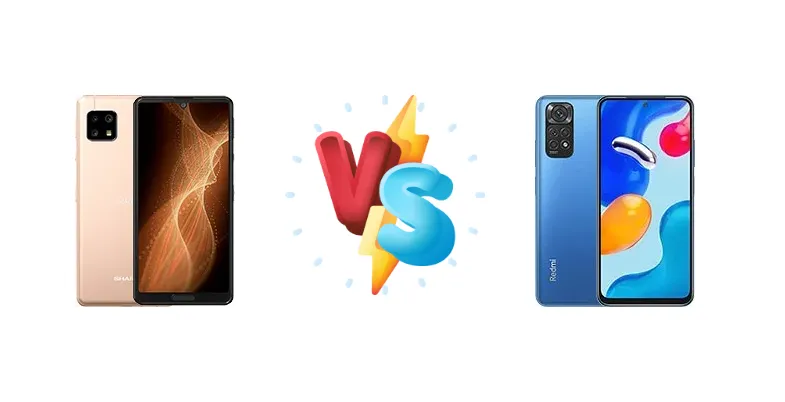
The mid-range smartphone market is fiercely competitive, offering incredible value for your money. Today, we're pitting two contenders against each other: the Sharp Aquos Sense 5G and the Xiaomi Redmi Note 11S. Both promise a solid experience, but which one truly comes out on top?
🏆 Quick Verdict
The Xiaomi Redmi Note 11S edges out the Aquos Sense 5G thanks to its faster charging, brighter display, and generally more modern chipset. While the Aquos Sense 5G offers a unique design and potentially better software support depending on your region, the Redmi Note 11S provides a more well-rounded package for most users.
| Network |
|---|
| 2G bands | GSM 850 / 900 / 1800 / 1900 | GSM 850 / 900 / 1800 / 1900 |
| 3G bands | HSDPA 850 / 900 / 1900 / 2100 | HSDPA 850 / 900 / 1700(AWS) / 1900 / 2100 |
| 4G bands | 1, 3, 7, 8, 20, 28, 38, 41 | 1, 2, 3, 4, 5, 7, 8, 20, 28, 38, 40, 41 |
| 5G bands | 1, 3, 28, 78 SA/NSA | - |
| Speed | HSPA, LTE, 5G | HSPA, LTE |
| Technology | GSM / HSPA / LTE / 5G | GSM / HSPA / LTE |
| Launch |
|---|
| Announced | 2020, September 25. Released 2021, June 10 | 2022, January 26 |
| Status | Discontinued | Available. Released 2022, February 09 |
| Body |
|---|
| Build | Glass front, aluminum frame, aluminum back | Glass front (Gorilla Glass 3), plastic frame, glass back |
| Dimensions | 148 x 71 x 8.9 mm (5.83 x 2.80 x 0.35 in) | 159.9 x 73.9 x 8.1 mm (6.30 x 2.91 x 0.32 in) |
| SIM | Nano-SIM + Nano-SIM | Nano-SIM + Nano-SIM |
| Weight | 178 g (6.28 oz) | 179 g (6.31 oz) |
| | IPX5/IP6X/IPX8 water/dust resistant (up to 1.5m for 30 min)
MIL-STD-810H compliant | IP53, dust and splash resistant |
| Display |
|---|
| Protection | - | Corning Gorilla Glass 3 |
| Resolution | 1080 x 2280 pixels, 19:9 ratio (~435 ppi density) | 1080 x 2400 pixels, 20:9 ratio (~409 ppi density) |
| Size | 5.8 inches, 84.0 cm2 (~79.9% screen-to-body ratio) | 6.43 inches, 99.8 cm2 (~84.5% screen-to-body ratio) |
| Type | IGZO IPS LCD, HDR10 | AMOLED, 90Hz, 700 nits, 1000 nits (peak) |
| Platform |
|---|
| CPU | Octa-core (2x2.0 GHz Kryo 560 Gold & 6x1.7 GHz Kryo 560 Silver) | Octa-core (2x2.05 GHz Cortex-A76 & 6x2.0 GHz Cortex-A55) |
| Chipset | Qualcomm SM6350 Snapdragon 690 5G (8 nm) | Mediatek MT6781 Helio G96 (12 nm) |
| GPU | Adreno 619L | Mali-G57 MC2 |
| OS | Android 11 | Android 11, MIUI 13 |
| Memory |
|---|
| Card slot | microSDXC | microSDXC (dedicated slot) |
| Internal | 128GB 8GB RAM | 64GB 6GB RAM, 128GB 6GB RAM, 128GB 8GB RAM |
| | UFS | UFS 2.2 |
| Main Camera |
|---|
| Features | LED flash, HDR, panorama | LED flash, HDR, panorama |
| Quad | - | 108 MP, f/1.9, 26mm (wide), 1/1.52", 0.7µm, PDAF
8 MP, f/2.2, 118˚ (ultrawide)
2 MP (macro)
Auxiliary lens |
| Triple | 12 MP, f/2.0, (wide), AF
8 MP, f/2.4, (telephoto), AF
12 MP, f/2.4, 121˚ (ultrawide) | - |
| Video | 4K@30fps, 1080p@60fps, 1080p@30fps | 1080p@30fps |
| Selfie camera |
|---|
| Single | 8 MP | 16 MP, f/2.5, (wide), 1/3.06" 1.0µm |
| Video | 1080p@30fps | 1080p@30fps |
| Sound |
|---|
| 3.5mm jack | Yes | Yes |
| 35mm jack | Yes | Yes |
| Loudspeaker | Yes | Yes, with stereo speakers |
| | - | 24-bit/192kHz audio |
| Comms |
|---|
| Bluetooth | 5.1, A2DP, LE | 5.0, A2DP, LE |
| Infrared port | - | Yes |
| NFC | Yes | Yes (market/region dependent) |
| Positioning | GPS (L1+L5), GLONASS, BDS, GALILEO, QZSS | GPS, GLONASS, BDS, GALILEO |
| Radio | No | FM radio |
| USB | USB Type-C 3.1 | USB Type-C 2.0, OTG |
| WLAN | Wi-Fi 802.11 a/b/g/n/ac/6, dual-band, Wi-Fi Direct | Wi-Fi 802.11 a/b/g/n/ac, dual-band, Wi-Fi Direct |
| Features |
|---|
| Sensors | Fingerprint (front-mounted), accelerometer, gyro, proximity, compass | Fingerprint (side-mounted), accelerometer, gyro, compass |
| | - | Virtual proximity sensing |
| Battery |
|---|
| Charging | 27W wired | 33W wired, PD3.0, QC3, 100% in 58 min |
| Type | Li-Ion 4570 mAh | Li-Po 5000 mAh |
| Misc |
|---|
| Colors | Satin Gold, Titanium Black | Graphite Gray, Pearl White, Twilight Blue |
| Models | SHG03 | 2201117SG, 2201117SI, 2201117SY, 2201117SL |
| Price | About 250 EUR | € 136.99 |
| SAR | - | 1.09 W/kg (head) 1.05 W/kg (body) |
| SAR EU | - | 0.59 W/kg (head) 0.88 W/kg (body) |
| Tests |
|---|
| Battery life | - |
Endurance rating 133h
|
| Camera | - |
Photo / Video |
| Display | - |
Contrast ratio: Infinite (nominal) |
| Loudspeaker | - |
-25.4 LUFS (Very good)
|
| Performance | - |
AnTuTu: 251201 (v8), 308741 (v9)
GeekBench: 1873 (v5.1)
GFXBench: 12fps (ES 3.1 onscreen) |
Sharp Aquos sense5G
- Compact design
- Potentially cleaner software (region dependent)
- 5G connectivity
- Unique aesthetic
- Less powerful chipset
- Slower charging
- Lower display brightness (likely)
- Limited camera details
Xiaomi Redmi Note 11S
- Brighter display
- Faster charging (33W)
- More powerful chipset (Helio G96)
- Versatile camera system (likely)
- Good value for money
- Larger form factor
- Xiaomi's MIUI software (can be polarizing)
- Older 12nm process
Display Comparison
The Redmi Note 11S boasts a significantly brighter display at 744 nits (measured) compared to the Aquos Sense 5G, which lacks specific brightness data but is likely lower. The Redmi Note 11S also advertises an 'infinite' contrast ratio, suggesting excellent image quality. While the Aquos Sense 5G may have a more compact form factor, the Redmi Note 11S offers a more visually engaging experience.
Camera Comparison
Both phones offer 'Photo / Video' capabilities, but detailed camera specifications are missing. Based on general knowledge, the Redmi Note 11S likely has a more versatile camera system with potentially better image processing due to the newer chipset and Xiaomi's software optimizations. The Aquos Sense 5G's camera is likely adequate but may not match the Redmi Note 11S in low-light conditions or overall image quality.
Performance
The Xiaomi Redmi Note 11S's Helio G96 chipset, while on a slightly older 12nm process, generally outperforms the Snapdragon 690 5G in real-world usage, particularly in gaming. The Cortex-A76 cores in the Redmi Note 11S provide a boost for demanding applications. The Aquos Sense 5G's 8nm Snapdragon 690 is still capable, but the Redmi Note 11S offers a noticeable performance advantage.
Battery Life
Both phones claim impressive endurance ratings (133h), suggesting excellent battery life. However, the Redmi Note 11S's 33W fast charging is a significant advantage over the Aquos Sense 5G's 27W charging, allowing for quicker top-ups.
Buying Guide
The Sharp Aquos Sense 5G is ideal for users prioritizing a compact design, potentially cleaner software experience (depending on region), and those who value a more understated aesthetic. The Xiaomi Redmi Note 11S is a better choice for those seeking a brighter display, faster charging, and a more powerful chipset for smoother performance in demanding tasks.
Frequently Asked Questions
❓ Which phone has better battery life?
Both phones have excellent endurance ratings, suggesting similar battery life. However, the Redmi Note 11S charges significantly faster.
❓ Is the Sharp Aquos Sense 5G worth buying?
It depends on your priorities. If you value a compact design and potentially cleaner software, it's worth considering. However, the Redmi Note 11S offers a more well-rounded package for most users.