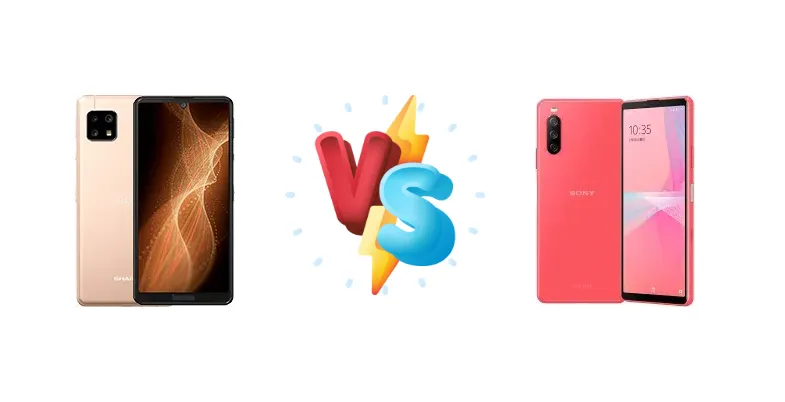
The Sharp Aquos sense5G and Sony Xperia 10 III Lite present a fascinating comparison: two phones built around the same Qualcomm Snapdragon 690 5G chipset. This head-to-head explores how Sony and Sharp differentiate these devices beyond the core processor, focusing on charging speeds, potential software experiences, and overall value proposition in the competitive mid-range 5G market.
🏆 Quick Verdict
For the average user prioritizing convenience, the Sony Xperia 10 III Lite is the better choice. While both phones leverage the Snapdragon 690, the Xperia 10 III Lite’s 30W charging with Power Delivery and Quick Charge support offers significantly faster refueling than the Aquos sense5G’s 27W wired charging, making it more practical for daily use.
| Network |
|---|
| 2G bands | GSM 850 / 900 / 1800 / 1900 | GSM 850 / 900 / 1800 / 1900 |
| 3G bands | HSDPA 850 / 900 / 1900 / 2100 | HSDPA 850 / 1900 |
| 4G bands | 1, 3, 7, 8, 20, 28, 38, 41 | 1, 3, 4, 12, 18, 19, 38, 41 |
| 5G bands | 1, 3, 28, 78 SA/NSA | 77, 78 SA/NSA |
| Speed | HSPA, LTE, 5G | HSPA, LTE, 5G |
| Technology | GSM / HSPA / LTE / 5G | GSM / HSPA / LTE / 5G |
| Launch |
|---|
| Announced | 2020, September 25. Released 2021, June 10 | 2021, August 20 |
| Status | Discontinued | Available. Released 2021, August 27 |
| Body |
|---|
| Build | Glass front, aluminum frame, aluminum back | Glass front (Gorilla Glass 6), glass back (Gorilla Glass 6), plastic frame |
| Dimensions | 148 x 71 x 8.9 mm (5.83 x 2.80 x 0.35 in) | 154 x 68 x 8.3 mm (6.06 x 2.68 x 0.33 in) |
| SIM | Nano-SIM + Nano-SIM | Nano-SIM + eSIM |
| Weight | 178 g (6.28 oz) | 169 g (5.96 oz) |
| | IPX5/IP6X/IPX8 water/dust resistant (up to 1.5m for 30 min)
MIL-STD-810H compliant | - |
| Display |
|---|
| Protection | - | Corning Gorilla Glass 6 |
| Resolution | 1080 x 2280 pixels, 19:9 ratio (~435 ppi density) | 1080 x 2520 pixels, 21:9 ratio (~457 ppi density) |
| Size | 5.8 inches, 84.0 cm2 (~79.9% screen-to-body ratio) | 6.0 inches, 84.1 cm2 (~80.3% screen-to-body ratio) |
| Type | IGZO IPS LCD, HDR10 | OLED, 1B colors, HDR |
| Platform |
|---|
| CPU | Octa-core (2x2.0 GHz Kryo 560 Gold & 6x1.7 GHz Kryo 560 Silver) | Octa-core (2x2.0 GHz Kryo 560 Gold & 6x1.7 GHz Kryo 560 Silver) |
| Chipset | Qualcomm SM6350 Snapdragon 690 5G (8 nm) | Qualcomm SM6350 Snapdragon 690 5G (8 nm) |
| GPU | Adreno 619L | Adreno 619 |
| OS | Android 11 | Android 11 |
| Memory |
|---|
| Card slot | microSDXC | microSDXC (uses shared SIM slot) |
| Internal | 128GB 8GB RAM | 64GB 6GB RAM |
| | UFS | - |
| Main Camera |
|---|
| Features | LED flash, HDR, panorama | LED flash, HDR, panorama |
| Triple | 12 MP, f/2.0, (wide), AF
8 MP, f/2.4, (telephoto), AF
12 MP, f/2.4, 121˚ (ultrawide) | 12 MP, f/1.8, 27mm (wide), 1/2.8", PDAF
8 MP, f/2.4, 54mm (telephoto), 1/4.0", PDAF, 2x optical zoom
8 MP, f/2.2, 16mm, 120˚ (ultrawide), 1/4.0" |
| Video | 4K@30fps, 1080p@60fps, 1080p@30fps | 4K@30fps, 1080p@30fps |
| Selfie camera |
|---|
| Features | - | HDR |
| Single | 8 MP | 8 MP, f/2.0, 24mm (wide), 1/4.0" |
| Video | 1080p@30fps | 1080p@30fps |
| Sound |
|---|
| 3.5mm jack | Yes | Yes |
| 35mm jack | Yes | Yes |
| Loudspeaker | Yes | Yes |
| Comms |
|---|
| Bluetooth | 5.1, A2DP, LE | 5.1, A2DP, LE, aptX HD |
| NFC | Yes | Yes |
| Positioning | GPS (L1+L5), GLONASS, BDS, GALILEO, QZSS | GPS, GLONASS, GALILEO, BDS, QZSS |
| Radio | No | No |
| USB | USB Type-C 3.1 | USB Type-C 3.1, OTG, video output |
| WLAN | Wi-Fi 802.11 a/b/g/n/ac/6, dual-band, Wi-Fi Direct | Wi-Fi 802.11 a/b/g/n/ac, dual-band, Wi-Fi Direct |
| Features |
|---|
| Sensors | Fingerprint (front-mounted), accelerometer, gyro, proximity, compass | Fingerprint (side-mounted), accelerometer, proximity, compass |
| Battery |
|---|
| Charging | 27W wired | 30W wired, PD, QC |
| Type | Li-Ion 4570 mAh | Li-Po 4500 mAh |
| Misc |
|---|
| Colors | Satin Gold, Titanium Black | Black, White, Blue, Pink |
| Models | SHG03 | XQ-BT44 |
| Price | About 250 EUR | About 370 EUR |
Sharp Aquos sense5G
- Potentially cleaner Android software experience
- Solid Snapdragon 690 performance
- Reliable brand reputation
- Slower 27W charging
- Limited charging protocol support
- Missing display specifications
Sony Xperia 10 III Lite
- Faster 30W charging with PD and QC
- Established brand with software support
- Potentially better image processing
- May include more pre-installed bloatware
- Missing display specifications
- Similar CPU performance to Aquos sense5G
Display Comparison
Both devices lack detailed display specifications in the provided data. However, given their market positioning, we can infer both likely utilize IPS LCD panels. The absence of information regarding refresh rates suggests a standard 60Hz experience on both. The real-world difference will likely come down to color calibration and peak brightness, areas where Sony typically excels due to its display technology expertise. Without specific nit ratings, it’s difficult to definitively declare a winner.
Camera Comparison
Camera details are sparse. Without sensor size or aperture information, a direct comparison is challenging. However, Sony’s history suggests a focus on image processing algorithms that prioritize natural colors and detail. Sharp, while capable, often leans towards more saturated images. The absence of information regarding Optical Image Stabilization (OIS) is notable; its presence on one device would be a significant advantage for low-light photography. The lack of detail suggests both phones likely feature a standard multi-camera setup, but the quality will depend heavily on the sensor and software processing.
Performance
The core of both phones is the Qualcomm SM6350 Snapdragon 690 5G (8 nm) paired with an Octa-core CPU configuration (2x2.0 GHz Kryo 560 Gold & 6x1.7 GHz Kryo 560 Silver). This means CPU performance will be virtually identical. The Snapdragon 690 offers a solid mid-range experience, capable of handling everyday tasks and moderate gaming. Thermal management will likely be similar, as the 8nm process node provides reasonable efficiency. RAM specifications are missing, but both will likely feature at least 4GB to ensure smooth multitasking. The GPU performance will also be identical, making graphically intensive tasks perform similarly on both devices.
Battery Life
Battery capacity is not provided, making a direct mAh comparison impossible. However, the charging speeds are a clear differentiator. The Sony Xperia 10 III Lite supports 30W wired charging with both Power Delivery (PD) and Quick Charge (QC) protocols, offering greater flexibility and potentially faster charging times with compatible adapters. The Sharp Aquos sense5G is limited to 27W wired charging. This 3W difference, combined with PD/QC support, translates to a more convenient charging experience for the Xperia 10 III Lite, allowing for quicker top-ups and broader charger compatibility.
Buying Guide
Buy the Sharp Aquos sense5G if you prioritize a potentially cleaner Android experience and are comfortable with slightly slower charging speeds. It’s a solid option for users who prefer a minimalist software approach. Buy the Sony Xperia 10 III Lite if you value faster charging, broader compatibility with charging standards (PD and QC), and a more established brand reputation for software updates and features. This phone suits users who are frequently on the go and need quick power top-ups.
Frequently Asked Questions
❓ Does the Snapdragon 690 in either phone struggle with demanding games like Genshin Impact?
The Snapdragon 690 is a capable mid-range chip, but demanding titles like Genshin Impact will require significant graphical settings compromises. Expect playable frame rates at low to medium settings, but don't anticipate a flagship-level gaming experience on either the Aquos sense5G or the Xperia 10 III Lite.
❓ Is the lack of 5G carrier aggregation a significant drawback on these phones?
The provided data doesn't specify carrier aggregation support. However, given the Snapdragon 690's capabilities, both phones likely support at least some level of carrier aggregation. The impact of limited aggregation depends on your carrier and location; in areas with strong 5G coverage, the difference may be negligible, but in fringe areas, it could affect speeds.
❓ How does the software experience differ between Sharp's and Sony's Android implementations?
Sharp typically offers a relatively stock Android experience with minimal bloatware, appealing to users who prefer a clean interface. Sony, while improving, historically includes more pre-installed apps and customizations. However, Sony also provides more advanced camera features and software enhancements.