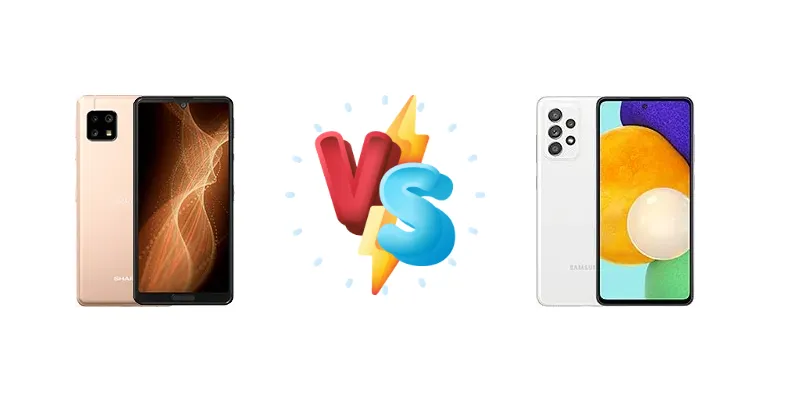
The mid-range 5G market is fiercely competitive, and the Sharp Aquos sense5G and Samsung Galaxy A52 5G represent compelling options. While both aim to deliver 5G connectivity at an accessible price, they take different approaches to achieving this. The Aquos sense5G prioritizes a streamlined experience with a Snapdragon 690, while the Galaxy A52 5G opts for the more powerful Snapdragon 750G, alongside a brighter display. This comparison will dissect their key differences to help you determine which device best suits your needs.
🏆 Quick Verdict
For the average user prioritizing display quality and overall performance, the Samsung Galaxy A52 5G emerges as the better choice. Its brighter 787 nit display and more potent Snapdragon 750G chipset provide a smoother, more visually engaging experience, despite both phones offering similar battery endurance.
| Network |
|---|
| 2G bands | GSM 850 / 900 / 1800 / 1900 | GSM 850 / 900 / 1800 / 1900 |
| 3G bands | HSDPA 850 / 900 / 1900 / 2100 | HSDPA 850 / 900 / 1700(AWS) / 1900 / 2100 |
| 4G bands | 1, 3, 7, 8, 20, 28, 38, 41 | 1, 2, 3, 4, 5, 7, 8, 12, 17, 20, 26, 28, 32, 38, 40, 41, 66 |
| 5G bands | 1, 3, 28, 78 SA/NSA | 1, 3, 5, 7, 8, 20, 28, 38, 40, 41, 66, 78 SA/NSA/Sub6 |
| Speed | HSPA, LTE, 5G | HSPA, LTE, 5G |
| Technology | GSM / HSPA / LTE / 5G | GSM / HSPA / LTE / 5G |
| Launch |
|---|
| Announced | 2020, September 25. Released 2021, June 10 | 2021, March 17 |
| Status | Discontinued | Available. Released 2021, March 19 |
| Body |
|---|
| Build | Glass front, aluminum frame, aluminum back | Glass front (Gorilla Glass 5), plastic back |
| Dimensions | 148 x 71 x 8.9 mm (5.83 x 2.80 x 0.35 in) | 159.9 x 75.1 x 8.4 mm (6.30 x 2.96 x 0.33 in) |
| SIM | Nano-SIM + Nano-SIM | · Nano-SIM· Nano-SIM + Nano-SIM |
| Weight | 178 g (6.28 oz) | 189 g (6.67 oz) |
| | IPX5/IP6X/IPX8 water/dust resistant (up to 1.5m for 30 min)
MIL-STD-810H compliant | IP67 dust/water resistant (up to 1m for 30 min) |
| Display |
|---|
| Protection | - | Corning Gorilla Glass 5 |
| Resolution | 1080 x 2280 pixels, 19:9 ratio (~435 ppi density) | 1080 x 2400 pixels, 20:9 ratio (~407 ppi density) |
| Size | 5.8 inches, 84.0 cm2 (~79.9% screen-to-body ratio) | 6.5 inches, 101.0 cm2 (~84.1% screen-to-body ratio) |
| Type | IGZO IPS LCD, HDR10 | Super AMOLED, 120Hz, HDR10+, 800 nits (HBM) |
| | - | Always-on display |
| Platform |
|---|
| CPU | Octa-core (2x2.0 GHz Kryo 560 Gold & 6x1.7 GHz Kryo 560 Silver) | Octa-core (2x2.2 GHz Kryo 570 & 6x1.8 GHz Kryo 570) |
| Chipset | Qualcomm SM6350 Snapdragon 690 5G (8 nm) | Qualcomm SM7225 Snapdragon 750G 5G (8 nm) |
| GPU | Adreno 619L | Adreno 619 |
| OS | Android 11 | Android 11, upgradable to Android 14, One UI 6.1 |
| Memory |
|---|
| Card slot | microSDXC | microSDXC (uses shared SIM slot) |
| Internal | 128GB 8GB RAM | 128GB 4GB RAM, 128GB 6GB RAM, 128GB 8GB RAM, 256GB 4GB RAM, 256GB 8GB RAM |
| | UFS | - |
| Main Camera |
|---|
| Features | LED flash, HDR, panorama | LED flash, panorama, HDR |
| Quad | - | 64 MP, f/1.8, 26mm (wide), 1/1.7X", 0.8µm, PDAF, OIS
12 MP, f/2.2, 123˚ (ultrawide), 1.12µm
5 MP (macro)
Auxiliary lens |
| Triple | 12 MP, f/2.0, (wide), AF
8 MP, f/2.4, (telephoto), AF
12 MP, f/2.4, 121˚ (ultrawide) | - |
| Video | 4K@30fps, 1080p@60fps, 1080p@30fps | 4K@30fps, 1080p@30/60fps; gyro-EIS |
| Selfie camera |
|---|
| Features | - | HDR |
| Single | 8 MP | 32 MP, f/2.2, 26mm (wide), 1/2.8", 0.8µm |
| Video | 1080p@30fps | 4K@30fps, 1080p@30fps |
| Sound |
|---|
| 3.5mm jack | Yes | Yes |
| 35mm jack | Yes | Yes |
| Loudspeaker | Yes | Yes, with stereo speakers |
| Comms |
|---|
| Bluetooth | 5.1, A2DP, LE | 5.0, A2DP, LE |
| NFC | Yes | Yes (market/region dependent) |
| Positioning | GPS (L1+L5), GLONASS, BDS, GALILEO, QZSS | GPS, GLONASS, GALILEO, BDS |
| Radio | No | FM radio (market/region dependent) |
| USB | USB Type-C 3.1 | USB Type-C 2.0, OTG |
| WLAN | Wi-Fi 802.11 a/b/g/n/ac/6, dual-band, Wi-Fi Direct | Wi-Fi 802.11 a/b/g/n/ac, dual-band, Wi-Fi Direct |
| Features |
|---|
| Sensors | Fingerprint (front-mounted), accelerometer, gyro, proximity, compass | Fingerprint (under display, optical), accelerometer, gyro, compass |
| | - | Virtual proximity sensing |
| Battery |
|---|
| Charging | 27W wired | 25W wired, 50% in 30 min |
| Type | Li-Ion 4570 mAh | Li-Po 4500 mAh |
| Misc |
|---|
| Colors | Satin Gold, Titanium Black | Awesome Black, Awesome White, Awesome Violet, Awesome Blue |
| Models | SHG03 | SM-A526B, SM-A526B/DS, SM-A5260, SM-A526W, SM-A526U, SM-A526U1 |
| Price | About 250 EUR | $ 137.39 / £ 280.00 / € 115.49 |
| SAR | - | 0.74 W/kg (head) 0.53 W/kg (body) |
| SAR EU | - | 1.05 W/kg (head) 1.42 W/kg (body) |
| Tests |
|---|
| Battery life | - |
Endurance rating 111h
|
| Camera | - |
Photo / Video |
| Display | - |
Contrast ratio: Infinite (nominal) |
| Loudspeaker | - |
-27.5 LUFS (Good)
|
| Performance | - |
AnTuTu: 334981 (v8), 386474 (v9)
GeekBench: 1820 (v5.1)
GFXBench: 16fps (ES 3.1 onscreen) |
Sharp Aquos sense5G
- Potentially lower price point
- Clean and streamlined software experience
- 27W wired charging
- Less powerful Snapdragon 690 chipset
- Limited display specifications
- Camera performance likely inferior to A52 5G
Samsung Galaxy A52 5G
- Brighter 787 nit display
- More powerful Snapdragon 750G chipset
- Faster 25W charging with 30-minute 50% boost
- May be more expensive than Aquos sense5G
- Samsung’s One UI can be resource-intensive
- Larger form factor
Display Comparison
The Samsung Galaxy A52 5G boasts a significant advantage in display technology, achieving a measured peak brightness of 787 nits. This is crucial for outdoor visibility, a scenario where the Aquos sense5G’s display specifications are not available for comparison, but likely falls short. While the A52 5G’s contrast ratio is listed as ‘Infinite (nominal)’ – a common marketing term – the higher peak brightness translates to a more dynamic and readable image in real-world conditions. The lack of detailed display specs for the Aquos sense5G makes a precise comparison difficult, but the A52 5G clearly leads in this category.
Camera Comparison
Both phones feature photo and video capabilities, but detailed camera specifications are limited. The absence of sensor size or megapixel counts prevents a thorough analysis. However, Samsung’s image processing algorithms are generally more refined, offering better dynamic range and color accuracy. The A52 5G likely benefits from more advanced software features, such as Single Take and improved night mode capabilities. Without specific details on the Aquos sense5G’s camera hardware, it’s difficult to assess its performance, but Samsung’s established camera reputation gives the A52 5G a likely advantage.
Performance
Both devices utilize Qualcomm Snapdragon chipsets fabricated on an 8nm process, but the Galaxy A52 5G’s Snapdragon 750G represents a step up from the Aquos sense5G’s Snapdragon 690. The A52 5G’s CPU configuration of 2x2.2 GHz Kryo 570 cores and 6x1.8 GHz Kryo 570 cores offers a performance edge over the Aquos sense5G’s 2x2.0 GHz Kryo 560 Gold and 6x1.7 GHz Kryo 560 Silver setup. This translates to faster app loading times and smoother multitasking. While both support 5G, the 750G’s improved modem may offer slightly better connectivity and efficiency. The Aquos sense5G will handle everyday tasks adequately, but the A52 5G provides headroom for more demanding applications and gaming.
Battery Life
Interestingly, both the Sharp Aquos sense5G and Samsung Galaxy A52 5G achieve an endurance rating of 111 hours, suggesting comparable real-world battery life. However, the A52 5G offers faster charging at 25W, capable of reaching 50% charge in just 30 minutes, while the Aquos sense5G’s 27W charging, while slightly higher on paper, lacks a specified time-to-charge metric. This faster charging capability on the A52 5G provides a convenience factor, allowing for quicker top-ups when needed, despite the similar overall endurance.
Buying Guide
Buy the Sharp Aquos sense5G if you prioritize a clean software experience and value a slightly more compact form factor, potentially at a lower price point. Buy the Samsung Galaxy A52 5G if you prefer a brighter, more vibrant display, a more versatile camera system, and a chipset capable of handling more demanding tasks and future software updates with greater ease.
Frequently Asked Questions
❓ Does the Snapdragon 750G in the Galaxy A52 5G experience significant throttling during extended gaming sessions?
While the Snapdragon 750G is a capable chipset, it can exhibit some throttling under sustained heavy load. However, Samsung’s thermal management system generally mitigates this effectively, preventing drastic performance drops during typical gaming sessions. The Aquos sense5G’s Snapdragon 690 is less powerful to begin with, so throttling is less of a concern, but it also won’t sustain peak performance for as long.
❓ Is the 27W charging on the Aquos sense5G significantly faster than the 25W charging on the Galaxy A52 5G?
Despite the slightly higher wattage, the Aquos sense5G lacks a specified time-to-charge metric. The Galaxy A52 5G’s 25W charging is confirmed to reach 50% charge in 30 minutes, providing a tangible benefit in terms of quick top-ups. The Aquos sense5G’s charging speed is likely comparable, but without concrete data, the A52 5G holds the advantage in convenience.
❓ How does the software experience differ between the Aquos sense5G and the Galaxy A52 5G?
The Aquos sense5G typically runs a cleaner, more stock-like version of Android, appealing to users who prefer a minimalist interface. The Galaxy A52 5G utilizes Samsung’s One UI, which offers a wealth of features and customization options but can be more resource-intensive and include pre-installed bloatware. This difference in software philosophy is a key consideration for many users.