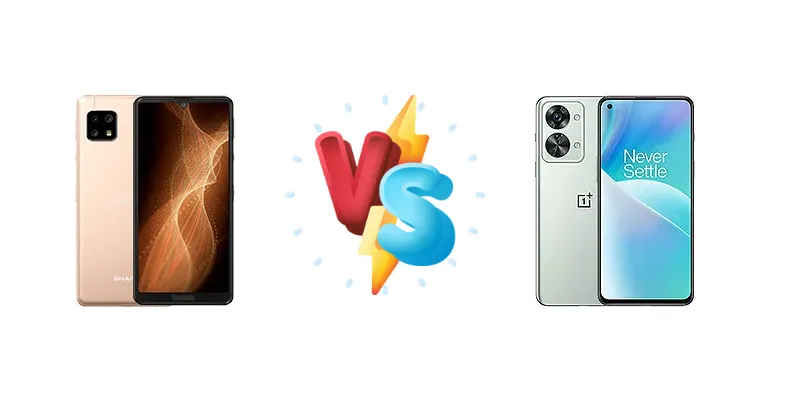
The mid-range 5G market is fiercely competitive, and the Sharp Aquos sense5G and OnePlus Nord 2T represent compelling options. The Aquos sense5G, powered by the Snapdragon 690, aims for efficiency, while the Nord 2T leverages the more powerful Mediatek Dimensity 1300. This comparison dissects their key differences to determine which phone delivers the best value.
🏆 Quick Verdict
For most users, the OnePlus Nord 2T emerges as the stronger choice. Its significantly faster 80W charging and more potent Dimensity 1300 chipset provide a smoother, more responsive experience. While the Aquos sense5G offers a respectable package, the Nord 2T’s performance edge is hard to ignore.
| Network |
|---|
| 2G bands | GSM 850 / 900 / 1800 / 1900 | GSM 850 / 900 / 1800 / 1900 |
| 3G bands | HSDPA 850 / 900 / 1900 / 2100 | HSDPA 800 / 850 / 900 / 1700(AWS) / 1800 / 1900 / 2100 |
| 4G bands | 1, 3, 7, 8, 20, 28, 38, 41 | 1, 2, 3, 4, 5, 7, 8, 12, 17, 18, 19, 20, 26, 28, 32, 34, 38, 39, 40, 41, 66 |
| 5G bands | 1, 3, 28, 78 SA/NSA | 1, 3, 7, 8, 20, 28, 38, 41, 78 SA/NSA |
| Speed | HSPA, LTE, 5G | HSPA 42.2/5.76 Mbps, LTE Cat18 1200/150 Mbps, 5G |
| Technology | GSM / HSPA / LTE / 5G | GSM / HSPA / LTE / 5G |
| Launch |
|---|
| Announced | 2020, September 25. Released 2021, June 10 | 2022, May 19 |
| Status | Discontinued | Available. Released 2022, May 21 |
| Body |
|---|
| Build | Glass front, aluminum frame, aluminum back | Glass front (Gorilla Glass 5), plastic frame |
| Dimensions | 148 x 71 x 8.9 mm (5.83 x 2.80 x 0.35 in) | 159.1 x 73.2 x 8.2 mm (6.26 x 2.88 x 0.32 in) |
| SIM | Nano-SIM + Nano-SIM | Nano-SIM + Nano-SIM |
| Weight | 178 g (6.28 oz) | 190 g (6.70 oz) |
| | IPX5/IP6X/IPX8 water/dust resistant (up to 1.5m for 30 min)
MIL-STD-810H compliant | - |
| Display |
|---|
| Protection | - | Corning Gorilla Glass 5 |
| Resolution | 1080 x 2280 pixels, 19:9 ratio (~435 ppi density) | 1080 x 2400 pixels, 20:9 ratio (~409 ppi density) |
| Size | 5.8 inches, 84.0 cm2 (~79.9% screen-to-body ratio) | 6.43 inches, 99.8 cm2 (~85.7% screen-to-body ratio) |
| Type | IGZO IPS LCD, HDR10 | AMOLED, 90Hz, HDR10+ |
| Platform |
|---|
| CPU | Octa-core (2x2.0 GHz Kryo 560 Gold & 6x1.7 GHz Kryo 560 Silver) | Octa-core (1x3.0 GHz Cortex-A78 & 3x2.6 GHz Cortex-A78 & 4x2.0 GHz Cortex-A55) |
| Chipset | Qualcomm SM6350 Snapdragon 690 5G (8 nm) | Mediatek Dimensity 1300 (6 nm) |
| GPU | Adreno 619L | Mali-G77 MC9 |
| OS | Android 11 | Android 12, upgradable to Android 14, OxygenOS 14 |
| Memory |
|---|
| Card slot | microSDXC | No |
| Internal | 128GB 8GB RAM | 128GB 8GB RAM, 256GB 12GB RAM |
| | UFS | UFS 3.1 |
| Main Camera |
|---|
| Features | LED flash, HDR, panorama | Dual-LED flash, HDR, panorama |
| Single | - | 32 MP, f/2.4, (wide), 1/2.8", 0.8µm |
| Triple | 12 MP, f/2.0, (wide), AF
8 MP, f/2.4, (telephoto), AF
12 MP, f/2.4, 121˚ (ultrawide) | 50 MP, f/1.9, 24mm (wide), 1/1.56", 1.0µm, PDAF, OIS
8 MP, f/2.2, 120˚ (ultrawide)
Auxiliary lens |
| Video | 4K@30fps, 1080p@60fps, 1080p@30fps | 4K@30fps, 1080p@30/60/120/480fps, gyro-EIS |
| Selfie camera |
|---|
| Features | - | Auto HDR |
| Single | 8 MP | 32 MP, f/2.4, (wide), 1/2.8", 0.8µm |
| Video | 1080p@30fps | 1080p@30fps, gyro-EIS |
| Sound |
|---|
| 3.5mm jack | Yes | No |
| 35mm jack | Yes | No |
| Loudspeaker | Yes | Yes, with stereo speakers |
| Comms |
|---|
| Bluetooth | 5.1, A2DP, LE | 5.2, A2DP, LE, aptX HD |
| NFC | Yes | Yes |
| Positioning | GPS (L1+L5), GLONASS, BDS, GALILEO, QZSS | GPS, GLONASS, GALILEO, BDS, NavIC |
| Radio | No | No |
| USB | USB Type-C 3.1 | USB Type-C 2.0, OTG |
| WLAN | Wi-Fi 802.11 a/b/g/n/ac/6, dual-band, Wi-Fi Direct | Wi-Fi 802.11 a/b/g/n/ac/6, dual-band, Wi-Fi Direct |
| Features |
|---|
| Sensors | Fingerprint (front-mounted), accelerometer, gyro, proximity, compass | Fingerprint (under display, optical), accelerometer, gyro, proximity, compass |
| Battery |
|---|
| Charging | 27W wired | 80W wired, PD |
| Type | Li-Ion 4570 mAh | Li-Po 4500 mAh |
| Misc |
|---|
| Colors | Satin Gold, Titanium Black | Gray Shadow, Jade Fog |
| Models | SHG03 | CPH2399, CPH2401 |
| Price | About 250 EUR | € 144.39 / $ 169.99 / ₹ 31,490 |
| Tests |
|---|
| Battery life | - |
Endurance rating 100h
|
| Camera | - |
Photo / Video |
| Display | - |
Contrast ratio: Infinite (nominal) |
| Loudspeaker | - |
-25.6 LUFS (Very good)
|
| Performance | - |
AnTuTu: 490545 (v8) | 604467 (v9)
GeekBench: 2790 (v5.1)
GFXBench: 40fps (ES 3.1 onscreen) |
Sharp Aquos sense5G
- Potentially longer software support from Sharp.
- More understated design aesthetic.
- Efficient Snapdragon 690 chipset for basic tasks.
- Significantly slower charging speed (27W).
- Less powerful chipset compared to the Dimensity 1300.
- Limited display brightness information.
OnePlus Nord 2T
- Much faster 80W SuperVOOC charging.
- More powerful Mediatek Dimensity 1300 chipset.
- Brighter display for better outdoor visibility.
- OxygenOS can be polarizing for some users.
- Potential for more aggressive background app management.
Display Comparison
The OnePlus Nord 2T boasts a brighter display, reaching a measured 636 nits, compared to an unspecified brightness for the Aquos sense5G. While both phones likely utilize AMOLED panels (based on brand trends), the Nord 2T’s higher peak brightness translates to better visibility outdoors. The Nord 2T’s 'Infinite' contrast ratio (nominal) suggests a standard AMOLED experience, while details on the Aquos sense5G’s panel characteristics are lacking. Bezels are likely comparable, given both phones target a similar price bracket.
Camera Comparison
Both devices feature 'Photo / Video' capabilities, but specifics are limited. The absence of sensor size or aperture information makes a direct comparison difficult. However, the Dimensity 1300’s integrated ISP (Image Signal Processor) is more advanced than the Snapdragon 690’s, potentially leading to better image processing, especially in low-light conditions. The Nord 2T likely benefits from more sophisticated computational photography features. We can assume both phones include standard features like HDR and portrait modes, but the Aquos sense5G’s camera system is likely more basic.
Performance
The core difference lies in the chipsets. The OnePlus Nord 2T’s Mediatek Dimensity 1300 (6nm) is a substantial upgrade over the Sharp Aquos sense5G’s Qualcomm Snapdragon 690 (8nm). The Dimensity 1300’s octa-core configuration, featuring a high-clocked Cortex-A78 prime core, delivers significantly improved CPU and GPU performance. The 6nm process node further enhances efficiency. While the Snapdragon 690 is adequate for everyday tasks, the Dimensity 1300 will handle demanding games and applications with greater ease. RAM specifications are not provided, but the Nord 2T likely benefits from faster LPDDR4X or LPDDR5 RAM, contributing to smoother multitasking.
Battery Life
Both phones achieve an endurance rating of 100 hours, suggesting similar overall battery life despite differing charging capabilities. However, the OnePlus Nord 2T’s 80W wired charging with PD support is a game-changer. This allows for a full charge in a fraction of the time compared to the Aquos sense5G’s 27W charging. While the Aquos sense5G might offer slightly longer screen-on time due to the less powerful chipset, the Nord 2T’s rapid charging mitigates any potential battery anxiety.
Buying Guide
Buy the Sharp Aquos sense5G if you prioritize a more understated design and a potentially longer software support lifecycle from Sharp, and are comfortable with slower charging speeds. Buy the OnePlus Nord 2T if you demand faster performance for gaming and multitasking, and value the convenience of incredibly rapid 80W SuperVOOC charging. The Nord 2T is the better pick for power users.
Frequently Asked Questions
❓ Does the Mediatek Dimensity 1300 in the Nord 2T get excessively hot during prolonged gaming sessions?
While the Dimensity 1300 is a powerful chip, Mediatek has made strides in thermal management. The 6nm process node helps with efficiency. However, sustained gaming will inevitably generate heat. The Nord 2T incorporates cooling solutions, but expect some throttling after extended periods of intense gameplay. It will still outperform the Snapdragon 690 in sustained performance.
❓ How long does it *actually* take to charge the OnePlus Nord 2T from 0% to 100% with the included charger?
OnePlus claims the Nord 2T can charge from 0% to 100% in approximately 27 minutes with the 80W SuperVOOC charger. Real-world results may vary slightly depending on ambient temperature and background processes, but it consistently delivers incredibly fast charging speeds.
❓ Is the software experience on the Sharp Aquos sense5G cleaner and less bloated compared to OxygenOS on the Nord 2T?
Generally, Sharp's software is known for being relatively clean and close to stock Android. OxygenOS, while improved, still includes some pre-installed apps and customizations. Users who prefer a minimalist experience may find the Aquos sense5G more appealing in this regard.