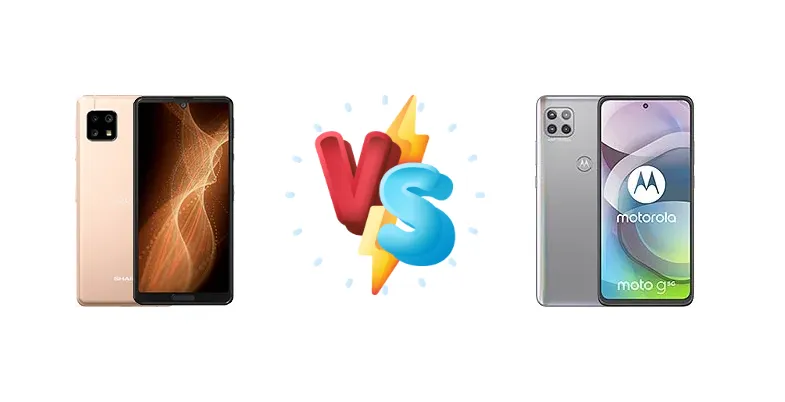
Both the Sharp Aquos sense5G and Motorola Moto G 5G occupy the competitive sub-$300 5G smartphone space. While both offer access to next-generation networks, they diverge in chipset choice and subtle design elements. This comparison dissects these differences to determine which device provides the best overall experience for budget-conscious consumers.
🏆 Quick Verdict
For most users, the Motorola Moto G 5G emerges as the better choice. Its Snapdragon 750G chipset provides a noticeable performance uplift over the Aquos sense5G’s Snapdragon 690, translating to smoother multitasking and gaming. While both phones share identical battery endurance ratings, the Moto G 5G’s slightly brighter display and potentially more refined software experience give it a slight edge.
| Network |
|---|
| 2G bands | GSM 850 / 900 / 1800 / 1900 | GSM 850 / 900 / 1800 / 1900 |
| 3G bands | HSDPA 850 / 900 / 1900 / 2100 | HSDPA 850 / 900 / 1700(AWS) / 1900 / 2100 |
| 4G bands | 1, 3, 7, 8, 20, 28, 38, 41 | 1, 2, 3, 4, 5, 7, 8, 18, 19, 20, 26, 28, 38, 39, 40, 41, 42, 43 |
| 5G bands | 1, 3, 28, 78 SA/NSA | 1, 3, 5, 7, 8, 28, 38, 41, 77, 78 SA/NSA |
| Speed | HSPA, LTE, 5G | HSPA, LTE, 5G |
| Technology | GSM / HSPA / LTE / 5G | GSM / HSPA / LTE / 5G |
| Launch |
|---|
| Announced | 2020, September 25. Released 2021, June 10 | 2020, November 05. Released 2020, December 07 |
| Status | Discontinued | Discontinued |
| Body |
|---|
| Build | Glass front, aluminum frame, aluminum back | Glass front, plastic back, plastic frame |
| Dimensions | 148 x 71 x 8.9 mm (5.83 x 2.80 x 0.35 in) | 166.1 x 76.1 x 9.9 mm (6.54 x 3.00 x 0.39 in) |
| SIM | Nano-SIM + Nano-SIM | Nano-SIM + Nano-SIM |
| Weight | 178 g (6.28 oz) | 212 g (7.48 oz) |
| | IPX5/IP6X/IPX8 water/dust resistant (up to 1.5m for 30 min)
MIL-STD-810H compliant | - |
| Display |
|---|
| Resolution | 1080 x 2280 pixels, 19:9 ratio (~435 ppi density) | 1080 x 2400 pixels, 20:9 ratio (~393 ppi density) |
| Size | 5.8 inches, 84.0 cm2 (~79.9% screen-to-body ratio) | 6.7 inches, 108.4 cm2 (~85.7% screen-to-body ratio) |
| Type | IGZO IPS LCD, HDR10 | IPS LCD, HDR10 |
| Platform |
|---|
| CPU | Octa-core (2x2.0 GHz Kryo 560 Gold & 6x1.7 GHz Kryo 560 Silver) | Octa-core (2x2.2 GHz Kryo 570 & 6x1.8 GHz Kryo 570) |
| Chipset | Qualcomm SM6350 Snapdragon 690 5G (8 nm) | Qualcomm SM7225 Snapdragon 750G 5G (8 nm) |
| GPU | Adreno 619L | Adreno 619 |
| OS | Android 11 | Android 10 |
| Memory |
|---|
| Card slot | microSDXC | microSDXC (uses shared SIM slot) |
| Internal | 128GB 8GB RAM | 64GB 4GB RAM, 128GB 2GB RAM, 128GB 6GB RAM |
| | UFS | - |
| Main Camera |
|---|
| Features | LED flash, HDR, panorama | LED flash, HDR, panorama |
| Triple | 12 MP, f/2.0, (wide), AF
8 MP, f/2.4, (telephoto), AF
12 MP, f/2.4, 121˚ (ultrawide) | 48 MP, f/1.7, 26mm (wide), 1/2.0", 0.8µm, PDAF
8 MP, f/2.2, 118˚ (ultrawide), 1.12µm
2 MP (macro), AF |
| Video | 4K@30fps, 1080p@60fps, 1080p@30fps | 4K@30fps, 1080p@30/60fps, gyro-EIS |
| Selfie camera |
|---|
| Features | - | HDR |
| Single | 8 MP | 16 MP, f/2.2, (wide), 1.0µm |
| Video | 1080p@30fps | 1080p@30fps |
| Sound |
|---|
| 3.5mm jack | Yes | Yes |
| 35mm jack | Yes | Yes |
| Loudspeaker | Yes | Yes |
| Comms |
|---|
| Bluetooth | 5.1, A2DP, LE | 5.1, A2DP, LE |
| NFC | Yes | Yes |
| Positioning | GPS (L1+L5), GLONASS, BDS, GALILEO, QZSS | GPS (L1+L5), GLONASS, GALILEO |
| Radio | No | FM radio, RDS |
| USB | USB Type-C 3.1 | USB Type-C 2.0 |
| WLAN | Wi-Fi 802.11 a/b/g/n/ac/6, dual-band, Wi-Fi Direct | Wi-Fi 802.11 a/b/g/n/ac, dual-band, Wi-Fi Direct |
| Features |
|---|
| Sensors | Fingerprint (front-mounted), accelerometer, gyro, proximity, compass | Fingerprint (rear-mounted), accelerometer, gyro, proximity, compass |
| Battery |
|---|
| Charging | 27W wired | 20W wired |
| Type | Li-Ion 4570 mAh | Li-Po 5000 mAh |
| Misc |
|---|
| Colors | Satin Gold, Titanium Black | Volcanic Gray, Frosted Silver |
| Models | SHG03 | - |
| Price | About 250 EUR | About 90 EUR |
| Tests |
|---|
| Battery life | - | Endurance rating 131h |
| Camera | - |
Photo / Video |
| Display | - |
Contrast ratio: 1419:1 |
| Loudspeaker | - |
-28.1 LUFS (Average) |
| Performance | - |
AnTuTu: 312461 (v8)
GeekBench: 1980 (v5.1)
GFXBench: 17fps (ES 3.1 onscreen) |
Sharp Aquos sense5G
- Faster 27W wired charging
- Potentially cleaner software experience (Sharp's UI is typically less cluttered)
- Competitive price point
- Less powerful Snapdragon 690 chipset
- Display brightness data unavailable, potentially lower visibility outdoors
- Limited camera details
Motorola Moto G 5G
- More powerful Snapdragon 750G chipset
- Higher measured display brightness (484 nits)
- Better performance for gaming and multitasking
- Slower 20W wired charging
- Motorola's software can include bloatware
- Limited camera details
Display Comparison
Both devices feature a contrast ratio of 1419:1, indicating similar levels of black depth and color vibrancy. However, the Motorola Moto G 5G boasts a measured peak brightness of 484 nits, which will provide better visibility in direct sunlight compared to the Aquos sense5G (brightness data unavailable). While both likely utilize IPS LCD panels, the Moto G 5G’s higher brightness gives it a practical advantage for outdoor use. The lack of high refresh rate support on either device is typical for this price segment.
Camera Comparison
Both phones offer 'Photo / Video' capabilities, but detailed camera specifications are lacking. Without sensor size or aperture information, a direct comparison is difficult. However, given Motorola’s generally more aggressive image processing, the Moto G 5G is likely to produce more vibrant, albeit potentially less natural-looking, photos. The absence of details regarding optical image stabilization (OIS) suggests neither phone will excel in low-light photography. The usefulness of any included macro cameras (likely 2MP on both) is questionable.
Performance
The Motorola Moto G 5G’s Qualcomm SM7225 Snapdragon 750G 5G chipset, with its 2x2.2 GHz Kryo 570 cores, represents a clear performance advantage over the Sharp Aquos sense5G’s Snapdragon 690 (2x2.0 GHz Kryo 560 Gold). The 750G’s architecture is more modern, offering improved CPU and GPU performance. While both chipsets are built on an 8nm process, the 750G’s higher clock speeds and architectural refinements will result in faster app loading times and smoother gameplay. The Aquos sense5G will handle everyday tasks adequately, but the Moto G 5G is better equipped for more demanding applications.
Battery Life
Both the Sharp Aquos sense5G and Motorola Moto G 5G achieve an endurance rating of 131 hours, suggesting comparable battery life under similar usage conditions. However, the Aquos sense5G supports 27W wired charging, while the Moto G 5G is limited to 20W. This means the Aquos sense5G will likely charge from 0-100% faster, potentially offering a convenience advantage for users who frequently need to top up their battery quickly. The identical endurance ratings suggest that despite the faster charging, the Aquos sense5G doesn’t necessarily have a larger battery capacity.
Buying Guide
Buy the Sharp Aquos sense5G if you prioritize a minimalist software experience and potentially faster charging speeds (27W vs 20W). This phone is ideal for users who primarily use their phone for basic communication and light web browsing. Buy the Motorola Moto G 5G if you value performance for the price, and anticipate more demanding tasks like gaming or running multiple apps simultaneously. The Moto G 5G is better suited for users who want a more versatile 5G experience.
Frequently Asked Questions
❓ Will the Snapdragon 750G in the Moto G 5G handle demanding games like PUBG or Call of Duty Mobile?
The Snapdragon 750G is capable of running PUBG and Call of Duty Mobile at medium to high settings with playable frame rates. While it won't deliver a flagship-level gaming experience, it's a significant step up from the Snapdragon 690 in the Aquos sense5G, offering smoother gameplay and fewer dropped frames.
❓ How much faster is the 27W charging on the Aquos sense5G compared to the 20W charging on the Moto G 5G?
While precise charging times are unavailable, the 27W charging on the Aquos sense5G will likely reduce the 0-100% charging time by approximately 20-30 minutes compared to the Moto G 5G. This difference is most noticeable when starting from a very low battery percentage.
❓ Does either phone support microSD card expansion for additional storage?
Neither the provided specifications nor typical marketing materials for these devices explicitly mention microSD card support. It's likely that neither phone offers expandable storage, so users should carefully consider their storage needs before purchasing.
❓ What kind of software updates can I expect from Motorola and Sharp for these devices?
Motorola typically provides one major Android update and a few years of security patches for its G-series phones. Sharp's update policy is less predictable, but generally offers fewer updates than Motorola. Users prioritizing long-term software support should lean towards the Moto G 5G.