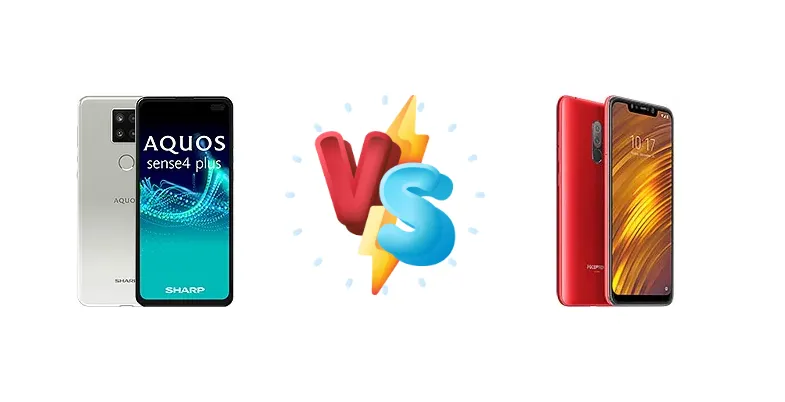
The smartphone market is brimming with options, making it tough to choose. Today, we pit two contenders against each other: the Sharp Aquos Sense4 Plus and the Xiaomi Pocophone F1. Both offer compelling features, but cater to slightly different needs. Let's dive into a detailed comparison to help you decide which one is right for you.
🏆 Quick Verdict
The Pocophone F1 wins on raw performance thanks to its Snapdragon 845, offering a significantly faster experience. However, the Aquos Sense4 Plus might appeal to those prioritizing a more modern design and potentially better software support. Ultimately, the F1 provides exceptional value for its price.
| Network |
|---|
| 2G bands | GSM 850 / 900 / 1800 / 1900 | GSM 850 / 900 / 1800 / 1900 |
| 3G bands | HSDPA 850 / 900 / 1900 / 2100 | HSDPA 850 / 900 / 1900 / 2100 |
| 4G bands | 1, 2, 3, 4, 5, 7, 8, 11, 12, 17, 18, 19, 20, 26, 28, 38, 40, 41 | 1, 3, 5, 7, 8, 20, 38, 40, 41 |
| Speed | HSPA, LTE | HSPA 42.2/5.76 Mbps, LTE (4CA) Cat16 1024/150 Mbps |
| Technology | GSM / HSPA / LTE | GSM / HSPA / LTE |
| Launch |
|---|
| Announced | 2020, September 11. Released 2020, September 11 | 2018, August 22. Released 2018, August 27 |
| Status | Discontinued | Discontinued |
| Body |
|---|
| Build | - | Glass front (Gorilla Glass), plastic back, plastic frame |
| Dimensions | 166 x 78 x 8.8 mm (6.54 x 3.07 x 0.35 in) | 155.5 x 75.3 x 8.8 mm (6.12 x 2.96 x 0.35 in) |
| SIM | Nano-SIM | Nano-SIM + Nano-SIM |
| Weight | 198 g (6.98 oz) | 182 g (6.42 oz) |
| | IPX5/IP6X/IPX8 water/dust resistant (up to 1.5m for 30 min) | - |
| Display |
|---|
| Protection | - | Corning Gorilla Glass (unspecified version) |
| Resolution | 1080 x 2400 pixels, 20:9 ratio (~393 ppi density) | 1080 x 2246 pixels, 18.7:9 ratio (~403 ppi density) |
| Size | 6.7 inches, 108.4 cm2 (~83.7% screen-to-body ratio) | 6.18 inches, 96.2 cm2 (~82.2% screen-to-body ratio) |
| Type | IPS LCD, 90Hz | IPS LCD |
| Platform |
|---|
| CPU | Octa-core (2x2.3 GHz Kryo 465 Gold & 6x1.8 GHz Kryo 465 Silver) | Octa-core (4x2.8 GHz Kryo 385 Gold & 4x1.8 GHz Kryo 385 Silver) |
| Chipset | Qualcomm SM7125 Snapdragon 720G (8 nm) | Qualcomm SDM845 Snapdragon 845 (10 nm) |
| GPU | Adreno 618 | Adreno 630 |
| OS | Android 10 | Android 8.1 (Oreo), upgradable to Android 10, MIUI 12 |
| Memory |
|---|
| Card slot | microSDXC | microSDXC (uses shared SIM slot) |
| Internal | 128GB 8GB RAM | 64GB 6GB RAM, 128GB 6GB RAM, 256GB 8GB RAM |
| | - | UFS 2.1 |
| Main Camera |
|---|
| Dual | - | 12 MP, f/1.9, 1/2.55", 1.4µm, dual pixel PDAF
Auxiliary lens |
| Features | LED flash, HDR, panorama | Dual-LED flash, HDR, panorama |
| Quad | 48 MP, f/1.8, (wide), AF
5 MP, f/2.2, 115˚ (ultrawide)
2 MP, f/2.4, 40mm (telephoto macro)
Auxiliary lens | - |
| Video | 1080p@30fps | 4K@30/60fps, 1080p@30fps (gyro-EIS), 1080p@240fps, 720p@960fps |
| Selfie camera |
|---|
| Features | - | HDR |
| Single | 8 MP | 20 MP, f/2.0, (wide), 1/3", 0.9µm |
| Video | 1080p@30fps | 1080p@30fps |
| Sound |
|---|
| 3.5mm jack | Yes | Yes |
| 35mm jack | Yes | Yes |
| Loudspeaker | Yes | Yes, with stereo speakers |
| Comms |
|---|
| Bluetooth | 5.1, A2DP, LE | 5.0, A2DP, LE, aptX HD |
| NFC | No | No |
| Positioning | GPS, GLONASS, BDS, GALILEO, QZSS | GPS, GLONASS, BDS |
| Radio | No | FM radio, recording |
| USB | USB Type-C | USB Type-C 2.0, OTG |
| WLAN | Wi-Fi 802.11 a/b/g/n/ac, dual-band, Wi-Fi Direct | Wi-Fi 802.11 a/b/g/n/ac, dual-band, Wi-Fi Direct, DLNA |
| Features |
|---|
| Sensors | Fingerprint (rear-mounted), accelerometer, gyro, proximity, compass | Infrared Face ID, fingerprint (rear-mounted), accelerometer, gyro, proximity, compass |
| Battery |
|---|
| Charging | Wired | 18W wired, QC3 |
| Type | Li-Po 4120 mAh | Li-Po 4000 mAh, non-removable |
| Misc |
|---|
| Colors | Deep Fog Black, Cloud White | Graphite Black, Steel Blue, Rosso Red, Armored Edition with Kevlar |
| Models | - | M1805E10A, POCO F1 |
| Price | About 600 EUR | About 360 EUR |
| SAR | - | 0.66 W/kg (head) 1.18 W/kg (body) |
| SAR EU | - | 0.54 W/kg (head) 1.58 W/kg (body) |
| Tests |
|---|
| Audio quality | - |
Noise -93.6dB / Crosstalk -93.8dB |
| Battery life | - |
Endurance rating 94h
|
| Camera | - |
Photo / Video |
| Display | - |
Contrast ratio: 1468:1 (nominal), 3.059 (sunlight) |
| Loudspeaker | - |
Voice 72dB / Noise 74dB / Ring 86dB
|
| Performance | - |
AnTuTu: 265314 (v7)
GeekBench: 9003 (v4.4)
GFXBench: 31fps (ES 3.1 onscreen) |
Sharp Aquos sense4 plus
- Modern Design
- Potentially Better Software Support
- Compact Size
- Good Battery Life
- Less Powerful Processor
- Limited Availability in Some Regions
- Wired Charging Only
Xiaomi Pocophone F1
- Exceptional Performance for the Price
- Excellent Battery Life
- High Contrast Display
- Fast Charging (QC3)
- Older Design
- Potentially Slower Software Updates
- No NFC (depending on region)
Display Comparison
The Pocophone F1 boasts a fantastic contrast ratio (1468:1) and exceptional sunlight readability (3.059), making it a winner in outdoor visibility. The Aquos Sense4 Plus likely has a more modern display technology (potentially OLED), but specific contrast ratio data is unavailable. The F1's larger size might also be a factor for some.
Camera Comparison
Camera performance is difficult to definitively declare a winner without detailed testing. The Pocophone F1's camera is generally considered decent for its price range. The Aquos Sense4 Plus, being a more recent device, may have improved image processing and potentially better low-light performance, but this is speculative without reviews. Both offer Photo/Video capabilities.
Performance
Here, the Pocophone F1 takes a clear lead. Its Snapdragon 845 is significantly more powerful than the Snapdragon 720G in the Aquos Sense4 Plus. Expect smoother multitasking, faster app loading, and better gaming performance on the F1. The Aquos Sense4 Plus is still capable, but not in the same league.
Battery Life
Both phones boast impressive battery life, with the Pocophone F1 claiming an endurance rating of 94 hours. The Aquos Sense4 Plus likely offers good battery life as well, though specific figures are unavailable. The F1's larger battery capacity contributes to its exceptional endurance.
Buying Guide
Who should buy the Sharp Aquos Sense4 Plus? Users seeking a more compact, modern design with potentially better software updates and a focus on Japanese features. Who should buy the Xiaomi Pocophone F1? Those prioritizing raw power and performance on a budget, willing to compromise on some modern features for a flagship-level processor.
Frequently Asked Questions
❓ Is the Pocophone F1 still worth buying in [current year]?
Yes, the Pocophone F1 remains an excellent value option, especially for those prioritizing performance on a budget. However, consider that it's an older device and may not receive the latest software updates.
❓ Does the Sharp Aquos Sense4 Plus have NFC?
NFC availability varies by region for the Sharp Aquos Sense4 Plus. Check the specifications for your specific model before purchasing.