
Sharp Aquos sense4 plus vs Realme 8 5G: Which 5G Phone Delivers the Best Value?
| Phones Images | |||||
|---|---|---|---|---|---|
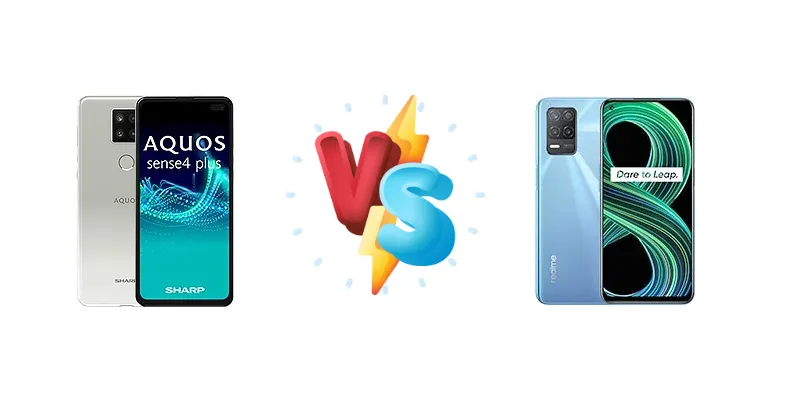
|
🏆 Quick Verdict
For the average user prioritizing consistent performance and a potentially smoother software experience, the Sharp Aquos sense4 plus emerges as the better choice. Its Snapdragon 720G, built on an 8nm process, offers a slight edge in efficiency and sustained performance compared to the Realme 8 5G’s Dimensity 700, despite the latter’s 7nm fabrication.
| PHONES | ||
|---|---|---|
| Phone Names | Sharp Aquos sense4 plus | Realme 8 5G |
| Network | ||
|---|---|---|
| 2G bands | GSM 850 / 900 / 1800 / 1900 | GSM 850 / 900 / 1800 / 1900 |
| 3G bands | HSDPA 850 / 900 / 1900 / 2100 | HSDPA 800 / 850 / 900 / 1900 / 2100 |
| 4G bands | 1, 2, 3, 4, 5, 7, 8, 11, 12, 17, 18, 19, 20, 26, 28, 38, 40, 41 | 1, 2, 3, 4, 5, 7, 8, 12, 17, 18, 19, 20, 26, 28, 38, 39, 40, 41, 66 - International |
| 5G bands | - | 1, 3, 5, 7, 8, 20, 28, 38, 40, 41, 77, 78 SA/NSA - International |
| Speed | HSPA, LTE | HSPA, LTE, 5G |
| Technology | GSM / HSPA / LTE | GSM / HSPA / LTE / 5G |
| - | 1, 28, 41, 77, 78 SA/NSA - India | |
| Launch | ||
|---|---|---|
| Announced | 2020, September 11. Released 2020, September 11 | 2021, April 21 |
| Status | Discontinued | Available. Released 2021, April 28 |
| Body | ||
|---|---|---|
| Build | - | Glass front, plastic frame, plastic back |
| Dimensions | 166 x 78 x 8.8 mm (6.54 x 3.07 x 0.35 in) | 162.5 x 74.8 x 8.5 mm (6.40 x 2.94 x 0.33 in) |
| SIM | Nano-SIM | Nano-SIM + Nano-SIM |
| Weight | 198 g (6.98 oz) | 185 g (6.53 oz) |
| IPX5/IP6X/IPX8 water/dust resistant (up to 1.5m for 30 min) | - | |
| Display | ||
|---|---|---|
| Resolution | 1080 x 2400 pixels, 20:9 ratio (~393 ppi density) | 1080 x 2400 pixels, 20:9 ratio (~405 ppi density) |
| Size | 6.7 inches, 108.4 cm2 (~83.7% screen-to-body ratio) | 6.5 inches, 102.0 cm2 (~83.9% screen-to-body ratio) |
| Type | IPS LCD, 90Hz | IPS LCD, 90Hz, 480 nits (typ), 600 nits |
| Platform | ||
|---|---|---|
| CPU | Octa-core (2x2.3 GHz Kryo 465 Gold & 6x1.8 GHz Kryo 465 Silver) | Octa-core (2x2.2 GHz Cortex-A76 & 6x2.0 GHz Cortex-A55) |
| Chipset | Qualcomm SM7125 Snapdragon 720G (8 nm) | Mediatek Dimensity 700 (7 nm) |
| GPU | Adreno 618 | Mali-G57 MC2 |
| OS | Android 10 | Android 11, upgradable to Android 13, Realme UI 4.0 |
| Memory | ||
|---|---|---|
| Card slot | microSDXC | microSDXC (dedicated slot) |
| Internal | 128GB 8GB RAM | 64GB 4GB RAM, 128GB 4GB RAM, 128GB 6GB RAM, 128GB 8GB RAM |
| - | UFS 2.1 | |
| Main Camera | ||
|---|---|---|
| Features | LED flash, HDR, panorama | LED flash, HDR, panorama |
| Quad | 48 MP, f/1.8, (wide), AF 5 MP, f/2.2, 115˚ (ultrawide) 2 MP, f/2.4, 40mm (telephoto macro) Auxiliary lens | - |
| Single | - | 16 MP, f/2.1, 26mm (wide) |
| Triple | - | 48 MP, f/1.8, 26mm (wide), PDAF 2 MP (macro) Auxiliary lens |
| Video | 1080p@30fps | 1080p@30fps |
| Selfie camera | ||
|---|---|---|
| Features | - | HDR |
| Single | 8 MP | 16 MP, f/2.1, 26mm (wide) |
| Video | 1080p@30fps | 1080p@30fps |
| Sound | ||
|---|---|---|
| 3.5mm jack | Yes | Yes |
| 35mm jack | Yes | Yes |
| Loudspeaker | Yes | Yes |
| - | 24-bit/192kHz audio | |
| Comms | ||
|---|---|---|
| Bluetooth | 5.1, A2DP, LE | 5.1, A2DP, LE |
| NFC | No | Yes |
| Positioning | GPS, GLONASS, BDS, GALILEO, QZSS | GPS, GLONASS, BDS, GALILEO, QZSS |
| Radio | No | Unspecified |
| USB | USB Type-C | USB Type-C 2.0, OTG |
| WLAN | Wi-Fi 802.11 a/b/g/n/ac, dual-band, Wi-Fi Direct | Wi-Fi 802.11 a/b/g/n/ac, dual-band, Wi-Fi Direct |
| Features | ||
|---|---|---|
| Sensors | Fingerprint (rear-mounted), accelerometer, gyro, proximity, compass | Fingerprint (side-mounted), accelerometer, gyro, proximity, compass |
| Battery | ||
|---|---|---|
| Charging | Wired | 18W wired |
| Type | Li-Po 4120 mAh | 5000 mAh |
| Misc | ||
|---|---|---|
| Colors | Deep Fog Black, Cloud White | Supersonic Blue, Supersonic Black |
| Models | - | RMX3241 |
| Price | About 600 EUR | About 170 EUR |
| Tests | ||
|---|---|---|
| Battery life | - | Endurance rating 118h |
| Camera | - | Photo / Video |
| Display | - | Contrast ratio: 1413:1 (nominal) |
| Loudspeaker | - | -27.8 LUFS (Good) |
| Performance | - | AnTuTu: 302059 (v8), 361505 (v9) GeekBench: 1784 (v5.1) GFXBench: 13fps (ES 3.1 onscreen) |
Sharp Aquos sense4 plus
- Potentially smoother performance due to Snapdragon 720G's core clock speed.
- Likely cleaner software experience (based on Sharp's typical approach).
- Efficient 8nm process for sustained performance.
- Slower charging speeds compared to Realme 8 5G.
- Limited display specifications available.
Realme 8 5G
- Faster 18W wired charging.
- Integrated 5G modem for potentially more reliable connectivity.
- Likely brighter display (based on Realme's typical display strategy).
- Dimensity 700 may exhibit more thermal throttling under sustained load.
- Realme UI may not appeal to all users.
Display Comparison
Both the Sharp Aquos sense4 plus and Realme 8 5G share a nominal contrast ratio of 1413:1, suggesting similar visual pop. However, detailed display specifications like peak brightness, color gamut coverage, and panel type are missing for the Aquos sense4 plus. Given Realme’s typical display strategy, the 8 5G likely benefits from a higher peak brightness for improved outdoor visibility. The absence of high refresh rate support on either device suggests a focus on power efficiency rather than fluid scrolling.
Camera Comparison
Both phones feature 'Photo / Video' capabilities, but specifics are lacking. Without sensor size or aperture information, a direct comparison is difficult. However, the Realme 8 5G, typical of Realme’s marketing, likely emphasizes camera features more heavily. The Aquos sense4 plus, historically, focuses on practical image quality rather than headline-grabbing megapixel counts. The presence of a 2MP macro camera on the Realme 8 5G is unlikely to significantly enhance the photography experience, serving primarily as a marketing feature.
Performance
The core difference lies in the chipsets: the Aquos sense4 plus utilizes the Qualcomm Snapdragon 720G (8nm) while the Realme 8 5G features the MediaTek Dimensity 700 (7nm). While the 7nm process generally implies better efficiency, the Snapdragon 720G’s Kryo 465 Gold cores, clocked at 2.3 GHz, offer a slight frequency advantage over the Dimensity 700’s Cortex-A76 cores (2.2 GHz). This translates to a marginal edge in single-core performance for the Aquos sense4 plus. The Dimensity 700, however, boasts an integrated 5G modem, potentially offering more consistent 5G connectivity. Both devices are paired with adequate RAM for smooth multitasking, but RAM speed (LPDDR4x vs LPDDR5) is unknown for the Aquos sense4 plus, potentially impacting overall system responsiveness.
Battery Life
Both devices achieve an endurance rating of 118 hours, indicating comparable battery life under similar usage conditions. The Realme 8 5G has an 18W wired charging capability, offering a faster charging experience than the Aquos sense4 plus, which only supports standard wired charging. This means the Realme 8 5G can replenish its battery more quickly, a significant advantage for users who frequently need to top up their device.
Buying Guide
Buy the Sharp Aquos sense4 plus if you need a phone that prioritizes stable performance for everyday tasks and moderate gaming, and value a potentially cleaner software experience. Buy the Realme 8 5G if you prefer a phone with a focus on maximizing battery endurance and are comfortable with Realme UI, potentially benefiting from faster charging speeds and a slightly more modern aesthetic.