
Sharp Aquos sense4 plus vs Nokia X20: A Deep Dive into Mid-Range Performance
| Phones Images | |||||
|---|---|---|---|---|---|
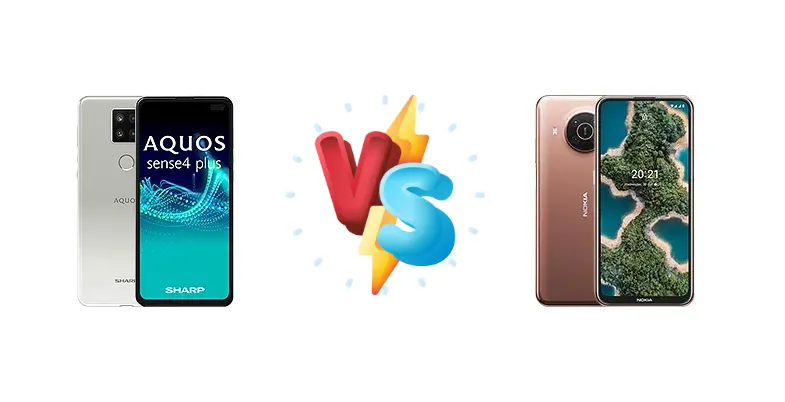
|
🏆 Quick Verdict
For most users, the Sharp Aquos sense4 plus emerges as the stronger choice. Its Snapdragon 720G chipset provides a noticeable performance advantage over the Snapdragon 480 in the Nokia X20, translating to smoother multitasking and gaming. While the Nokia X20 offers 5G, the performance trade-off isn't justified for the average user.
| PHONES | ||
|---|---|---|
| Phone Names | Sharp Aquos sense4 plus | Nokia X20 |
| Network | ||
|---|---|---|
| 2G bands | GSM 850 / 900 / 1800 / 1900 | GSM 850 / 900 / 1800 / 1900 |
| 3G bands | HSDPA 850 / 900 / 1900 / 2100 | HSDPA 850 / 900 / 1700(AWS) / 1900 / 2100 |
| 4G bands | 1, 2, 3, 4, 5, 7, 8, 11, 12, 17, 18, 19, 20, 26, 28, 38, 40, 41 | 1, 2, 3, 4, 5, 7, 8, 12, 20, 28, 66, 38, 39, 40, 41 |
| 5G bands | - | 1, 2, 3, 5, 7, 28, 38, 41, 66, 78 SA/NSA/Sub6 |
| Speed | HSPA, LTE | HSPA, LTE, 5G |
| Technology | GSM / HSPA / LTE | GSM / HSPA / LTE / 5G |
| Launch | ||
|---|---|---|
| Announced | 2020, September 11. Released 2020, September 11 | 2021, April 08 |
| Status | Discontinued | Available. Released 2021, May 12 |
| Body | ||
|---|---|---|
| Dimensions | 166 x 78 x 8.8 mm (6.54 x 3.07 x 0.35 in) | 168.9 x 79.7 x 9.1 mm (6.65 x 3.14 x 0.36 in) |
| SIM | Nano-SIM | · Nano-SIM· Nano-SIM + Nano-SIM |
| Weight | 198 g (6.98 oz) | 220 g (7.76 oz) |
| IPX5/IP6X/IPX8 water/dust resistant (up to 1.5m for 30 min) | - | |
| Display | ||
|---|---|---|
| Protection | - | Corning Gorilla Glass 5 |
| Resolution | 1080 x 2400 pixels, 20:9 ratio (~393 ppi density) | 1080 x 2400 pixels, 20:9 ratio (~395 ppi density) |
| Size | 6.7 inches, 108.4 cm2 (~83.7% screen-to-body ratio) | 6.67 inches, 107.4 cm2 (~79.8% screen-to-body ratio) |
| Type | IPS LCD, 90Hz | IPS LCD, 450 nits (typ) |
| Platform | ||
|---|---|---|
| CPU | Octa-core (2x2.3 GHz Kryo 465 Gold & 6x1.8 GHz Kryo 465 Silver) | Octa-core (2x2.0 GHz Kryo 460 & 6x1.8 GHz Kryo 460) |
| Chipset | Qualcomm SM7125 Snapdragon 720G (8 nm) | Qualcomm SM4350 Snapdragon 480 5G (8 nm) |
| GPU | Adreno 618 | Adreno 619 |
| OS | Android 10 | Android 11, upgradable to Android 14 |
| Memory | ||
|---|---|---|
| Card slot | microSDXC | microSDXC (uses shared SIM slot) |
| Internal | 128GB 8GB RAM | 128GB 6GB RAM, 128GB 8GB RAM |
| Main Camera | ||
|---|---|---|
| Features | LED flash, HDR, panorama | Zeiss optics, LED flash, HDR, panorama |
| Quad | 48 MP, f/1.8, (wide), AF 5 MP, f/2.2, 115˚ (ultrawide) 2 MP, f/2.4, 40mm (telephoto macro) Auxiliary lens | 64 MP, (wide), PDAF 5 MP, (ultrawide) 2 MP (macro) Auxiliary lens |
| Single | - | 32 MP, (wide) |
| Video | 1080p@30fps | 1080p@30/60fps |
| Selfie camera | ||
|---|---|---|
| Single | 8 MP | 32 MP, (wide) |
| Video | 1080p@30fps | 1080p@30fps |
| Sound | ||
|---|---|---|
| 3.5mm jack | Yes | Yes |
| 35mm jack | Yes | Yes |
| Loudspeaker | Yes | Yes |
| Comms | ||
|---|---|---|
| Bluetooth | 5.1, A2DP, LE | 5.0, A2DP, LE, aptX HD |
| NFC | No | Yes |
| Positioning | GPS, GLONASS, BDS, GALILEO, QZSS | GPS, GLONASS, GALILEO |
| Radio | No | FM radio |
| USB | USB Type-C | USB Type-C 2.0, OTG |
| WLAN | Wi-Fi 802.11 a/b/g/n/ac, dual-band, Wi-Fi Direct | Wi-Fi 802.11 a/b/g/n/ac, dual-band, Wi-Fi Direct |
| Features | ||
|---|---|---|
| Sensors | Fingerprint (rear-mounted), accelerometer, gyro, proximity, compass | Fingerprint (side-mounted), accelerometer, gyro, proximity |
| Battery | ||
|---|---|---|
| Charging | Wired | 18W wired |
| Type | Li-Po 4120 mAh | Li-Po 4470 mAh |
| Misc | ||
|---|---|---|
| Colors | Deep Fog Black, Cloud White | Midnight Sun, Nordic Blue |
| Models | - | TA-1341, TA-1344 |
| Price | About 600 EUR | About 130 EUR |
| SAR | - | 1.04 W/kg (head) 0.62 W/kg (body) |
| SAR EU | - | 0.51 W/kg (head) 1.29 W/kg (body) |
Sharp Aquos sense4 plus
- Superior CPU and GPU performance with Snapdragon 720G
- More efficient chipset for better battery life
- Potentially better camera image processing
- Lacks 5G connectivity
- Charging speed is unspecified and likely slower than Nokia X20
Nokia X20
- 5G connectivity for faster data speeds
- 18W fast charging
- Nokia's commitment to software updates
- Lower CPU and GPU performance with Snapdragon 480
- Less efficient chipset
- Potentially lower camera image quality
Display Comparison
Neither device boasts a standout display. While specific display specs (resolution, panel type) are missing for the Aquos sense4 plus, the focus is on functionality. The Nokia X20's display is adequate, but the real difference lies under the hood. The absence of high refresh rates on both devices suggests a focus on battery life over visual fluidity. The Snapdragon 720G in the Aquos sense4 plus has a more powerful ISP, potentially leading to better image processing from the front camera, which is important for video calls.
Camera Comparison
Without detailed camera specifications, a direct comparison is challenging. However, the Snapdragon 720G's image signal processor (ISP) is more capable than the one found in the Snapdragon 480. This suggests the Aquos sense4 plus will likely deliver better image quality, particularly in challenging lighting conditions. The Nokia X20 may benefit from software optimizations, but the hardware advantage leans towards the Sharp. The absence of information regarding sensor sizes and optical image stabilization (OIS) makes a definitive judgment impossible, but the 720G's processing power is a significant factor.
Performance
The core difference lies in the chipsets. The Sharp Aquos sense4 plus utilizes the Qualcomm SM7125 Snapdragon 720G (8nm), featuring an octa-core CPU with 2x2.3 GHz Kryo 465 Gold and 6x1.8 GHz Kryo 465 Silver cores. The Nokia X20, conversely, employs the Qualcomm SM4350 Snapdragon 480 5G (8nm) with an octa-core CPU clocked at 2x2.0 GHz Kryo 460 and 6x1.8 GHz Kryo 460 cores. The Snapdragon 720G's higher clock speeds on its performance cores, combined with a more mature architecture, result in superior CPU and GPU performance. This translates to faster app loading times, smoother multitasking, and a more enjoyable gaming experience. While both are 8nm chips, the 720G is generally more efficient at handling demanding tasks. The Nokia X20's 5G capability is its primary advantage, but the Snapdragon 480 is a lower-tier 5G chipset.
Battery Life
The Nokia X20 features 18W wired charging, while the Sharp Aquos sense4 plus only offers standard wired charging (wattage unspecified). This gives the Nokia X20 a slight edge in charging speed. However, the Snapdragon 720G's efficiency in the Aquos sense4 plus could offset the charging advantage, potentially resulting in comparable real-world battery life. The actual battery capacity of both devices is crucial, but without that data, we can only speculate. The 18W charging on the Nokia X20 will likely deliver a 0-100% charge in around 2-3 hours, while the Aquos sense4 plus may take longer.
Buying Guide
Buy the Sharp Aquos sense4 plus if you prioritize consistent performance for everyday tasks and occasional gaming, and don't require 5G connectivity. It's ideal for users who value a responsive experience and efficient power management. Buy the Nokia X20 if 5G is a non-negotiable requirement and you're willing to accept a slight performance compromise. It caters to users who anticipate utilizing 5G networks frequently and appreciate Nokia's commitment to software updates.