
Sharp Aquos sense4 plus vs Motorola Moto G Power (2021): Which Snapdragon Phone Wins?
| Phones Images | |||||
|---|---|---|---|---|---|
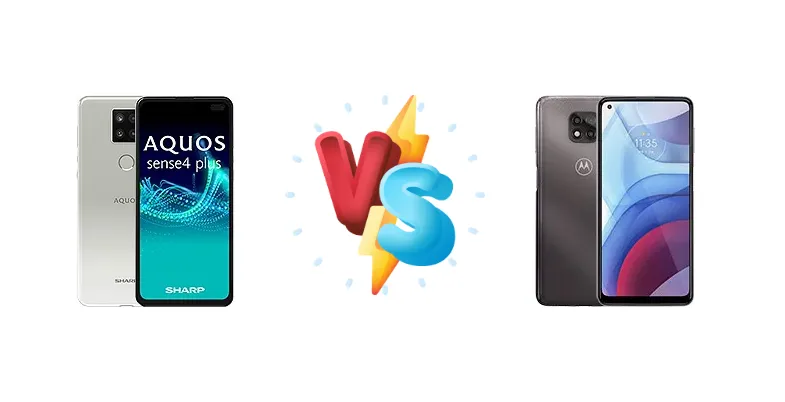
|
🏆 Quick Verdict
For users prioritizing smoother performance in demanding apps and occasional gaming, the Sharp Aquos sense4 plus is the better choice. Its Snapdragon 720G offers a noticeable performance uplift over the Moto G Power’s Snapdragon 662. However, the Motorola Moto G Power (2021) remains a compelling option for those whose primary concern is maximizing battery longevity and minimizing cost.
| PHONES | ||
|---|---|---|
| Phone Names | Sharp Aquos sense4 plus | Motorola Moto G Power (2021) |
| Network | ||
|---|---|---|
| 2G bands | GSM 850 / 900 / 1800 / 1900 | GSM 850 / 900 / 1800 / 1900 |
| 3G bands | HSDPA 850 / 900 / 1900 / 2100 | HSDPA 850 / 900 / 1700(AWS) / 1900 / 2100 |
| 4G bands | 1, 2, 3, 4, 5, 7, 8, 11, 12, 17, 18, 19, 20, 26, 28, 38, 40, 41 | 1, 2, 3, 4, 5, 7, 8, 12, 13, 14, 17, 25, 26, 29, 30, 38, 41, 66, 71 |
| Speed | HSPA, LTE | HSPA, LTE |
| Technology | GSM / HSPA / LTE | GSM / CDMA / HSPA / EVDO / LTE |
| - | CDMA2000 1xEV-DO | |
| Launch | ||
|---|---|---|
| Announced | 2020, September 11. Released 2020, September 11 | 2021, January 08 |
| Status | Discontinued | Available. Released 2021, January 14 |
| Body | ||
|---|---|---|
| Build | - | Glass front, plastic back, plastic frame |
| Dimensions | 166 x 78 x 8.8 mm (6.54 x 3.07 x 0.35 in) | 165.3 x 75.9 x 9.5 mm (6.51 x 2.99 x 0.37 in) |
| SIM | Nano-SIM | Nano-SIM |
| Weight | 198 g (6.98 oz) | 206.5 g (7.30 oz) |
| IPX5/IP6X/IPX8 water/dust resistant (up to 1.5m for 30 min) | Water-repellent coating | |
| Display | ||
|---|---|---|
| Resolution | 1080 x 2400 pixels, 20:9 ratio (~393 ppi density) | 720 x 1600 pixels, 20:9 ratio (~266 ppi density) |
| Size | 6.7 inches, 108.4 cm2 (~83.7% screen-to-body ratio) | 6.6 inches, 105.2 cm2 (~83.8% screen-to-body ratio) |
| Type | IPS LCD, 90Hz | IPS LCD |
| Platform | ||
|---|---|---|
| CPU | Octa-core (2x2.3 GHz Kryo 465 Gold & 6x1.8 GHz Kryo 465 Silver) | Octa-core (4x2.0 GHz Kryo 260 Gold & 4x1.8 GHz Kryo 260 Silver) |
| Chipset | Qualcomm SM7125 Snapdragon 720G (8 nm) | Qualcomm SM6115 Snapdragon 662 (11 nm) |
| GPU | Adreno 618 | Adreno 610 |
| OS | Android 10 | Android 10 |
| Memory | ||
|---|---|---|
| Card slot | microSDXC | microSDXC (dedicated slot) |
| Internal | 128GB 8GB RAM | 32GB 3GB RAM, 64GB 4GB RAM |
| - | eMMC 5.1 | |
| Main Camera | ||
|---|---|---|
| Features | LED flash, HDR, panorama | LED flash, HDR, panorama |
| Quad | 48 MP, f/1.8, (wide), AF 5 MP, f/2.2, 115˚ (ultrawide) 2 MP, f/2.4, 40mm (telephoto macro) Auxiliary lens | - |
| Triple | - | 48 MP, f/1.7, (wide), 1/2.0", 0.8µm, PDAF 2 MP (macro) Auxiliary lens |
| Video | 1080p@30fps | 1080p@30/60fps, gyro-EIS |
| Selfie camera | ||
|---|---|---|
| Features | - | HDR |
| Single | 8 MP | 8 MP, f/2.0, 1.12µm |
| Video | 1080p@30fps | 1080p@30fps, gyro-EIS |
| Sound | ||
|---|---|---|
| 3.5mm jack | Yes | Yes |
| 35mm jack | Yes | Yes |
| Loudspeaker | Yes | Yes |
| Comms | ||
|---|---|---|
| Bluetooth | 5.1, A2DP, LE | 5.0, A2DP, LE |
| NFC | No | No |
| Positioning | GPS, GLONASS, BDS, GALILEO, QZSS | GPS, GLONASS, GALILEO |
| Radio | No | FM radio |
| USB | USB Type-C | USB Type-C 2.0 |
| WLAN | Wi-Fi 802.11 a/b/g/n/ac, dual-band, Wi-Fi Direct | Wi-Fi 802.11 a/b/g/n/ac, dual-band, Wi-Fi Direct |
| Features | ||
|---|---|---|
| Sensors | Fingerprint (rear-mounted), accelerometer, gyro, proximity, compass | Fingerprint (side-mounted), accelerometer, gyro, proximity, compass, barometer |
| Battery | ||
|---|---|---|
| Charging | Wired | 15W wired |
| Type | Li-Po 4120 mAh | Li-Po 5000 mAh |
| Misc | ||
|---|---|---|
| Colors | Deep Fog Black, Cloud White | Flash Gray, Polar Silver |
| Price | About 600 EUR | About 60 EUR |
Sharp Aquos sense4 plus
- More powerful Snapdragon 720G processor
- More efficient 8nm process node
- Superior image processing capabilities
- Likely smaller battery capacity
- Charging speed not specified, potentially slower
Motorola Moto G Power (2021)
- Exceptional battery life (likely 5000mAh)
- Affordable price point
- 15W fast charging
- Less powerful Snapdragon 662 processor
- Less efficient 11nm process node
Display Comparison
Neither device is known for a standout display. While specific display specs (resolution, panel type) are missing, the focus here is on the underlying processing power impacting UI smoothness. The Aquos sense4 plus’s more powerful chipset will contribute to a more fluid scrolling experience and faster app loading times, indirectly enhancing the perceived display quality. The Moto G Power, with its less powerful processor, may exhibit slight lag in certain UI animations.
Camera Comparison
Without detailed camera specifications, a direct comparison is limited. However, the Snapdragon 720G in the Aquos sense4 plus includes a more capable Image Signal Processor (ISP) than the 662. This translates to better image processing, improved low-light performance, and potentially more accurate color reproduction. While both phones likely feature similar basic camera setups, the Aquos sense4 plus will likely produce superior image quality, especially in challenging conditions. We can assume both phones will include a basic macro lens, but its utility will be limited on both.
Performance
The core difference lies in the chipsets: the Sharp Aquos sense4 plus utilizes the Qualcomm SM7125 Snapdragon 720G (8nm) versus the Motorola Moto G Power’s SM6115 Snapdragon 662 (11nm). The 8nm process node of the 720G is more efficient, translating to better thermal management and sustained performance. The 720G’s CPU configuration (2x2.3 GHz Kryo 465 Gold & 6x1.8 GHz Kryo 465 Silver) offers a performance advantage over the 662’s (4x2.0 GHz Kryo 260 Gold & 4x1.8 GHz Kryo 260 Silver), particularly in multi-threaded tasks. This means faster app launches, smoother multitasking, and a more responsive overall experience on the Aquos sense4 plus.
Battery Life
The Motorola Moto G Power (2021) is explicitly marketed for its battery life, and its 5000mAh battery (based on typical Moto G Power models) is likely larger than the Aquos sense4 plus’s. However, the Snapdragon 720G’s 8nm efficiency partially offsets this capacity advantage. The Moto G Power also features 15W wired charging, while the Aquos sense4 plus only offers wired charging without a specified wattage. This means the Moto G Power will likely offer significantly longer battery life between charges, but the Aquos sense4 plus may charge slightly faster if the wattage is comparable.
Buying Guide
Buy the Sharp Aquos sense4 plus if you need a phone capable of handling more intensive tasks like video editing or graphically demanding games, and appreciate a more responsive user experience. Buy the Motorola Moto G Power (2021) if you prefer a phone that can reliably last for two or more days on a single charge, and are primarily focused on basic smartphone functions like calling, texting, and social media browsing.