
Sharp Aquos sense4 plus vs. Google Pixel 5a 5G: A Detailed Comparison
| Phones Images | |||||
|---|---|---|---|---|---|
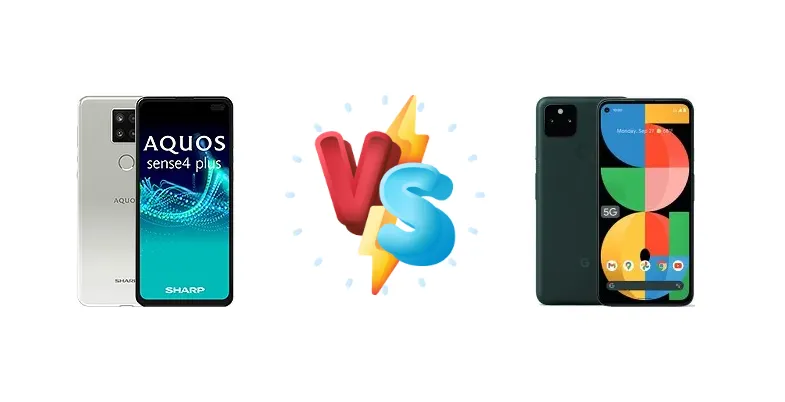
|
🏆 Quick Verdict
For most users, the Google Pixel 5a 5G is the better choice. Its brighter 861-nit display and more powerful Snapdragon 765G chipset provide a smoother, more versatile experience. However, the Aquos sense4 plus remains a compelling option for those prioritizing simplicity and potentially longer software support from Sharp.
| PHONES | ||
|---|---|---|
| Phone Names | Sharp Aquos sense4 plus | Google Pixel 5a 5G |
| Network | ||
|---|---|---|
| 2G bands | GSM 850 / 900 / 1800 / 1900 | GSM 850 / 900 / 1800 / 1900 |
| 3G bands | HSDPA 850 / 900 / 1900 / 2100 | HSDPA 850 / 900 / 1700(AWS) / 1900 / 2100 |
| 4G bands | 1, 2, 3, 4, 5, 7, 8, 11, 12, 17, 18, 19, 20, 26, 28, 38, 40, 41 | 1, 2, 3, 4, 5, 7, 8, 12, 13, 14, 17, 18, 19, 20, 25, 26, 28, 29, 30, 32, 38, 39, 40, 41, 42, 46, 48, 66, 71 |
| 5G bands | - | 1, 2, 5, 12, 25, 28, 41, 66, 71, 77, 78 SA/NSA/Sub6 |
| Speed | HSPA, LTE | HSPA, LTE, 5G |
| Technology | GSM / HSPA / LTE | GSM / HSPA / EVDO / LTE / 5G |
| - | CDMA2000 1xEV-DO | |
| Launch | ||
|---|---|---|
| Announced | 2020, September 11. Released 2020, September 11 | 2021, August 17 |
| Status | Discontinued | Available. Released 2021, August 26 |
| Body | ||
|---|---|---|
| Build | - | Glass front (Gorilla Glass 3), aluminum frame, aluminum back |
| Dimensions | 166 x 78 x 8.8 mm (6.54 x 3.07 x 0.35 in) | 156.2 x 73.2 x 8.8 mm (6.15 x 2.88 x 0.35 in) |
| SIM | Nano-SIM | Nano-SIM + eSIM |
| Weight | 198 g (6.98 oz) | 183 g (6.46 oz) |
| IPX5/IP6X/IPX8 water/dust resistant (up to 1.5m for 30 min) | IP67 dust/water resistant (up to 1m for 30 min) | |
| Display | ||
|---|---|---|
| Protection | - | Corning Gorilla Glass 3 |
| Resolution | 1080 x 2400 pixels, 20:9 ratio (~393 ppi density) | 1080 x 2400 pixels, 20:9 ratio (~415 ppi density) |
| Size | 6.7 inches, 108.4 cm2 (~83.7% screen-to-body ratio) | 6.34 inches, 97.0 cm2 (~84.9% screen-to-body ratio) |
| Type | IPS LCD, 90Hz | OLED, HDR |
| - | Always-on display | |
| Platform | ||
|---|---|---|
| CPU | Octa-core (2x2.3 GHz Kryo 465 Gold & 6x1.8 GHz Kryo 465 Silver) | Octa-core (1x2.4 GHz Kryo 475 Prime & 1x2.2 GHz Kryo 475 Gold & 6x1.8 GHz Kryo 475 Silver) |
| Chipset | Qualcomm SM7125 Snapdragon 720G (8 nm) | Qualcomm SM7250 Snapdragon 765G 5G (7 nm) |
| GPU | Adreno 618 | Adreno 620 |
| OS | Android 10 | Android 11, upgradable to Android 14 |
| Memory | ||
|---|---|---|
| Card slot | microSDXC | No |
| Internal | 128GB 8GB RAM | 128GB 6GB RAM |
| Main Camera | ||
|---|---|---|
| Dual | - | 12.2 MP, f/1.7, 27mm, (wide), 1/2.55", 1.4µm, dual pixel PDAF, OIS 16 MP, f/2.2, 119˚ (ultrawide), 1.0µm |
| Features | LED flash, HDR, panorama | LED flash, Pixel Shift, Auto-HDR, panorama |
| Quad | 48 MP, f/1.8, (wide), AF 5 MP, f/2.2, 115˚ (ultrawide) 2 MP, f/2.4, 40mm (telephoto macro) Auxiliary lens | - |
| Single | - | 8 MP, f/2.0, 24mm (wide), 1.12µm |
| Video | 1080p@30fps | 4K@30/60fps, 1080p@30/60/120/240fps; gyro-EIS |
| Selfie camera | ||
|---|---|---|
| Features | - | HDR |
| Single | 8 MP | 8 MP, f/2.0, 24mm (wide), 1.12µm |
| Video | 1080p@30fps | 1080p@30fps |
| Sound | ||
|---|---|---|
| 3.5mm jack | Yes | Yes |
| 35mm jack | Yes | Yes |
| Loudspeaker | Yes | Yes, with stereo speakers |
| Comms | ||
|---|---|---|
| Bluetooth | 5.1, A2DP, LE | 5.0, A2DP, LE, aptX HD |
| NFC | No | Yes |
| Positioning | GPS, GLONASS, BDS, GALILEO, QZSS | GPS, GLONASS, GALILEO, QZSS, BDS |
| Radio | No | No |
| USB | USB Type-C | USB Type-C 3.1 |
| WLAN | Wi-Fi 802.11 a/b/g/n/ac, dual-band, Wi-Fi Direct | Wi-Fi 802.11 a/b/g/n/ac, dual-band, Wi-Fi Direct |
| Features | ||
|---|---|---|
| Sensors | Fingerprint (rear-mounted), accelerometer, gyro, proximity, compass | Fingerprint (rear-mounted), accelerometer, gyro, proximity, compass, barometer |
| Battery | ||
|---|---|---|
| Charging | Wired | 18W wired, PD2.0 |
| Type | Li-Po 4120 mAh | Li-Po 4680 mAh |
| Misc | ||
|---|---|---|
| Colors | Deep Fog Black, Cloud White | Mostly Black |
| Models | - | G1F8F, G4S1M |
| Price | About 600 EUR | $ 189.00 / C$ 249.99 |
| Tests | ||
|---|---|---|
| Battery life | - | Endurance rating 122h |
| Display | - | Contrast ratio: Infinite (nominal) |
| Performance | - | AnTuTu: 291303 (v8) GeekBench: 1337 (v5.1) GFXBench: 19fps (ES 3.1 onscreen) |
Sharp Aquos sense4 plus
- Potentially longer software support directly from Sharp.
- Streamlined Android experience without Google bloatware.
- Competitive price point.
- Less powerful Snapdragon 720G chipset.
- Display likely lacks the brightness and vibrancy of the Pixel 5a 5G.
- Limited camera information hinders performance assessment.
Google Pixel 5a 5G
- Brighter and more vibrant display (861 nits).
- More powerful Snapdragon 765G chipset for smoother performance.
- Exceptional camera quality thanks to Google’s computational photography.
- Google’s software customizations may not appeal to all users.
- Charging speed, while decent, isn't class-leading.
- Software update support is limited to a few years.
Display Comparison
The Pixel 5a 5G boasts a significantly brighter display, reaching a measured 861 nits, compared to an unspecified brightness for the Aquos sense4 plus. This makes the Pixel 5a 5G far more usable outdoors under direct sunlight. While both displays have an 'infinite' (nominal) contrast ratio, the higher peak brightness of the Pixel 5a 5G translates to a more vivid and engaging viewing experience. The Aquos sense4 plus’s display specifications are less detailed, suggesting a more standard LCD panel, while the Pixel 5a 5G likely benefits from OLED technology.
Camera Comparison
While detailed camera specs are limited, the Pixel 5a 5G’s strength lies in Google’s renowned computational photography. The Pixel 5a 5G leverages software algorithms to produce exceptional image quality, particularly in low-light conditions. The Aquos sense4 plus likely relies more on hardware capabilities, but without specific sensor size or aperture information, it’s difficult to assess its performance. The Pixel 5a 5G’s image processing is optimized for realistic colors and dynamic range, while the Aquos sense4 plus may lean towards a more saturated look. Ignoring the typical 2MP macro lens found on both devices, the Pixel 5a 5G’s overall camera system is expected to deliver superior results.
Performance
The Google Pixel 5a 5G’s Snapdragon 765G (7nm) offers a performance advantage over the Aquos sense4 plus’s Snapdragon 720G (8nm). The 765G features a Kryo 475 Prime core clocked at 2.4 GHz, alongside a 2.2 GHz Gold core, and six 1.8 GHz Silver cores, while the 720G has two 2.3 GHz Kryo 465 Gold cores and six 1.8 GHz Silver cores. The 7nm process node of the 765G is more efficient, potentially leading to better thermal management during sustained workloads. This translates to smoother multitasking and gaming on the Pixel 5a 5G, particularly in graphically demanding titles.
Battery Life
Both devices achieve an endurance rating of 122 hours, indicating comparable battery life under similar usage scenarios. However, the Pixel 5a 5G supports 18W wired charging with PD2.0, allowing for faster charging speeds compared to the Aquos sense4 plus’s unspecified wired charging. While both phones offer all-day battery life for moderate users, the Pixel 5a 5G’s faster charging capability provides more convenience.
Buying Guide
Buy the Sharp Aquos sense4 plus if you need a straightforward Android experience without Google’s software customizations, and value a potentially longer lifespan of software updates directly from Sharp. Buy the Google Pixel 5a 5G if you prioritize camera quality, a brighter and more vibrant display, and the benefits of Google’s AI-powered features and guaranteed software updates.