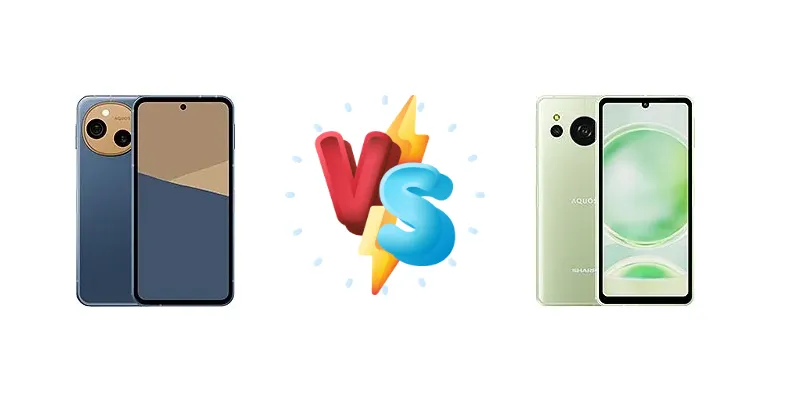
Sharp's Aquos sense line consistently delivers solid mid-range options, but the sense10 and sense8 represent distinct approaches. The sense10 leverages the newer Snapdragon 7s Gen 3, while the sense8 opts for the Snapdragon 6 Gen 1. This comparison dissects the implications of these chipset choices, alongside differences in charging and overall user experience, to help you determine which device best suits your needs.
🏆 Quick Verdict
For most users, the Sharp Aquos sense10 emerges as the stronger choice. Its Snapdragon 7s Gen 3 chipset offers a noticeable performance uplift over the sense8’s Snapdragon 6 Gen 1, translating to smoother multitasking and a more responsive experience. While the sense8’s battery may last slightly longer due to the less power-hungry chip, the sense10’s faster 36W charging mitigates this difference.
| Network |
|---|
| 2G bands | GSM 850 / 900 / 1800 / 1900 | GSM 850 / 900 / 1800 / 1900 |
| 3G bands | HSDPA 850 / 900 / 1900 / 2100 | HSDPA 900 / 2100 |
| 4G bands | LTE | LTE |
| 5G bands | SA/NSA/Sub6 | SA/NSA |
| Speed | HSPA, LTE, 5G | HSPA, LTE, 5G |
| Technology | GSM / HSPA / LTE / 5G | GSM / HSPA / LTE / 5G |
| Launch |
|---|
| Announced | 2025, October 31 | 2024, January 17 |
| Status | Available. Released 2025, November | Available. Released 2024, January |
| Body |
|---|
| Build | Glass front, aluminum frame, aluminum back | Glass front, aluminum frame, aluminum back |
| Dimensions | 149 x 73 x 8.9 mm (5.87 x 2.87 x 0.35 in) | 153 x 71 x 8.4 mm (6.02 x 2.80 x 0.33 in) |
| SIM | Nano-SIM + eSIM | Nano-SIM + eSIM |
| Weight | 166 g (5.86 oz) | 159 g (5.61 oz) |
| Display |
|---|
| Resolution | 1080 x 2340 pixels, 19.5:9 ratio (~422 ppi density) | 1080 x 2340 pixels, 19.5:9 ratio (~422 ppi density) |
| Size | 6.1 inches, 91.3 cm2 (~84.0% screen-to-body ratio) | 6.1 inches, 91.3 cm2 (~84.1% screen-to-body ratio) |
| Type | LTPO IGZO OLED, 1B colors, 240Hz, 1500 nits (HBM), 2000 nits (peak) | IGZO OLED, 1B colors, 90Hz, 1300 nits (peak) |
| Platform |
|---|
| CPU | Octa-core (1x2.5 GHz Cortex-A720 & 3x2.4 GHz Cortex-A720 & 4x1.8 GHz Cortex-A520) | Octa-core (4x2.2 GHz Cortex-A78 & 4x1.8 GHz Cortex-A55) |
| Chipset | Qualcomm SM7635 Snapdragon 7s Gen 3 (4 nm) | Qualcomm SM6450 Snapdragon 6 Gen 1 (4 nm) |
| GPU | Adreno 810 | Adreno 710 |
| OS | Android 16, up to 3 major Android upgrades | Android 13, upgradable to Android 15 |
| Memory |
|---|
| Card slot | microSDXC | microSDXC |
| Internal | 128GB 6GB RAM, 256GB 8GB RAM | 256GB 8GB RAM |
| Main Camera |
|---|
| Dual | 50 MP, f/1.9, 23mm (wide), 1/1.55", dual pixel PDAF, OIS
50 MP, f/2.2, 13mm, 122˚ (ultrawide), 1/2.5", PDAF | 50 MP, f/1.9, 23mm (wide), 1/1.55", dual pixel PDAF, OIS
8 MP, f/2.4, 15mm, 120˚ (ultrawide) |
| Features | LED flash, HDR, panorama | LED flash, HDR, panorama |
| Video | Yes, gyro-EIS | Yes |
| Selfie camera |
|---|
| Single | 32 MP, f/2.2, 25mm (wide) | 8 MP, f/2.0, 26mm (wide) |
| Video | Yes, gyro-EIS | 1080p@30fps |
| Sound |
|---|
| 35mm jack | No | Yes |
| Loudspeaker | Yes, with stereo speakers | Yes |
| Comms |
|---|
| Bluetooth | 5.2, A2DP, LE, aptX Adaptive | 5.1, A2DP, LE, aptX HD, aptX Adaptive |
| NFC | Yes | Yes |
| Positioning | GPS, GALILEO, GLONASS, BDS, QZSS | GPS |
| Radio | No | No |
| USB | USB Type-C 3.2, DisplayPort 1.4 | USB Type-C 3.2 |
| WLAN | Wi-Fi 802.11 a/b/g/n/ac/6e, dual-band | Wi-Fi 802.11 a/b/g/n/ac/6, dual-band |
| Features |
|---|
| Sensors | Fingerprint (side-mounted), accelerometer, gyro, proximity, compass | Fingerprint (side-mounted), accelerometer, gyro, proximity, compass |
| Battery |
|---|
| Charging | 36W wired | 18W wired |
| Type | 5000 mAh | 5000 mAh |
| Misc |
|---|
| Colors | Denim Navy, Khaki Green, Pale Pink, Pale Mint, Full Black, Light Silver | Black, Green, Copper |
| Models | - | SH-M26ID, SH-M26 |
| Price | About 350 EUR | About 310 EUR |
Sharp Aquos sense10
- Faster processor for smoother performance
- Faster 36W charging for quicker top-ups
- More capable ISP for improved camera processing
- Potentially slightly lower battery life
- May be more expensive than the sense8
Sharp Aquos sense8
- Potentially longer battery life
- More affordable price point
- Sufficient performance for basic tasks
- Slower processor for demanding apps
- Slower 18W charging
- Less capable ISP for camera processing
Display Comparison
Unfortunately, display specifications are not provided. However, given the sense series’ positioning, we can expect both devices to utilize IPS LCD panels. The sense10’s more powerful processor *could* support higher refresh rates or more sophisticated image processing for improved visual quality, but this is speculative. Bezels are likely similar, reflecting a focus on practicality over premium aesthetics. Color accuracy will likely be adequate for everyday use on both devices.
Camera Comparison
Without detailed camera specs, a direct comparison is difficult. However, the chipset difference indirectly impacts camera performance. The sense10’s more powerful ISP (Image Signal Processor) within the Snapdragon 7s Gen 3 will enable faster image processing, potentially resulting in better low-light performance and more detailed photos. Both phones likely feature similar sensor sizes and lens apertures, given their market segment. We can assume both will have a primary camera, ultrawide, and potentially a depth sensor, but the sense10’s processing capabilities will likely give it an edge in image quality.
Performance
The core difference lies in the chipsets. The Aquos sense10’s Snapdragon 7s Gen 3 (4nm) boasts a more modern CPU architecture – specifically, Cortex-A720 cores – compared to the sense8’s Snapdragon 6 Gen 1 (4nm) which uses Cortex-A78 cores. While both are 4nm, the A720 offers architectural improvements leading to better single-core performance. The sense10’s CPU configuration (1x2.5 GHz Cortex-A720, 3x2.4 GHz Cortex-A720, 4x1.8 GHz Cortex-A520) is also more aggressive than the sense8’s (4x2.2 GHz Cortex-A78, 4x1.8 GHz Cortex-A55). This translates to faster app launches and smoother multitasking. The sense10 is likely to handle graphically intensive tasks and games with fewer stutters. The sense8 will be sufficient for everyday tasks, but will show its limitations under heavier load.
Battery Life
Battery capacity isn’t specified, but the Snapdragon 6 Gen 1 in the sense8 is generally more power-efficient than the 7s Gen 3. This *could* translate to slightly longer battery life for the sense8 during typical usage. However, the sense10 compensates with significantly faster 36W wired charging compared to the sense8’s 18W charging. This means the sense10 can replenish its battery much quicker, minimizing downtime. A full charge on the sense10 is likely to take under an hour, while the sense8 could take over two hours.
Buying Guide
Buy the Sharp Aquos sense10 if you prioritize performance for demanding apps, occasional gaming, and future-proofing. Its more powerful processor will handle software updates and evolving app requirements with greater ease. Buy the Sharp Aquos sense8 if your primary focus is maximizing battery life for basic tasks like calls, messaging, and light social media use, and you are on a tighter budget.
Frequently Asked Questions
❓ Will the Snapdragon 6 Gen 1 in the sense8 struggle with demanding games like Genshin Impact?
Yes, the Snapdragon 6 Gen 1 is not designed for high-end gaming. While it can run less demanding titles, Genshin Impact and similar games will likely require significant graphical settings reductions and may still experience noticeable lag or frame drops. The sense10’s Snapdragon 7s Gen 3 will provide a much smoother gaming experience.
❓ How much faster is the 36W charging on the sense10 compared to the 18W charging on the sense8 in real-world use?
Expect a significant difference. The sense10 can likely go from 0-50% in around 30 minutes, while the sense8 will likely take over an hour to reach the same level. A full charge on the sense10 should take under 75 minutes, whereas the sense8 could take upwards of 2 hours, depending on battery capacity.
❓ Does the sense10’s processor offer any benefits for video recording?
Absolutely. The Snapdragon 7s Gen 3’s enhanced ISP supports higher-quality video recording, including potentially better stabilization and dynamic range. It may also support higher resolution or frame rate options compared to the sense8.