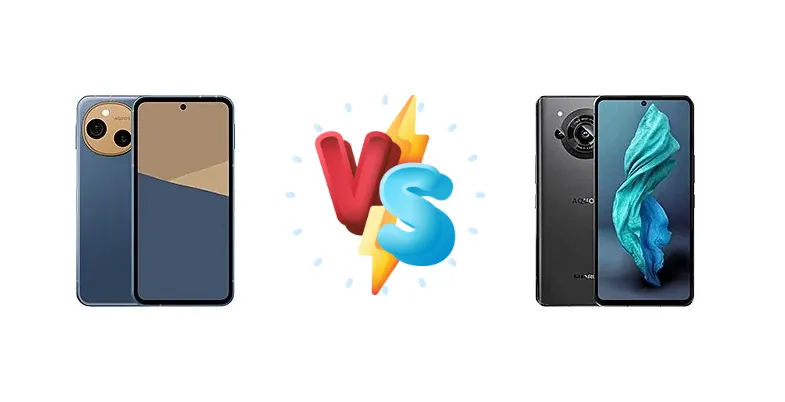
Sharp's Aquos lineup offers a compelling blend of Japanese engineering and competitive pricing. The R7s, equipped with the flagship Snapdragon 8 Gen 1, represents a performance-focused approach, while the sense10 leverages the newer, more efficient Snapdragon 7s Gen 3. This comparison dissects the key differences to help you determine which Aquos best suits your needs.
🏆 Quick Verdict
For users prioritizing raw performance and demanding tasks like gaming, the Sharp Aquos R7s is the clear winner thanks to its Snapdragon 8 Gen 1. However, the Aquos sense10 offers excellent value and efficiency for everyday use, making it the better choice for budget-conscious consumers.
| Network |
|---|
| 2G bands | GSM 850 / 900 / 1800 / 1900 | GSM 850 / 900 / 1800 / 1900 |
| 3G bands | HSDPA 850 / 900 / 1900 / 2100 | HSDPA 850 / 900 / 1700(AWS) / 1900 / 2100 |
| 4G bands | LTE | LTE |
| 5G bands | SA/NSA/Sub6 | SA/NSA |
| Speed | HSPA, LTE, 5G | HSPA, LTE, 5G |
| Technology | GSM / HSPA / LTE / 5G | GSM / HSPA / LTE / 5G |
| Launch |
|---|
| Announced | 2025, October 31 | 2023, July |
| Status | Available. Released 2025, November | Available. Released 2023, July |
| Body |
|---|
| Build | Glass front, aluminum frame, aluminum back | Glass front (Gorilla Glass Victus), glass back (Gorilla Glass Victus), aluminum frame |
| Dimensions | 149 x 73 x 8.9 mm (5.87 x 2.87 x 0.35 in) | 161 x 77 x 9.3 mm (6.34 x 3.03 x 0.37 in) |
| SIM | Nano-SIM + eSIM | Nano-SIM + Nano-SIM |
| Weight | 166 g (5.86 oz) | 208 g (7.34 oz) |
| Display |
|---|
| Protection | - | Corning Gorilla Glass Victus |
| Resolution | 1080 x 2340 pixels, 19.5:9 ratio (~422 ppi density) | 1260 x 2730 pixels, 19.5:9 ratio (~456 ppi density) |
| Size | 6.1 inches, 91.3 cm2 (~84.0% screen-to-body ratio) | 6.6 inches, 106.9 cm2 (~86.3% screen-to-body ratio) |
| Type | LTPO IGZO OLED, 1B colors, 240Hz, 1500 nits (HBM), 2000 nits (peak) | PRO IGZO OLED, 1B colors, 120Hz, Dolby Vision |
| Platform |
|---|
| CPU | Octa-core (1x2.5 GHz Cortex-A720 & 3x2.4 GHz Cortex-A720 & 4x1.8 GHz Cortex-A520) | Octa-core (1x3.00 GHz Cortex-X2 & 3x2.50 GHz Cortex-A710 & 4x1.80 GHz Cortex-A510) |
| Chipset | Qualcomm SM7635 Snapdragon 7s Gen 3 (4 nm) | Qualcomm SM8450 Snapdragon 8 Gen 1 (4 nm) |
| GPU | Adreno 810 | Adreno 730 |
| OS | Android 16, up to 3 major Android upgrades | Android 13 |
| Memory |
|---|
| Card slot | microSDXC | microSDXC |
| Internal | 128GB 6GB RAM, 256GB 8GB RAM | 256GB 12GB RAM |
| Main Camera |
|---|
| Dual | 50 MP, f/1.9, 23mm (wide), 1/1.55", dual pixel PDAF, OIS
50 MP, f/2.2, 13mm, 122˚ (ultrawide), 1/2.5", PDAF | 47.2 MP, f/1.9, 19mm (ultrawide), 1.0"-type, dual pixel PDAF
Auxiliary lens |
| Features | LED flash, HDR, panorama | LED flash, HDR, panorama |
| Video | Yes, gyro-EIS | 8K, 4K, 1080p; gyro-EIS |
| Selfie camera |
|---|
| Single | 32 MP, f/2.2, 25mm (wide) | 12.6 MP, (wide) |
| Video | Yes, gyro-EIS | 1080p@30fps |
| Sound |
|---|
| 35mm jack | No | Yes |
| Loudspeaker | Yes, with stereo speakers | Yes, with stereo speakers |
| Comms |
|---|
| Bluetooth | 5.2, A2DP, LE, aptX Adaptive | 5.2, A2DP, LE |
| NFC | Yes | Yes |
| Positioning | GPS, GALILEO, GLONASS, BDS, QZSS | GPS (L1+L5), GLONASS, GALILEO, BDS |
| Radio | No | No |
| USB | USB Type-C 3.2, DisplayPort 1.4 | USB Type-C 3.0 |
| WLAN | Wi-Fi 802.11 a/b/g/n/ac/6e, dual-band | Wi-Fi 802.11 a/b/g/n/ac/6, dual-band |
| Features |
|---|
| Sensors | Fingerprint (side-mounted), accelerometer, gyro, proximity, compass | Fingerprint (under display, ultrasonic), accelerometer, gyro, proximity, compass |
| Battery |
|---|
| Charging | 36W wired | 27W wired, PD3 |
| Type | 5000 mAh | Li-Ion 5000 mAh |
| Misc |
|---|
| Colors | Denim Navy, Khaki Green, Pale Pink, Pale Mint, Full Black, Light Silver | Black |
| Models | - | SH-R70 |
| Price | About 350 EUR | About 1000 EUR |
Sharp Aquos sense10
- More efficient Snapdragon 7s Gen 3 chipset
- Faster 36W wired charging
- Potentially better battery life due to chipset efficiency
- Significantly lower peak performance compared to the R7s
- Likely less advanced camera system
- May lack flagship features like 8K video recording
Sharp Aquos R7s
- Flagship Snapdragon 8 Gen 1 processor for superior performance
- Likely more advanced camera system with OIS and larger sensor
- Faster processing for demanding applications and gaming
- Lower 27W charging wattage
- Potentially shorter battery life due to power-hungry chipset
- Higher price point
Display Comparison
While display specs aren't provided, the R7s, being the flagship, likely features a higher peak brightness and potentially a more advanced panel technology. The sense10, positioned as a mid-range device, will likely prioritize efficiency over absolute display fidelity. Both devices are expected to utilize OLED panels, common in the Aquos line, but the R7s may benefit from a higher refresh rate or LTPO technology for adaptive refresh rates, improving battery life during static content viewing.
Camera Comparison
Without specific camera specs, it's reasonable to assume the R7s has a more sophisticated camera system. The flagship status typically implies a larger main sensor, optical image stabilization (OIS), and a wider aperture for improved low-light performance. The R7s likely benefits from more advanced image processing algorithms powered by the Snapdragon 8 Gen 1’s ISP. While the sense10 will offer a capable camera experience, it will likely prioritize computational photography to compensate for potentially smaller sensors and less advanced optics. The presence or absence of features like 8K video recording will likely be exclusive to the R7s.
Performance
The core difference lies in the chipsets. The Aquos R7s’ Snapdragon 8 Gen 1 (4nm) boasts a prime Cortex-X2 core clocked at 3.00 GHz, alongside three Cortex-A710 cores at 2.50 GHz, and four Cortex-A510 cores at 1.80 GHz. This configuration delivers significantly higher peak performance compared to the sense10’s Snapdragon 7s Gen 3 (4nm). The sense10’s CPU features a 2.5 GHz Cortex-A720 prime core, three 2.4 GHz Cortex-A720 cores, and four 1.8 GHz Cortex-A520 cores. While both are built on a 4nm process, the 8 Gen 1’s architectural advantages translate to faster processing speeds and superior graphics capabilities. This difference is particularly noticeable in graphically intensive tasks like gaming and video editing. The R7s will likely also benefit from faster RAM speeds (LPDDR5x) compared to the sense10.
Battery Life
The Aquos R7s, despite having a lower charging wattage (27W with PD3) than the sense10 (36W), may achieve comparable or even faster charging times due to the Snapdragon 8 Gen 1’s more efficient power management. The sense10’s higher wattage doesn’t guarantee faster charging if the battery capacity is significantly larger or the charging circuitry is less optimized. Real-world battery life will depend on usage patterns, but the Snapdragon 7s Gen 3 in the sense10 is likely to offer better efficiency, potentially offsetting a smaller battery capacity.
Buying Guide
Buy the Sharp Aquos sense10 if you need a reliable daily driver with good battery life and don't require top-tier gaming performance. It's ideal for users who prioritize efficiency and value. Buy the Sharp Aquos R7s if you prefer a faster, more responsive experience for demanding applications, gaming, and content creation, and are willing to trade some battery life for that performance boost.
Frequently Asked Questions
❓ Will the Snapdragon 7s Gen 3 in the sense10 handle demanding games like Genshin Impact?
While the Snapdragon 7s Gen 3 is a capable chip, Genshin Impact and similar graphically intensive games will likely require reduced graphics settings on the sense10 to maintain a smooth frame rate. The R7s, with its Snapdragon 8 Gen 1, will provide a significantly better gaming experience with higher settings and more consistent performance.
❓ Does the Aquos R7s suffer from significant thermal throttling during extended gaming sessions?
The Snapdragon 8 Gen 1 is known to generate more heat than newer chipsets. While Sharp likely implemented thermal management solutions, prolonged gaming sessions on the R7s may result in some degree of thermal throttling, potentially leading to reduced performance over time. The sense10's 7s Gen 3 is more efficient and less prone to overheating.
❓ Is the 27W charging on the R7s significantly slower than the 36W on the sense10 in real-world use?
Not necessarily. The R7s' Snapdragon 8 Gen 1 has more efficient power management, which can offset the lower wattage. The actual 0-100% charge time will depend on battery capacity, but the difference may be minimal in practice.