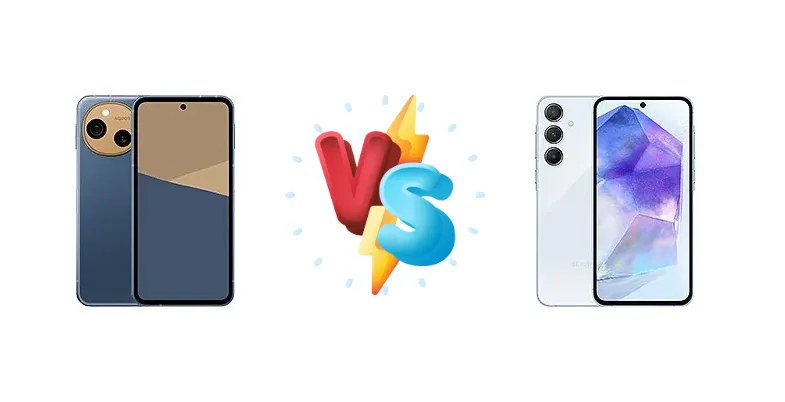
The mid-range smartphone market is fiercely competitive, and the Sharp Aquos sense10 and Samsung Galaxy A55 represent compelling options. The sense10, with its newer Snapdragon 7s Gen 3, aims for efficiency and modern architecture, while the Galaxy A55 leverages Samsung’s established brand and a focus on display quality and battery endurance. This comparison dissects their key differences to determine which device delivers the best value.
🏆 Quick Verdict
For the average user prioritizing all-day battery life and a vibrant display, the Samsung Galaxy A55 is the better choice. Its 13:27h active use score and 1010 nits peak brightness are significant advantages. However, the Aquos sense10’s Snapdragon 7s Gen 3 offers a more modern CPU architecture and potentially better long-term performance.
| Network |
|---|
| 2G bands | GSM 850 / 900 / 1800 / 1900 | GSM 850 / 900 / 1800 / 1900 |
| 3G bands | HSDPA 850 / 900 / 1900 / 2100 | HSDPA 850 / 900 / 1700(AWS) / 1900 / 2100 |
| 4G bands | LTE | 1, 2, 3, 4, 5, 7, 8, 12, 17, 20, 25, 26, 28, 32, 38, 40, 41, 66 |
| 5G bands | SA/NSA/Sub6 | 1, 3, 5, 7, 8, 20, 28, 38, 40, 41, 66, 77, 78 SA/NSA/Sub6 |
| Speed | HSPA, LTE, 5G | HSPA, LTE, 5G |
| Technology | GSM / HSPA / LTE / 5G | GSM / HSPA / LTE / 5G |
| Launch |
|---|
| Announced | 2025, October 31 | 2024, March 11 |
| Status | Available. Released 2025, November | Available. Released 2024, March 15 |
| Body |
|---|
| Build | Glass front, aluminum frame, aluminum back | Glass front (Gorilla Glass Victus+), glass back (Gorilla Glass), aluminum frame |
| Dimensions | 149 x 73 x 8.9 mm (5.87 x 2.87 x 0.35 in) | 161.1 x 77.4 x 8.2 mm (6.34 x 3.05 x 0.32 in) |
| SIM | Nano-SIM + eSIM | · Nano-SIM· Nano-SIM + eSIM· Nano-SIM + Nano-SIM· Nano-SIM + Nano-SIM + eSIM (max 2 at a time) |
| Weight | 166 g (5.86 oz) | 213 g (7.51 oz) |
| Display |
|---|
| Protection | - | Corning Gorilla Glass Victus+ |
| Resolution | 1080 x 2340 pixels, 19.5:9 ratio (~422 ppi density) | 1080 x 2340 pixels, 19.5:9 ratio (~390 ppi density) |
| Size | 6.1 inches, 91.3 cm2 (~84.0% screen-to-body ratio) | 6.6 inches, 106.9 cm2 (~85.8% screen-to-body ratio) |
| Type | LTPO IGZO OLED, 1B colors, 240Hz, 1500 nits (HBM), 2000 nits (peak) | Super AMOLED, 120Hz, HDR10+, 1000 nits (HBM) |
| Platform |
|---|
| CPU | Octa-core (1x2.5 GHz Cortex-A720 & 3x2.4 GHz Cortex-A720 & 4x1.8 GHz Cortex-A520) | Octa-core (4x2.75 GHz Cortex-A78 & 4x2.0 GHz Cortex-A55) |
| Chipset | Qualcomm SM7635 Snapdragon 7s Gen 3 (4 nm) | Exynos 1480 (4 nm) |
| GPU | Adreno 810 | Xclipse 530 |
| OS | Android 16, up to 3 major Android upgrades | Android 14, up to 4 major Android upgrades, One UI 6.1 |
| Memory |
|---|
| Card slot | microSDXC | microSDXC (uses shared SIM slot) |
| Internal | 128GB 6GB RAM, 256GB 8GB RAM | 128GB 6GB RAM, 128GB 8GB RAM, 256GB 6GB RAM, 256GB 8GB RAM, 256GB 12GB RAM |
| Main Camera |
|---|
| Dual | 50 MP, f/1.9, 23mm (wide), 1/1.55", dual pixel PDAF, OIS
50 MP, f/2.2, 13mm, 122˚ (ultrawide), 1/2.5", PDAF | - |
| Features | LED flash, HDR, panorama | LED flash, panorama, HDR |
| Triple | - | 50 MP, f/1.8, (wide), 1/1.56", 1.0µm, PDAF, OIS
12 MP, f/2.2, 123˚ (ultrawide), 1/3.06", 1.12µm
5 MP (macro) |
| Video | Yes, gyro-EIS | 4K@30fps, 1080p@30/60fps, gyro-EIS |
| Selfie camera |
|---|
| Single | 32 MP, f/2.2, 25mm (wide) | 32 MP, f/2.2, 26mm (wide), 1/2.74", 0.8µm |
| Video | Yes, gyro-EIS | 4K@30fps, 1080p@30/60fps |
| Sound |
|---|
| 35mm jack | No | No |
| Loudspeaker | Yes, with stereo speakers | Yes, with stereo speakers |
| Comms |
|---|
| Bluetooth | 5.2, A2DP, LE, aptX Adaptive | 5.3, A2DP, LE |
| NFC | Yes | Yes (market/region dependent) |
| Positioning | GPS, GALILEO, GLONASS, BDS, QZSS | GPS, GALILEO, GLONASS, BDS, QZSS |
| Radio | No | No |
| USB | USB Type-C 3.2, DisplayPort 1.4 | USB Type-C 2.0, OTG |
| WLAN | Wi-Fi 802.11 a/b/g/n/ac/6e, dual-band | Wi-Fi 802.11 a/b/g/n/ac/6, dual-band, Wi-Fi Direct |
| Features |
|---|
| Sensors | Fingerprint (side-mounted), accelerometer, gyro, proximity, compass | Fingerprint (under display, optical), accelerometer, gyro, compass |
| Battery |
|---|
| Charging | 36W wired | 25W wired |
| Type | 5000 mAh | Li-Ion 5000 mAh |
| Misc |
|---|
| Colors | Denim Navy, Khaki Green, Pale Pink, Pale Mint, Full Black, Light Silver | Iceblue, Lilac, Navy, Lemon |
| Models | - | SM-A556V, SM-A556B, SM-A556B/DS, SM-A556E, SM-A556E/DS, SM-A5560 |
| Price | About 350 EUR | $ 324.99 / £ 251.50 / € 319.99 / ₹ 23,998 |
| SAR EU | - | 0.68 W/kg (head) 1.04 W/kg (body) |
Sharp Aquos sense10
- More modern CPU architecture (Cortex-A720)
- Faster 36W wired charging
- Potentially better long-term performance due to newer chipset
- Battery life is likely inferior to the Galaxy A55
- Display brightness likely lower than the Galaxy A55
Samsung Galaxy A55
- Exceptional battery life (13:27h active use)
- Bright and vibrant 1010 nit display
- Established Samsung ecosystem and software support
- Older CPU architecture (Cortex-A78)
- Slower 25W wired charging
Display Comparison
The Samsung Galaxy A55 boasts a significantly brighter display, reaching a measured 1010 nits, compared to an unstated value for the Aquos sense10. This brightness advantage translates to superior visibility outdoors. While the Aquos sense10’s panel technology isn’t specified, the A55’s likely utilizes Super AMOLED, offering vibrant colors and deep blacks. The A55’s display is likely to have a higher contrast ratio, enhancing the viewing experience. Bezels are expected to be comparable, given both phones target a similar price point, but the A55’s brightness is a clear win.
Camera Comparison
Without detailed camera specs for the Aquos sense10, a direct comparison is challenging. However, Samsung typically excels in image processing. The Galaxy A55 likely features a more sophisticated image signal processor (ISP) within the Exynos 1480, resulting in better dynamic range and noise reduction. While both phones likely include a standard main sensor, the A55’s image processing algorithms will likely provide a more polished final image. The presence of Optical Image Stabilization (OIS) on the A55 (a common Samsung feature) would further enhance low-light performance and video stabilization. We can assume the sense10 will have a similar camera setup to other phones in its class, but the A55’s software advantage is likely significant.
Performance
The core difference lies in the chipsets: the Aquos sense10 features the Qualcomm Snapdragon 7s Gen 3 (4nm) while the Galaxy A55 uses the Exynos 1480 (4nm). The Snapdragon 7s Gen 3 employs a more modern CPU core configuration – Cortex-A720 – compared to the A55’s Cortex-A78. This suggests the sense10 will offer better single-core performance and improved efficiency. However, the Exynos 1480’s four larger cores (2.75 GHz) may provide a slight edge in multi-threaded tasks. Both are built on a 4nm process, indicating similar power efficiency, but the architectural advantage leans towards the Snapdragon. The A55’s RAM configuration (likely LPDDR5) isn’t specified, but the sense10’s performance will be heavily influenced by its RAM speed and optimization.
Battery Life
The Samsung Galaxy A55 demonstrably leads in battery performance, achieving 13 hours and 27 minutes of active use. While the Aquos sense10’s battery capacity is unknown, the A55’s endurance is a major selling point. The A55 supports 25W wired charging, while the sense10 offers 36W. This suggests the sense10 will charge faster, potentially reaching 100% in less time. However, the A55’s superior battery capacity mitigates the slower charging speed, providing a longer overall usage time between charges.
Buying Guide
Buy the Sharp Aquos sense10 if you prioritize a more recent chipset architecture for sustained performance and potential software updates. This phone is ideal for users who frequently multitask or play graphically demanding games. Buy the Samsung Galaxy A55 if you value exceptional battery life, a bright and color-accurate display, and the established ecosystem of Samsung’s One UI. It’s the better option for media consumption and everyday use.
Frequently Asked Questions
❓ Does the Exynos 1480 in the Galaxy A55 tend to overheat during prolonged gaming sessions?
While the Exynos 1480 is a capable chip, it's known to exhibit some thermal throttling under sustained heavy load. Samsung’s software optimizations help mitigate this, but users engaging in extended gaming may experience some performance dips. The 4nm process helps, but it's not immune to heat buildup.
❓ Is the 36W charging on the Aquos sense10 significantly faster in real-world use compared to the A55’s 25W?
Yes, the 36W charging on the Aquos sense10 will likely result in a faster 0-100% charge time. However, the Galaxy A55’s larger battery capacity means the difference in total charging time may not be as dramatic as the wattage difference suggests. The A55’s battery endurance also reduces the need for frequent top-ups.
❓ How does the Snapdragon 7s Gen 3 handle multitasking compared to the Exynos 1480?
The Snapdragon 7s Gen 3’s newer Cortex-A720 cores offer a performance advantage in single-core tasks and potentially better efficiency during multitasking. While the Exynos 1480 has more cores, the architectural improvements in the Snapdragon chip give it an edge in responsiveness when switching between apps.