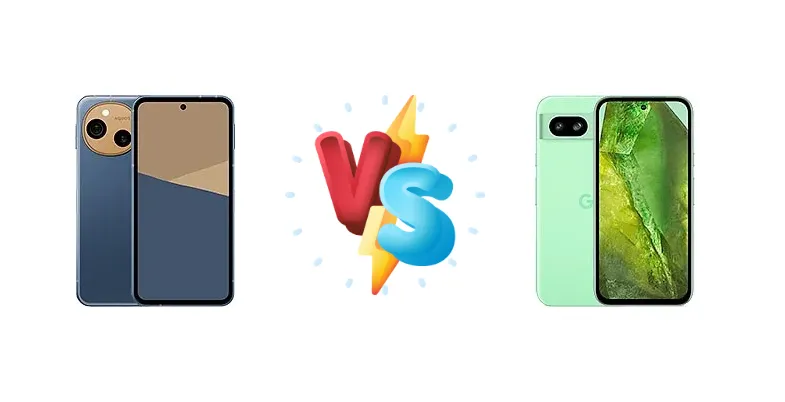
The Sharp Aquos sense10 and Google Pixel 8a represent distinct approaches to the mid-range smartphone market. The Aquos sense10, popular in Japan, focuses on a balanced feature set with a Snapdragon 7s Gen 3, while the Pixel 8a leverages Google’s Tensor G3 chip and renowned software experience. This comparison dissects their strengths and weaknesses to determine which device delivers the best value.
🏆 Quick Verdict
For the average user prioritizing software support and camera quality, the Google Pixel 8a is the clear winner. Its Tensor G3 chip, combined with Google’s computational photography, provides a superior experience. However, the Aquos sense10 offers a compelling alternative for those seeking a more efficient processor and faster wired charging.
| Network |
|---|
| 2G bands | GSM 850 / 900 / 1800 / 1900 | GSM 850 / 900 / 1800 / 1900 |
| 3G bands | HSDPA 850 / 900 / 1900 / 2100 | HSDPA 800 / 850 / 900 / 1700(AWS) / 1900 / 2100 |
| 4G bands | LTE | 1, 2, 3, 4, 5, 7, 8, 12, 17, 18, 19, 20, 26, 28, 32, 38, 40, 41, 42, 66 - G6GPR (International) |
| 5G bands | SA/NSA/Sub6 | 1, 2, 3, 5, 7, 8, 12, 20, 26, 28, 38, 40, 41, 66, 75, 76, 77, 78 SA/NSA/Sub6 - G6GPR (International) |
| Speed | HSPA, LTE, 5G | HSPA, LTE, 5G |
| Technology | GSM / HSPA / LTE / 5G | GSM / HSPA / LTE / 5G |
| Launch |
|---|
| Announced | 2025, October 31 | 2024, May 07 |
| Status | Available. Released 2025, November | Available. Released 2024, May 14 |
| Body |
|---|
| Build | Glass front, aluminum frame, aluminum back | Glass front (Gorilla Glass 3), aluminum frame, plastic back |
| Dimensions | 149 x 73 x 8.9 mm (5.87 x 2.87 x 0.35 in) | 152.1 x 72.7 x 8.9 mm (5.99 x 2.86 x 0.35 in) |
| SIM | Nano-SIM + eSIM | Nano-SIM + eSIM |
| Weight | 166 g (5.86 oz) | 188 g (6.63 oz) |
| Display |
|---|
| Protection | - | Corning Gorilla Glass 3, Mohs level 5 |
| Resolution | 1080 x 2340 pixels, 19.5:9 ratio (~422 ppi density) | 1080 x 2400 pixels, 20:9 ratio (~430 ppi density) |
| Size | 6.1 inches, 91.3 cm2 (~84.0% screen-to-body ratio) | 6.1 inches, 90.3 cm2 (~81.6% screen-to-body ratio) |
| Type | LTPO IGZO OLED, 1B colors, 240Hz, 1500 nits (HBM), 2000 nits (peak) | OLED, HDR, 120Hz, 2000 nits (peak) |
| Platform |
|---|
| CPU | Octa-core (1x2.5 GHz Cortex-A720 & 3x2.4 GHz Cortex-A720 & 4x1.8 GHz Cortex-A520) | Nona-core (1x3.0 GHz Cortex-X3 & 4x2.45 GHz Cortex-A715 & 4x2.15 GHz Cortex-A510) |
| Chipset | Qualcomm SM7635 Snapdragon 7s Gen 3 (4 nm) | Google Tensor G3 (4 nm) |
| GPU | Adreno 810 | Immortalis-G715s MC10 |
| OS | Android 16, up to 3 major Android upgrades | Android 14, upgradable to Android 16, up to 7 major Android upgrades |
| Memory |
|---|
| Card slot | microSDXC | No |
| Internal | 128GB 6GB RAM, 256GB 8GB RAM | 128GB 8GB RAM, 256GB 8GB RAM |
| Main Camera |
|---|
| Dual | 50 MP, f/1.9, 23mm (wide), 1/1.55", dual pixel PDAF, OIS
50 MP, f/2.2, 13mm, 122˚ (ultrawide), 1/2.5", PDAF | 64 MP (16 MP eff.), f/1.9, 26mm (wide), 1/1.73", 0.8µm, dual pixel PDAF, OIS
13 MP, f/2.2, 120˚ (ultrawide), 1.12µm |
| Features | LED flash, HDR, panorama | Dual-LED flash, Pixel Shift, Ultra HDR, panorama, Best Take |
| Video | Yes, gyro-EIS | 4K@30/60fps, 1080p@30/60/120/240fps, OIS |
| Selfie camera |
|---|
| Features | - | HDR, panorama |
| Single | 32 MP, f/2.2, 25mm (wide) | 13 MP, f/2.2, 20mm (ultrawide), 1.12µm |
| Video | Yes, gyro-EIS | 4K@30fps, 1080p@30/60fps |
| Sound |
|---|
| 35mm jack | No | No |
| Loudspeaker | Yes, with stereo speakers | Yes, with stereo speakers |
| Comms |
|---|
| Bluetooth | 5.2, A2DP, LE, aptX Adaptive | 5.3, A2DP, LE |
| NFC | Yes | Yes |
| Positioning | GPS, GALILEO, GLONASS, BDS, QZSS | GPS, GLONASS, GALILEO, BDS, QZSS, NavIC |
| Radio | No | No |
| USB | USB Type-C 3.2, DisplayPort 1.4 | USB Type-C 3.2 |
| WLAN | Wi-Fi 802.11 a/b/g/n/ac/6e, dual-band | Wi-Fi 802.11 a/b/g/n/ac/6e, dual/tri-band (market/region dependent) |
| Features |
|---|
| Sensors | Fingerprint (side-mounted), accelerometer, gyro, proximity, compass | Fingerprint (under display, optical), accelerometer, gyro, proximity, compass, barometer |
| Battery |
|---|
| Charging | 36W wired | 18W wired, PD3.0
7.5W wireless
Bypass charging |
| Type | 5000 mAh | Li-Po 4492 mAh |
| Misc |
|---|
| Colors | Denim Navy, Khaki Green, Pale Pink, Pale Mint, Full Black, Light Silver | Obsidian, Porcelain, Bay, Aloe |
| Models | - | GKV4X, G6GPR, G8HHN, G576D |
| Price | About 350 EUR | $ 229.98 / C$ 417.99 / £ 279.00 / € 299.99 / ₹ 33,300 |
| EU LABEL |
|---|
| Battery | - | 40:06h endurance, 1000 cycles |
| Energy | - | Class B |
| Free fall | - | Class A (270 falls) |
| Repairability | - | Class B |
Sharp Aquos sense10
- Faster 36W wired charging
- Potentially better thermal efficiency with Snapdragon 7s Gen 3
- More understated design (subjective)
- Inferior camera capabilities compared to Pixel 8a
- Likely less frequent software updates
Google Pixel 8a
- Superior camera performance and image processing
- Long-term software support from Google
- Brighter and more vibrant display
- Slower 18W wired charging
- Tensor G3 may be prone to thermal throttling under sustained load
Display Comparison
The Google Pixel 8a boasts a significantly brighter display, reaching a measured 1508 nits, making it far more usable in direct sunlight compared to the Aquos sense10 (brightness data unavailable). While the Aquos sense10’s panel technology isn’t specified, the Pixel 8a’s OLED panel delivers superior contrast and color accuracy. The Pixel 8a’s smaller bezels also contribute to a more immersive viewing experience. The absence of LTPO on either device suggests neither offers adaptive refresh rates for power saving.
Camera Comparison
The Pixel 8a’s camera system is a key differentiator, leveraging Google’s renowned computational photography algorithms. While specific sensor sizes are not provided, the Pixel 8a’s image processing excels in dynamic range and low-light performance. The Aquos sense10’s camera capabilities are less emphasized in available data, suggesting a more standard mid-range experience. The absence of details regarding OIS on the Aquos sense10 further highlights the Pixel 8a’s likely advantage in image stabilization.
Performance
The Google Pixel 8a’s Tensor G3, with its nona-core configuration (1x3.0 GHz Cortex-X3, 4x2.45 GHz Cortex-A715, 4x2.15 GHz Cortex-A510), is architecturally more complex and performance-focused than the Aquos sense10’s Snapdragon 7s Gen 3 (1x2.5 GHz Cortex-A720, 3x2.4 GHz Cortex-A720, 4x1.8 GHz Cortex-A520). Both chips are built on a 4nm process, but the Tensor G3’s Cortex-X3 prime core provides a substantial advantage in demanding tasks. However, the Snapdragon 7s Gen 3 is likely to exhibit better sustained performance due to potentially superior thermal management, a common trade-off with Tensor chips. The Pixel 8a benefits from faster RAM, likely LPDDR5x, while the Aquos sense10’s RAM specification is unknown.
Battery Life
The Google Pixel 8a demonstrates impressive battery endurance, achieving 40:06h of endurance and an active use score of 11:25h, alongside a reported 1000 cycle lifespan. While the Aquos sense10’s battery capacity is unknown, its 36W wired charging significantly outpaces the Pixel 8a’s 18W charging. The Pixel 8a does offer 7.5W wireless charging and bypass charging, features absent on the Aquos sense10. The Pixel 8a’s endurance rating of 83h (older data) suggests a well-optimized power management system.
Buying Guide
Buy the Sharp Aquos sense10 if you prioritize efficient performance for everyday tasks, value faster 36W wired charging, and appreciate a more understated design. Buy the Google Pixel 8a if you demand best-in-class camera capabilities, seamless software updates, and a brighter, more vibrant display, even if it means sacrificing some charging speed.
Frequently Asked Questions
❓ Does the Tensor G3 in the Pixel 8a get noticeably hot during extended gaming sessions?
The Tensor G3 is known to generate more heat than some competing chips, particularly during prolonged, graphically intensive tasks like gaming. While Google has implemented thermal management solutions, some users may experience throttling, leading to reduced performance over extended periods. The Aquos sense10’s Snapdragon 7s Gen 3 is likely to maintain more consistent performance under similar conditions.
❓ How does the software update policy differ between the Aquos sense10 and the Pixel 8a?
Google guarantees at least 7 years of software updates for the Pixel 8a, including security patches and OS upgrades. Sharp’s update policy for the Aquos sense10 is less extensive, typically offering a shorter period of support. This means the Pixel 8a will remain secure and feature-rich for a significantly longer time.
❓ Is the 36W charging on the Aquos sense10 a significant advantage in real-world use?
Yes, 36W charging is considerably faster than the Pixel 8a’s 18W charging. While the Pixel 8a’s battery life is excellent, the Aquos sense10 can top up much quicker, which is beneficial for users who frequently need to recharge their phone throughout the day. A full charge will take significantly less time on the Aquos sense10.