
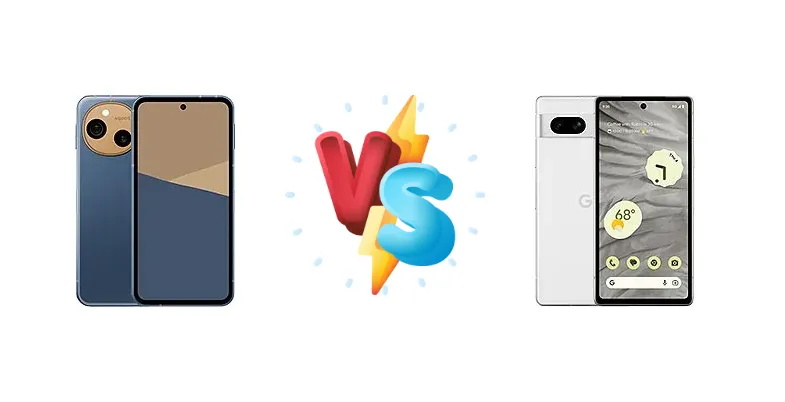
Sharp Aquos sense10 vs Google Pixel 7a: A Deep Dive into Mid-Range Champions
| Phones Images | |||||
|---|---|---|---|---|---|
|
🏆 Quick Verdict
For the average user prioritizing camera quality and software experience, the Google Pixel 7a is the better choice. Its Tensor G2 chip, while built on a slightly older 5nm process, delivers superior image processing capabilities. However, the Aquos sense10 offers faster 36W charging and a potentially more efficient chipset for sustained tasks.
| PHONES | ||
|---|---|---|
| Phone Names | Sharp Aquos sense10 | Google Pixel 7a |
| Network | ||
|---|---|---|
| 2G bands | GSM 850 / 900 / 1800 / 1900 | GSM 850 / 900 / 1800 / 1900 |
| 3G bands | HSDPA 850 / 900 / 1900 / 2100 | HSDPA 800 / 850 / 900 / 1700(AWS) / 1900 / 2100 |
| 4G bands | LTE | 1, 2, 3, 4, 5, 7, 8, 12, 13, 14, 17, 20, 25, 26, 28, 29, 30, 38, 40, 41, 48, 66, 71 - GWKK3, G0DZQ |
| 5G bands | SA/NSA/Sub6 | 1, 2, 3, 5, 7, 8, 12, 14, 20, 25, 28, 30, 38, 41, 48, 66, 71, 77, 78 SA/NSA/Sub6 - GWKK3 |
| Speed | HSPA, LTE, 5G | HSPA, LTE, 5G |
| Technology | GSM / HSPA / LTE / 5G | GSM / HSPA / LTE / 5G |
| - | 1, 2, 3, 5, 7, 8, 12, 20, 25, 28, 38, 40, 41, 66, 75, 76, 77, 78, 79 SA/NSA/Sub6 - GHL1X, G82U8 | |
| Launch | ||
|---|---|---|
| Announced | 2025, October 31 | 2023, May 10 |
| Status | Available. Released 2025, November | Available. Released 2023, May 10 |
| Body | ||
|---|---|---|
| Build | Glass front, aluminum frame, aluminum back | Glass front (Gorilla Glass 3), aluminum frame, plastic back |
| Dimensions | 149 x 73 x 8.9 mm (5.87 x 2.87 x 0.35 in) | 152 x 72.9 x 9 mm (5.98 x 2.87 x 0.35 in) |
| SIM | Nano-SIM + eSIM | Nano-SIM + eSIM |
| Weight | 166 g (5.86 oz) | 193.5 g (6.84 oz) |
| - | IP67 dust/water resistant (up to 1m for 30 min) | |
| Display | ||
|---|---|---|
| Protection | - | Corning Gorilla Glass 3 |
| Resolution | 1080 x 2340 pixels, 19.5:9 ratio (~422 ppi density) | 1080 x 2400 pixels, 20:9 ratio (~429 ppi density) |
| Size | 6.1 inches, 91.3 cm2 (~84.0% screen-to-body ratio) | 6.1 inches, 90.7 cm2 (~81.8% screen-to-body ratio) |
| Type | LTPO IGZO OLED, 1B colors, 240Hz, 1500 nits (HBM), 2000 nits (peak) | OLED, HDR, 90Hz |
| - | Always-on display | |
| Platform | ||
|---|---|---|
| CPU | Octa-core (1x2.5 GHz Cortex-A720 & 3x2.4 GHz Cortex-A720 & 4x1.8 GHz Cortex-A520) | Octa-core (2x2.85 GHz Cortex-X1 & 2x2.35 GHz Cortex-A78 & 4x1.80 GHz Cortex-A55) |
| Chipset | Qualcomm SM7635 Snapdragon 7s Gen 3 (4 nm) | Google Tensor G2 (5 nm) |
| GPU | Adreno 810 | Mali-G710 MP7 |
| OS | Android 16, up to 3 major Android upgrades | Android 13, upgradable to Android 15, up to 5 major Android upgrades |
| Memory | ||
|---|---|---|
| Card slot | microSDXC | No |
| Internal | 128GB 6GB RAM, 256GB 8GB RAM | 128GB 8GB RAM |
| - | UFS 3.1 | |
| Main Camera | ||
|---|---|---|
| Dual | 50 MP, f/1.9, 23mm (wide), 1/1.55", dual pixel PDAF, OIS 50 MP, f/2.2, 13mm, 122˚ (ultrawide), 1/2.5", PDAF | 64 MP, f/1.9, 26mm (wide), 1/1.73", 0.8µm, dual pixel PDAF, OIS 13 MP, f/2.2, 120˚ (ultrawide), 1.12µm |
| Features | LED flash, HDR, panorama | Dual-LED flash, Pixel Shift, Auto-HDR, panorama |
| Video | Yes, gyro-EIS | 4K@30/60fps, 1080p@30/60/120/240fps, OIS |
| Selfie camera | ||
|---|---|---|
| Features | - | HDR, panorama |
| Single | 32 MP, f/2.2, 25mm (wide) | 13 MP, f/2.2, 20mm (ultrawide), 1.12µm |
| Video | Yes, gyro-EIS | 4K@30fps, 1080p@30fps |
| Sound | ||
|---|---|---|
| 3.5mm jack | - | No |
| 35mm jack | No | No |
| Loudspeaker | Yes, with stereo speakers | Yes, with stereo speakers |
| Comms | ||
|---|---|---|
| Bluetooth | 5.2, A2DP, LE, aptX Adaptive | 5.3, A2DP, LE |
| NFC | Yes | Yes |
| Positioning | GPS, GALILEO, GLONASS, BDS, QZSS | GPS, GLONASS, GALILEO, BDS, QZSS, NavIC |
| Radio | No | No |
| USB | USB Type-C 3.2, DisplayPort 1.4 | USB Type-C 3.2 |
| WLAN | Wi-Fi 802.11 a/b/g/n/ac/6e, dual-band | Wi-Fi 802.11 a/b/g/n/ac/6e, tri-band |
| Features | ||
|---|---|---|
| Sensors | Fingerprint (side-mounted), accelerometer, gyro, proximity, compass | Fingerprint (under display, optical), accelerometer, gyro, proximity, compass, barometer |
| Battery | ||
|---|---|---|
| Charging | 36W wired | 18W wired, PD3.0 7.5W wireless |
| Type | 5000 mAh | Li-Po 4385 mAh |
| Misc | ||
|---|---|---|
| Colors | Denim Navy, Khaki Green, Pale Pink, Pale Mint, Full Black, Light Silver | Charcoal, Snow, Sea, Coral |
| Models | - | GWKK3, GHL1X, G0DZQ, G82U8 |
| Price | About 350 EUR | € 179.90 / $ 150.00 / £ 170.00 / ₹ 25,980 |
Sharp Aquos sense10
- Faster 36W wired charging
- Potentially better thermal efficiency with 4nm Snapdragon 7s Gen 3
- Competitive price point
- Less refined camera system compared to Pixel 7a
- Software updates may be less frequent
Google Pixel 7a
- Superior camera performance and image processing
- Google’s AI-powered features and software experience
- Brighter display for outdoor visibility
- Slower 18W charging
- Tensor G2 may exhibit more thermal throttling under sustained load
Display Comparison
The Pixel 7a boasts a significantly brighter display, reaching a measured 1070 nits, compared to an unstated value for the Aquos sense10. This brightness advantage translates to better outdoor visibility. While both likely utilize OLED panels, the Pixel 7a’s higher peak brightness and Google’s color calibration provide a more vibrant and accurate viewing experience. The absence of LTPO on either device suggests standard 60Hz or 90Hz refresh rates, impacting smoothness compared to flagship models.
Camera Comparison
The Pixel 7a shines in the camera department, leveraging Google’s renowned computational photography. While specific sensor sizes aren’t provided, the Pixel 7a’s image processing algorithms consistently deliver excellent dynamic range, detail, and low-light performance. The Aquos sense10’s camera capabilities are less well-defined, and likely rely more on hardware than software enhancements. The Pixel 7a’s video recording capabilities are also expected to be superior, benefiting from the Tensor G2’s image signal processor (ISP).
Performance
The core difference lies in the chipsets. The Google Pixel 7a’s Tensor G2 (5nm) features a prime Cortex-X1 core for peak performance, alongside Cortex-A78 cores, while the Aquos sense10 utilizes the Snapdragon 7s Gen 3 (4nm) with Cortex-A720 cores. While the Snapdragon 7s Gen 3 benefits from a more efficient 4nm process, the Tensor G2’s architectural advantages – particularly the X1 core – provide a performance edge in demanding tasks. The Aquos sense10’s CPU configuration (1x2.5 GHz Cortex-A720, 3x2.4 GHz Cortex-A720, 4x1.8 GHz Cortex-A520) suggests a focus on balanced performance, while the Pixel 7a (2x2.85 GHz Cortex-X1, 2x2.35 GHz Cortex-A78, 4x1.80 GHz Cortex-A55) prioritizes burst performance. Both utilize 8GB of RAM, but the Pixel 7a’s Tensor G2 benefits from Google’s software optimizations.
Battery Life
The Pixel 7a has an endurance rating of 76 hours, indicating strong battery life despite its 18W wired and 7.5W wireless charging. The Aquos sense10 counters with 36W wired charging, promising significantly faster top-up times. While the Aquos sense10’s battery capacity is unknown, the Snapdragon 7s Gen 3’s 4nm efficiency could offset a potentially smaller battery size. The Pixel 7a’s PD3.0 support offers wider compatibility with chargers, while the Aquos sense10’s faster charging is a key advantage for users who need a quick boost.
Buying Guide
Buy the Sharp Aquos sense10 if you prioritize fast charging speeds and potentially longer sustained performance due to the Snapdragon 7s Gen 3’s 4nm efficiency. This phone is ideal for users who frequently top up their battery and engage in extended media consumption. Buy the Google Pixel 7a if you value a class-leading camera experience, seamless software updates, and Google’s AI-powered features. It’s the perfect phone for photography enthusiasts and those deeply integrated into the Google ecosystem.