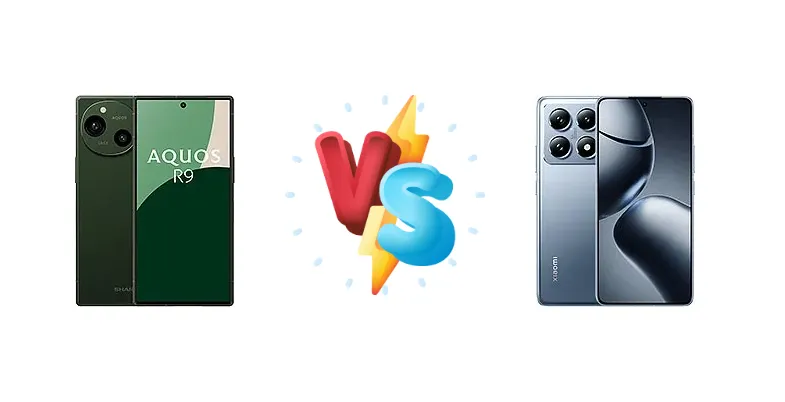
The Sharp Aquos R9 and Xiaomi 14T Pro represent compelling options in the increasingly competitive mid-range smartphone market. The R9 leverages Qualcomm’s efficient Snapdragon 7+ Gen 3, while the 14T Pro boasts the flagship-class Mediatek Dimensity 9300+. This comparison dissects their key differences to help you determine which device best suits your needs.
🏆 Quick Verdict
For most users, the Xiaomi 14T Pro emerges as the stronger choice. Its Mediatek Dimensity 9300+ chipset delivers significantly higher CPU performance, coupled with blazing-fast 120W charging and a bright 1228nit display. While the Aquos R9 offers a solid experience, it can't match the 14T Pro's raw power and convenience.
| Network |
|---|
| 2G bands | GSM 850 / 900 / 1800 / 1900 | GSM 850 / 900 / 1800 / 1900 |
| 3G bands | HSDPA 850 / 900 / 1900 / 2100 | HSDPA 800 / 850 / 900 / 1700(AWS) / 1900 / 2100 |
| 4G bands | LTE | 1, 2, 3, 4, 5, 7, 8, 12, 13, 17, 18, 19, 20, 25, 26, 28, 32, 38, 39, 40, 41, 42, 48, 66 |
| 5G bands | SA/NSA | 1, 2, 3, 5, 7, 8, 12, 20, 25, 26, 28, 38, 40, 41, 48, 66, 75, 77, 78 SA/NSA |
| Speed | HSPA, LTE, 5G | HSPA, LTE, 5G |
| Technology | GSM / HSPA / LTE / 5G | GSM / HSPA / LTE / 5G |
| Launch |
|---|
| Announced | 2024, July 18 | 2024, September 26 |
| Status | Available. Released 2024, September | Available. Released 2024, September 26 |
| Body |
|---|
| Build | Glass front (Gorilla Glass 5), glass back (Gorilla Glass Victus 2), aluminum frame | Glass front (Gorilla Glass 5), aluminum frame, glass back (Panda X) |
| Dimensions | 156 x 75 x 8.9 mm (6.14 x 2.95 x 0.35 in) | 160.4 x 75.1 x 8.4 mm (6.31 x 2.96 x 0.33 in) |
| SIM | Nano-SIM + eSIM | · Nano-SIM + eSIM· eSIM + eSIM· Nano-SIM + Nano-SIM |
| Weight | 195 g (6.88 oz) | 209 g (7.37 oz) |
| Display |
|---|
| Protection | Corning Gorilla Glass 5 | Corning Gorilla Glass 5 |
| Resolution | 1080 x 2340 pixels, 19.5:9 ratio (~396 ppi density) | 1220 x 2712 pixels, 20:9 ratio (~446 ppi density) |
| Size | 6.5 inches, 103.7 cm2 (~88.6% screen-to-body ratio) | 6.67 inches, 107.4 cm2 (~89.1% screen-to-body ratio) |
| Type | PRO IGZO LTPO OLED, 240Hz, Dolby Vision, HDR, 1500 nits (HBM), 2000 nits (peak) | AMOLED, 68B colors, 144Hz, 3840Hz PWM, Dolby Vision, HDR10+, 1600 nits (HBM), 4000 nits (peak) |
| Platform |
|---|
| CPU | Octa-core (1x2.8 GHz Cortex-X4 & 4x2.6 GHz Cortex-A720 & 3x1.9 GHz Cortex-A520) | Octa-core (1x3.4 GHz Cortex-X4 & 3x2.85 GHz Cortex-X4 & 4x2.0 GHz Cortex-A720) |
| Chipset | Qualcomm SM7675-AB Snapdragon 7+ Gen 3 (4 nm) | Mediatek Dimensity 9300+ (4 nm) |
| GPU | Adreno 732 | Immortalis-G720 MC12 |
| OS | Android 14, up to 3 major Android upgrades | Android 14, HyperOS |
| Memory |
|---|
| Card slot | microSDXC | No |
| Internal | 256GB 12GB RAM | 256GB 12GB RAM, 512GB 12GB RAM, 512GB 16GB RAM, 1TB 12GB RAM |
| Main Camera |
|---|
| Dual | 50.3 MP, f/1.9, 23mm (wide), 1/1.55", dual pixel PDAF, OIS
50.3 MP, f/2.2, 13mm, 122˚ (ultrawide), 1/2.55", PDAF | - |
| Features | Leica lens, LED flash, HDR, panorama | Leica lens, Ultra HDR, LED flash, HDR, panorama |
| Triple | - | 50 MP, f/1.6, 23mm (wide), 1/1.31", 1.2µm, PDAF, OIS
50 MP, f/2.0, 60mm (telephoto), 1/2.88", 0.61µm, PDAF, 2.6x optical zoom
12 MP, f/2.2, 15mm (ultrawide), 1/3.06", 1.12µm |
| Video | 4K@30fps, 1080p@30/60fps, gyro-EIS | 8K@24/30fps, 4K@24/30/60fps, 1080p@30/60/120/240/960fps, gyro-EIS, 10-bit Rec. 2020, HDR10+ |
| Selfie camera |
|---|
| Features | - | HDR |
| Single | 50.3 MP, f/2.2, 23mm (wide), 1/2.88", AF | 32 MP, f/2.0, 25mm (wide), 1/3.44", 0.64µm |
| Video | Yes | 4K@30fps, 1080p@30/60fps, HDR10+ |
| Sound |
|---|
| 35mm jack | No | No |
| Loudspeaker | Yes, with stereo speakers | Yes, with stereo speakers |
| Comms |
|---|
| Bluetooth | 5.4, A2DP, LE | 5.4, A2DP, LE, LHDC |
| Infrared port | - | Yes |
| NFC | Yes | Yes (market/region dependent) |
| Positioning | GPS, GLONASS, GALILEO, BDS | GPS (L1+L5), BDS (B1I+B1C+B2a+B2b), GALILEO (E1+E5a+E5b), QZSS (L1+L5), NavIC (L5), GLONASS |
| Radio | No | No |
| USB | USB Type-C | USB Type-C 2.0, OTG |
| WLAN | Wi-Fi 802.11 a/b/g/n/ac/6/7 | Wi-Fi 802.11 a/b/g/n/ac/6e/7, dual-band, Wi-Fi Direct |
| Features |
|---|
| Sensors | Fingerprint (side-mounted), accelerometer, gyro, proximity, compass | Fingerprint (under display, optical), accelerometer, gyro, proximity, compass |
| Battery |
|---|
| Charging | - | 120W wired, PD3.0, QC4, 100% in 19 min
50W wireless, 100% in 45 min |
| Type | 5000 mAh | Li-Po 5000 mAh |
| Misc |
|---|
| Colors | Snow White, Forest Green | Titan Gray, Titan Blue, Titan Black |
| Models | SH-M28SG | 2407FPN8EG |
| Price | About 550 EUR | $ 550.00 / £ 498.00 / € 539.99 |
| SAR EU | - | 0.99 W/kg (head) 1.00 W/kg (body) |
Sharp Aquos R9
- Potentially refined software experience (based on Sharp's history)
- Efficient Snapdragon 7+ Gen 3 chipset
- Likely focus on color accuracy in display
- Lower CPU performance compared to Dimensity 9300+
- Charging speed and battery capacity unknown, potentially slower
Xiaomi 14T Pro
- Powerful Mediatek Dimensity 9300+ chipset
- Blazing-fast 120W wired and 50W wireless charging
- Bright 1228nit display for excellent visibility
- Software experience may be less refined than Sharp
- Potentially higher power consumption due to brighter display
Display Comparison
The Xiaomi 14T Pro’s display immediately stands out with a measured peak brightness of 1228 nits, ensuring excellent visibility even in direct sunlight. While the Aquos R9’s display specifications are currently unavailable, Sharp historically focuses on color accuracy. However, the 14T Pro’s brightness advantage is substantial. Both devices utilize a 4nm process, suggesting similar power efficiency in display operation, but the 14T Pro’s higher brightness will naturally consume more power during peak usage. The absence of LTPO information for the R9 suggests the 14T Pro may offer more adaptive refresh rate control, further optimizing battery life.
Camera Comparison
Without detailed camera specifications for the Aquos R9, a direct comparison is limited. However, the Xiaomi 14T Pro is expected to feature a high-resolution primary sensor (details unavailable in context data), likely with optical image stabilization (OIS). The Dimensity 9300+ also includes a powerful ISP (Image Signal Processor) capable of advanced image processing. The absence of information regarding the R9’s sensor size and OIS makes it difficult to assess its camera capabilities, but the 14T Pro’s chipset and expected sensor quality position it as the likely leader in image quality and low-light performance. We can assume both phones will include standard wide and ultrawide lenses, but the 14T Pro’s processing power will likely provide a more refined image.
Performance
The core difference lies in the chipsets. The Xiaomi 14T Pro’s Mediatek Dimensity 9300+ features a unique triple-cluster architecture with a primary Cortex-X4 core clocked at 3.4 GHz, significantly exceeding the 2.8 GHz Cortex-X4 in the Sharp Aquos R9’s Snapdragon 7+ Gen 3. The 14T Pro also employs *three* additional Cortex-X4 cores, further amplifying its multi-core performance. While both are built on a 4nm process, the Dimensity 9300+'s architecture provides a clear advantage in demanding tasks. The R9’s Snapdragon 7+ Gen 3 is still a capable performer, but the 14T Pro is geared towards users who prioritize speed and responsiveness. The 14T Pro's CPU configuration suggests superior performance in multi-threaded applications and gaming.
Battery Life
The Xiaomi 14T Pro’s battery performance is a standout feature, achieving an active use score of 12 hours and 32 minutes. Crucially, it supports 120W wired charging, capable of fully charging the device in just 19 minutes. It also offers 50W wireless charging, reaching 100% in 45 minutes. The Aquos R9’s battery capacity and charging speeds are currently unknown. However, the 14T Pro’s charging capabilities are a significant advantage, minimizing downtime and offering unparalleled convenience. Even if the R9 has a larger battery capacity, the 14T Pro’s faster charging could result in less perceived battery anxiety.
Buying Guide
Buy the Sharp Aquos R9 if you prioritize a potentially more refined software experience and value Qualcomm’s Snapdragon ecosystem. It’s a good fit for users who don’t demand the absolute highest performance and prefer a balanced approach. Buy the Xiaomi 14T Pro if you’re a power user, gamer, or frequently find yourself needing to quickly top up your battery. The Dimensity 9300+ and 120W charging make it ideal for those who demand speed and efficiency.
Frequently Asked Questions
❓ Does the Mediatek Dimensity 9300+ in the Xiaomi 14T Pro generate excessive heat during prolonged gaming sessions?
While the Dimensity 9300+ is a powerful chip, Mediatek has made significant strides in thermal management. The 4nm process and optimized architecture help mitigate heat generation. However, sustained high-intensity gaming will inevitably produce some heat. The Xiaomi 14T Pro is expected to incorporate effective cooling solutions to prevent significant throttling, but real-world testing is needed to confirm its long-term thermal performance.
❓ How does the Snapdragon 7+ Gen 3 in the Sharp Aquos R9 handle graphically demanding games like Genshin Impact or Call of Duty Mobile?
The Snapdragon 7+ Gen 3 is a capable chipset and can run most popular games at medium to high settings. However, it won't deliver the same level of performance as the Dimensity 9300+ in the Xiaomi 14T Pro. Expect slightly lower frame rates and potentially more noticeable frame drops in graphically intensive scenes. The R9 is suitable for casual gaming, but serious mobile gamers will likely prefer the 14T Pro.
❓ Is the 120W charging of the Xiaomi 14T Pro safe for long-term battery health?
Xiaomi employs multiple safety mechanisms to protect the battery during fast charging. These include temperature monitoring, voltage regulation, and optimized charging algorithms. While fast charging *can* theoretically contribute to slightly faster battery degradation over the long term, the benefits of convenience and reduced downtime generally outweigh the potential risks. Xiaomi's charging technology is designed to minimize any negative impact on battery health.