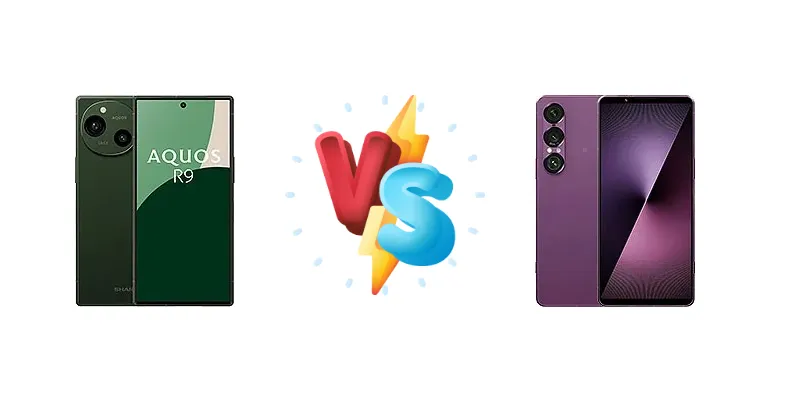
The Sony Xperia 1 VII represents Sony’s continued commitment to a premium, creator-focused smartphone experience, while the Sharp Aquos R9 aims to deliver a compelling flagship experience at a potentially more accessible price point. This comparison dissects the core differences between these two devices, focusing on their chipsets, displays, and battery performance to determine which best suits your needs.
🏆 Quick Verdict
For users prioritizing raw performance and extended battery life, the Sony Xperia 1 VII is the clear winner, thanks to its Snapdragon 8 Elite and impressive 43:30h endurance. However, the Sharp Aquos R9 offers a strong value proposition with its Snapdragon 7+ Gen 3, making it ideal for users seeking flagship features without the top-tier price tag.
| Network |
|---|
| 2G bands | GSM 850 / 900 / 1800 / 1900 | GSM 850 / 900 / 1800 / 1900 |
| 3G bands | HSDPA 850 / 900 / 1900 / 2100 | HSDPA 800 / 850 / 900 / 1700(AWS) / 1900 / 2100 |
| 4G bands | LTE | 1, 2, 3, 4, 5, 7, 8, 12, 13, 17, 19, 20, 25, 26, 28, 32, 34, 38, 39, 40, 41, 66 - Europe |
| 5G bands | SA/NSA | 1, 3, 5, 7, 8, 20, 28, 38, 40, 41, 75, 77, 78 SA/NSA/Sub6 - Europe |
| Speed | HSPA, LTE, 5G | HSPA, LTE, 5G |
| Technology | GSM / HSPA / LTE / 5G | GSM / HSPA / LTE / 5G |
| Launch |
|---|
| Announced | 2024, July 18 | 2025, May 13 |
| Status | Available. Released 2024, September | Available. Released 2025, June 04 |
| Body |
|---|
| Build | Glass front (Gorilla Glass 5), glass back (Gorilla Glass Victus 2), aluminum frame | Glass front (Gorilla Glass Victus 2), glass back (Gorilla Glass Victus), aluminum frame |
| Dimensions | 156 x 75 x 8.9 mm (6.14 x 2.95 x 0.35 in) | 162 x 74 x 8.2 mm (6.38 x 2.91 x 0.32 in) |
| SIM | Nano-SIM + eSIM | · Nano-SIM + eSIM· Nano-SIM + Nano-SIM |
| Weight | 195 g (6.88 oz) | 197 g (6.95 oz) |
| Display |
|---|
| Protection | Corning Gorilla Glass 5 | Corning Gorilla Glass Victus 2, Mohs level 5 |
| Resolution | 1080 x 2340 pixels, 19.5:9 ratio (~396 ppi density) | 1080 x 2340 pixels, 19.5:9 ratio (~396 ppi density) |
| Size | 6.5 inches, 103.7 cm2 (~88.6% screen-to-body ratio) | 6.5 inches, 103.7 cm2 (~86.5% screen-to-body ratio) |
| Type | PRO IGZO LTPO OLED, 240Hz, Dolby Vision, HDR, 1500 nits (HBM), 2000 nits (peak) | LTPO OLED, 1B colors, 120Hz, HDR BT.2020 |
| Platform |
|---|
| CPU | Octa-core (1x2.8 GHz Cortex-X4 & 4x2.6 GHz Cortex-A720 & 3x1.9 GHz Cortex-A520) | Octa-core (2x4.32 GHz Oryon V2 Phoenix L + 6x3.53 GHz Oryon V2 Phoenix M) |
| Chipset | Qualcomm SM7675-AB Snapdragon 7+ Gen 3 (4 nm) | Qualcomm SM8750-AB Snapdragon 8 Elite (3 nm) |
| GPU | Adreno 732 | Adreno 830 |
| OS | Android 14, up to 3 major Android upgrades | Android 15, up to 4 major Android upgrades |
| Memory |
|---|
| Card slot | microSDXC | microSDXC (uses shared SIM slot) |
| Internal | 256GB 12GB RAM | 256GB 12GB RAM, 512GB 12GB RAM |
| Main Camera |
|---|
| Dual | 50.3 MP, f/1.9, 23mm (wide), 1/1.55", dual pixel PDAF, OIS
50.3 MP, f/2.2, 13mm, 122˚ (ultrawide), 1/2.55", PDAF | - |
| Features | Leica lens, LED flash, HDR, panorama | Zeiss optics, Zeiss T* lens coating, color spectrum sensor, LED flash, panorama, HDR, eye tracking |
| Triple | - | 48 MP, f/1.9, 24mm (wide), 1/1.35", 1.12µm, dual pixel PDAF, OIS
12 MP, f/2.3, 85mm (telephoto), f/3.5, 170mm (telephoto), 1/3.5", 1.0µm, dual pixel PDAF, 3.5x-7.1x continuous optical zoom, OIS, 4cm macro @ 120mm, no AF
48 MP, f/2.0, 16mm (ultrawide), 1/1.56", 1.0µm, PDAF |
| Video | 4K@30fps, 1080p@30/60fps, gyro-EIS | 4K@24/30/60/120fps HDR, 1080p@30/60/120fps; 5-axis gyro-EIS, OIS |
| Selfie camera |
|---|
| Features | - | HDR |
| Single | 50.3 MP, f/2.2, 23mm (wide), 1/2.88", AF | 12 MP, f/2.0, 24mm (wide), 1/2.9", 1.22µm |
| Video | Yes | 4K@30/60fps, 1080p@30/60fps, 5-axis gyro-EIS |
| Sound |
|---|
| 35mm jack | No | Yes |
| Loudspeaker | Yes, with stereo speakers | Yes, with stereo speakers |
| Comms |
|---|
| Bluetooth | 5.4, A2DP, LE | 6.0, A2DP, LE Audio, aptX HD, aptX Adaptive, aptX Lossless |
| NFC | Yes | Yes |
| Positioning | GPS, GLONASS, GALILEO, BDS | GPS, GLONASS, BDS, GALILEO, QZSS |
| Radio | No | No |
| USB | USB Type-C | USB Type-C 3.2, OTG, video output |
| WLAN | Wi-Fi 802.11 a/b/g/n/ac/6/7 | Wi-Fi 802.11 a/b/g/n/ac/6e/7, tri-band, Wi-Fi Direct, DLNA |
| Features |
|---|
| Sensors | Fingerprint (side-mounted), accelerometer, gyro, proximity, compass | Fingerprint (side-mounted), accelerometer, gyro, proximity, barometer, compass |
| Battery |
|---|
| Charging | - | 30W wired, PD3.0, PPS, 50% in 30 min
15W wireless
Reverse wireless |
| Type | 5000 mAh | 5000 mAh |
| Misc |
|---|
| Colors | Snow White, Forest Green | Moss Green, Orchid Purple, Slate Black |
| Models | SH-M28SG | XQ-FS54, XQFS54EUKCG.GC, XQFS54EUKCV.GC, XQFS54EUKCB.GC, PDX256 |
| Price | About 550 EUR | € 1,338.99 / $ 1,394.99 / £ 1,149.94 |
| EU LABEL |
|---|
| Battery | - | 43:30h endurance, 1400 cycles |
| Energy | - | Class B |
| Free fall | - | Class B (181 falls) |
| Repairability | - | Class D |
Sharp Aquos R9
- Excellent value for a flagship experience
- Efficient Snapdragon 7+ Gen 3 chipset
- Potentially more compact design (based on Sharp's history)
- Performance lags behind the Snapdragon 8 Elite
- Limited battery life information available
Sony Xperia 1 VII
- Unmatched performance with Snapdragon 8 Elite
- Exceptional battery life (43:30h endurance)
- Fast charging (30W wired, 15W wireless)
- Higher price point
- May be larger and heavier than the Aquos R9
Display Comparison
The Sony Xperia 1 VII boasts a significantly brighter display, reaching a measured 1475 nits, which translates to superior visibility in direct sunlight compared to the Aquos R9 (brightness data unavailable). While the Aquos R9’s panel technology isn’t specified, the Xperia 1 VII likely utilizes an LTPO OLED panel, enabling variable refresh rates for improved power efficiency. The Xperia 1 VII’s focus on display quality caters to content creators and media consumers who demand accurate colors and high brightness.
Camera Comparison
Without detailed camera specifications for the Aquos R9, a direct comparison is limited. However, Sony’s Xperia 1 series traditionally emphasizes image quality and advanced features. The Xperia 1 VII likely features a sophisticated image processing pipeline and potentially larger sensor sizes, benefiting low-light performance and dynamic range. The Aquos R9 will likely offer a competent camera system, but may not match the Xperia 1 VII’s capabilities in challenging conditions. We can assume the Xperia 1 VII will have more advanced video recording features.
Performance
The core difference lies in the chipsets: the Sony Xperia 1 VII features the Qualcomm SM8750-AB Snapdragon 8 Elite (3nm), with a custom Oryon CPU architecture (2x4.32 GHz Phoenix L + 6x3.53 GHz Phoenix M), offering a substantial performance leap over the Sharp Aquos R9’s Snapdragon 7+ Gen 3 (4nm) with its Cortex-X4 prime core. The 3nm process node of the Snapdragon 8 Elite provides superior power efficiency and thermal management, minimizing throttling during sustained workloads. This benefits gamers and users running demanding applications. The Aquos R9’s 7+ Gen 3 is still a very capable chip, but will fall behind in benchmarks and sustained performance.
Battery Life
The Sony Xperia 1 VII excels in battery life, offering a remarkable 43:30h endurance and 15:32h of active use. Its 30W wired charging with PD3.0 and PPS allows for a 50% charge in just 30 minutes, alongside 15W wireless and reverse wireless charging. While the Aquos R9’s battery capacity is unknown, the Snapdragon 7+ Gen 3’s efficiency may partially offset the difference. The Xperia 1 VII’s 1400 charge cycles also suggest a longer lifespan.
Buying Guide
Buy the Sharp Aquos R9 if you need a capable flagship experience with a focus on efficiency and value, and aren't demanding the absolute highest performance for intensive tasks. Buy the Sony Xperia 1 VII if you prioritize uncompromising performance for gaming, content creation, and demand the longest possible battery life, and are willing to pay a premium for it.
Frequently Asked Questions
❓ Does the Snapdragon 7+ Gen 3 in the Aquos R9 struggle with graphically intensive games like Genshin Impact?
While the Snapdragon 7+ Gen 3 is a capable chip, it won't deliver the same sustained performance as the Snapdragon 8 Elite in demanding titles like Genshin Impact. You may need to lower graphics settings to maintain a smooth frame rate, especially during extended gaming sessions. Thermal throttling could also become a factor.
❓ How does the Xperia 1 VII's battery life hold up with heavy video recording and 4K streaming?
The Xperia 1 VII's exceptional 43:30h endurance and efficient Snapdragon 8 Elite chipset mean it can handle extended video recording and 4K streaming with minimal battery drain. The 15W wireless charging is also convenient for topping up the battery on the go.
❓ Is the 30W charging speed on the Xperia 1 VII fast enough compared to competitors offering 65W or 120W charging?
While 30W isn't the fastest charging speed available, it's still respectable and can charge the Xperia 1 VII to 50% in 30 minutes. Sony prioritizes battery health and longevity, and extremely fast charging can sometimes degrade battery life over time. The combination of 30W wired, 15W wireless, and reverse wireless provides versatile charging options.