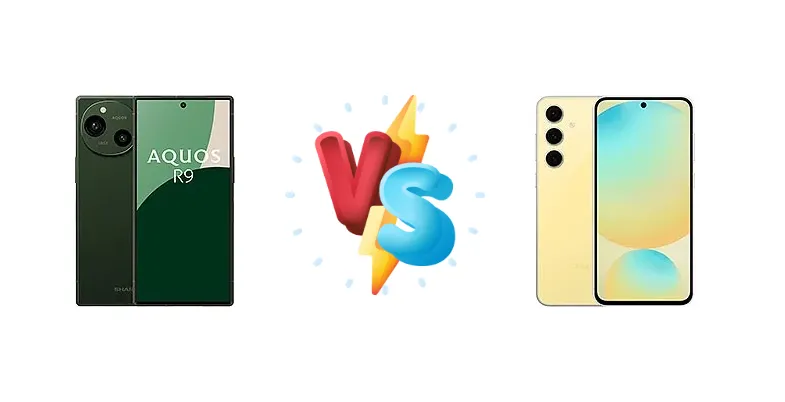
The Sharp Aquos R9 and Samsung Galaxy S24 FE represent compelling options in the increasingly competitive mid-range smartphone market. The Aquos R9, powered by the Snapdragon 7+ Gen 3, aims for raw performance, while the S24 FE leverages Samsung’s established brand and the Exynos 2400e, prioritizing a balance of features and longevity. This comparison dissects their key differences to help you choose the right device.
🏆 Quick Verdict
For the average user prioritizing all-day battery life and a polished software experience, the Samsung Galaxy S24 FE is the stronger choice. Its 42-hour endurance and 25W charging significantly outweigh the Aquos R9’s performance edge, especially considering the S24 FE’s broader feature set.
| Network |
|---|
| 2G bands | GSM 850 / 900 / 1800 / 1900 | GSM 850 / 900 / 1800 / 1900 |
| 3G bands | HSDPA 850 / 900 / 1900 / 2100 | HSDPA 850 / 900 / 1700(AWS) / 1900 / 2100 |
| 4G bands | LTE | 1, 2, 3, 4, 5, 7, 8, 12, 17, 18, 19, 20, 25, 26, 28, 32, 38, 40, 41, 66 - International |
| 5G bands | SA/NSA | 1, 2, 3, 5, 7, 8, 12, 20, 25, 26, 28, 38, 40, 41, 66, 75, 77, 78 SA/NSA/Sub6 - International |
| Speed | HSPA, LTE, 5G | HSPA, LTE, 5G |
| Technology | GSM / HSPA / LTE / 5G | GSM / HSPA / LTE / 5G |
| Launch |
|---|
| Announced | 2024, July 18 | 2024, September 26 |
| Status | Available. Released 2024, September | Available. Released 2024, October 03 |
| Body |
|---|
| Build | Glass front (Gorilla Glass 5), glass back (Gorilla Glass Victus 2), aluminum frame | Glass front (Gorilla Glass Victus+), glass back (Gorilla Glass Victus+), aluminum frame |
| Dimensions | 156 x 75 x 8.9 mm (6.14 x 2.95 x 0.35 in) | 162 x 77.3 x 8 mm (6.38 x 3.04 x 0.31 in) |
| SIM | Nano-SIM + eSIM | · Nano-SIM· Nano-SIM + Nano-SIM· Nano-SIM + eSIM· eSIM + eSIM |
| Weight | 195 g (6.88 oz) | 213 g (7.51 oz) |
| Display |
|---|
| Protection | Corning Gorilla Glass 5 | Corning Gorilla Glass Victus+, Mohs level 5 |
| Resolution | 1080 x 2340 pixels, 19.5:9 ratio (~396 ppi density) | 1080 x 2340 pixels, 19.5:9 ratio (~385 ppi density) |
| Size | 6.5 inches, 103.7 cm2 (~88.6% screen-to-body ratio) | 6.7 inches, 110.2 cm2 (~88.0% screen-to-body ratio) |
| Type | PRO IGZO LTPO OLED, 240Hz, Dolby Vision, HDR, 1500 nits (HBM), 2000 nits (peak) | Dynamic AMOLED 2X, 120Hz, HDR10+, 1900 nits (peak) |
| Platform |
|---|
| CPU | Octa-core (1x2.8 GHz Cortex-X4 & 4x2.6 GHz Cortex-A720 & 3x1.9 GHz Cortex-A520) | 10-core (1x3.1 GHz + 2x2.9 GHz + 3x2.6 GHz + 4x1.95 GHz) |
| Chipset | Qualcomm SM7675-AB Snapdragon 7+ Gen 3 (4 nm) | Exynos 2400e (4 nm) |
| GPU | Adreno 732 | Xclipse 940 |
| OS | Android 14, up to 3 major Android upgrades | Android 14, up to 7 major Android upgrades, One UI 8.0 |
| Memory |
|---|
| Card slot | microSDXC | No |
| Internal | 256GB 12GB RAM | 128GB 8GB RAM, 256GB 8GB RAM, 512GB 8GB RAM |
| Main Camera |
|---|
| Dual | 50.3 MP, f/1.9, 23mm (wide), 1/1.55", dual pixel PDAF, OIS
50.3 MP, f/2.2, 13mm, 122˚ (ultrawide), 1/2.55", PDAF | - |
| Features | Leica lens, LED flash, HDR, panorama | LED flash, HDR, panorama |
| Triple | - | 50 MP, f/1.8, 24mm (wide), 1/1.57", 1.0µm, dual pixel PDAF, OIS
8 MP, f/2.4, 75mm (telephoto), 1/4.4", 1.0µm, PDAF, OIS, 3x optical zoom
12 MP, f/2.2, 13mm, 123˚ (ultrawide), 1/3.0", 1.12µm |
| Video | 4K@30fps, 1080p@30/60fps, gyro-EIS | 8K@30fps, 4K@30/60/120fps, 1080p@30/60/120/240fps |
| Selfie camera |
|---|
| Single | 50.3 MP, f/2.2, 23mm (wide), 1/2.88", AF | 10 MP, f/2.4, 26mm (wide), 1/3.0", 1.22µm |
| Video | Yes | 4K@30/60fps, 1080p@30/60fps; gyro-EIS |
| Sound |
|---|
| 35mm jack | No | No |
| Loudspeaker | Yes, with stereo speakers | Yes, with stereo speakers |
| Comms |
|---|
| Bluetooth | 5.4, A2DP, LE | 5.3, A2DP, LE |
| NFC | Yes | Yes |
| Positioning | GPS, GLONASS, GALILEO, BDS | GPS, GLONASS, GALILEO, BDS |
| Radio | No | Unspecified |
| USB | USB Type-C | USB Type-C 3.2, OTG |
| WLAN | Wi-Fi 802.11 a/b/g/n/ac/6/7 | Wi-Fi 802.11 a/b/g/n/ac/6e, dual-band or tri-band (market/region dependent), Wi-Fi Direct |
| Features |
|---|
| Sensors | Fingerprint (side-mounted), accelerometer, gyro, proximity, compass | Fingerprint (under display, optical), accelerometer, gyro, compass |
| Battery |
|---|
| Charging | - | 25W wired, PD, QC2, 50% in 30 min
15W wireless
Reverse wireless |
| Type | 5000 mAh | 4700 mAh |
| Misc |
|---|
| Colors | Snow White, Forest Green | Blue, Graphite, Gray, Mint, Yellow |
| Models | SH-M28SG | SM-S721B, SM-S721B/DS, SM-S721U1, SM-S721U, SM-S721W, SM-S7210, SM-S721N |
| Price | About 550 EUR | $ 249.74 / C$ 498.99 / £ 335.00 / € 387.00 / ₹ 34,180 |
| SAR | - | 0.94 W/kg (head) 0.71 W/kg (body) |
| SAR EU | - | 0.86 W/kg (head) 1.29 W/kg (body) |
| EU LABEL |
|---|
| Battery | - | 42:00h endurance, 2000 cycles |
| Energy | - | Class B |
| Free fall | - | Class A (270 falls) |
| Repairability | - | Class C |
Sharp Aquos R9
- Potentially superior single-core performance with Snapdragon 7+ Gen 3
- 4nm process for improved efficiency
- Likely more affordable price point
- Unknown camera capabilities
- Software support may be limited compared to Samsung
- Battery life is currently unknown
Samsung Galaxy S24 FE
- Exceptional 42-hour battery endurance
- Bright and vibrant display (1372 nits)
- Fast 25W wired and 15W wireless charging
- Exynos 2400e may be prone to throttling under sustained load
- Potentially higher price compared to the Aquos R9
- One UI can be resource-intensive
Display Comparison
The Samsung Galaxy S24 FE boasts a significantly brighter display, reaching a measured 1372 nits, crucial for outdoor visibility. While the Aquos R9’s display specs are currently unavailable, Samsung’s panel technology and peak brightness provide a clear advantage in challenging lighting conditions. The S24 FE likely utilizes a higher refresh rate panel as well, contributing to smoother scrolling and animations. The S24 FE’s display is geared towards a more visually immersive experience.
Camera Comparison
Without detailed camera specifications for the Aquos R9, it’s difficult to make a direct comparison. However, Samsung typically excels in image processing, and the S24 FE likely benefits from this expertise. The S24 FE’s image processing algorithms are optimized for vibrant colors and detailed images. The Aquos R9 will need a strong sensor and software to compete. The presence of OIS on the S24 FE is a significant advantage for stable video recording and low-light photography.
Performance
The core difference lies in the chipsets. The Aquos R9’s Snapdragon 7+ Gen 3 (4nm) features an octa-core configuration with a prime Cortex-X4 core clocked at 2.8 GHz, designed for peak performance. The S24 FE’s Exynos 2400e (4nm) employs a 10-core setup, but its clock speeds are more distributed, with a top speed of 3.1 GHz. While the Exynos has more cores, the Snapdragon’s X4 core offers superior single-core performance, potentially translating to snappier app launches and smoother multitasking. However, the Exynos’s architecture may offer better sustained multi-core performance. Thermal management will be critical for the Exynos, as 10 cores packed into a 4nm process can generate significant heat.
Battery Life
The Samsung Galaxy S24 FE dominates in battery performance. Its 42-hour endurance and 11:48-hour active use score are impressive, indicating a truly all-day battery life. The 25W wired charging with PD and QC2 support allows for a 50% charge in just 30 minutes, minimizing downtime. The addition of 15W wireless and reverse wireless charging adds further convenience. The Aquos R9’s battery capacity and charging speed are currently unknown, but it will need to offer comparable figures to compete.
Buying Guide
Buy the Sharp Aquos R9 if you prioritize sustained gaming performance and responsiveness, and are comfortable with a potentially less refined software experience. This phone is ideal for users who frequently engage in demanding mobile games or applications. Buy the Samsung Galaxy S24 FE if you value long-lasting battery life, a vibrant display, and Samsung’s feature-rich One UI, making it perfect for everyday users and content consumers.
Frequently Asked Questions
❓ Does the Exynos 2400e in the Galaxy S24 FE overheat during prolonged gaming sessions?
The Exynos 2400e is known to generate heat under sustained load. While Samsung has implemented thermal management solutions, users may experience some throttling during extended gaming sessions. The severity of throttling will depend on ambient temperature and the game's graphical settings.
❓ How does the Snapdragon 7+ Gen 3 in the Aquos R9 handle graphically demanding games like Genshin Impact?
The Snapdragon 7+ Gen 3 is a capable chipset that should handle Genshin Impact at medium to high settings. However, it's unlikely to match the sustained performance of flagship Snapdragon 8 Gen 3 devices. Expect smooth gameplay with occasional frame drops during intense scenes.
❓ Is the 2MP macro camera on the Galaxy S24 FE actually useful for taking detailed close-up photos?
Generally, 2MP macro cameras on smartphones offer limited detail and image quality. While they can capture close-up shots, the low resolution often results in soft and noisy images. It's more of a novelty feature than a truly useful camera tool.
❓ Does the Galaxy S24 FE support 90fps or 120fps gameplay in popular titles like PUBG Mobile?
The Galaxy S24 FE supports high frame rate gameplay in PUBG Mobile, but achieving 90fps or 120fps depends on the device settings and the game's optimization. Users can typically enable 'Extreme' or 'Ultra' graphics settings to unlock higher frame rates, but this may impact battery life.