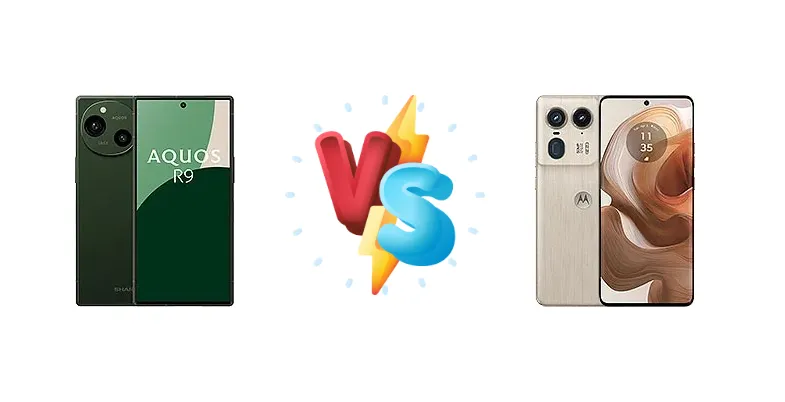
The Sharp Aquos R9 and Motorola Edge 50 Ultra represent interesting points in the Android landscape. The Aquos R9 aims to deliver a solid experience with a newer generation 7+ Gen 3 chip, while the Edge 50 Ultra pushes for near-flagship performance with the Snapdragon 8s Gen 3, alongside incredibly fast charging. This comparison dissects their strengths and weaknesses to determine which phone offers the best value.
🏆 Quick Verdict
For the average user prioritizing raw performance and rapid charging, the Motorola Edge 50 Ultra is the clear winner. Its Snapdragon 8s Gen 3 provides a noticeable performance uplift, and the 125W charging is a game-changer. However, the Aquos R9 presents a compelling alternative for those seeking a balanced experience at a potentially lower price point.
| Network |
|---|
| 2G bands | GSM 850 / 900 / 1800 / 1900 | GSM 850 / 900 / 1800 / 1900 |
| 3G bands | HSDPA 850 / 900 / 1900 / 2100 | HSDPA 850 / 900 / 1700(AWS) / 1900 / 2100 |
| 4G bands | LTE | 1, 2, 3, 4, 5, 7, 8, 12, 13, 17, 18, 19, 20, 25, 26, 28, 32, 38, 39, 40, 41, 42, 43, 66 |
| 5G bands | SA/NSA | 1, 2, 3, 5, 7, 8, 20, 26, 28, 38, 40, 41, 66, 71, 75, 77, 78 SA/NSA/Sub6 |
| Speed | HSPA, LTE, 5G | HSPA, LTE, 5G |
| Technology | GSM / HSPA / LTE / 5G | GSM / HSPA / LTE / 5G |
| Launch |
|---|
| Announced | 2024, July 18 | 2024, April 16 |
| Status | Available. Released 2024, September | Available. Released 2024, May 15 |
| Body |
|---|
| Build | Glass front (Gorilla Glass 5), glass back (Gorilla Glass Victus 2), aluminum frame | Glass front (Gorilla Glass Victus), wooden back or silicone polymer back (eco leather), aluminum frame |
| Dimensions | 156 x 75 x 8.9 mm (6.14 x 2.95 x 0.35 in) | 161.1 x 72.4 x 8.6 mm (6.34 x 2.85 x 0.34 in) |
| SIM | Nano-SIM + eSIM | Nano-SIM + eSIM |
| Weight | 195 g (6.88 oz) | 197 g (6.95 oz) |
| Display |
|---|
| Protection | Corning Gorilla Glass 5 | Corning Gorilla Glass Victus |
| Resolution | 1080 x 2340 pixels, 19.5:9 ratio (~396 ppi density) | 1220 x 2712 pixels, 20:9 ratio (~446 ppi density) |
| Size | 6.5 inches, 103.7 cm2 (~88.6% screen-to-body ratio) | 6.7 inches, 107.4 cm2 (~92.1% screen-to-body ratio) |
| Type | PRO IGZO LTPO OLED, 240Hz, Dolby Vision, HDR, 1500 nits (HBM), 2000 nits (peak) | P-OLED, 1B colors, 144Hz, HDR10+, 2500 nits (peak) |
| Platform |
|---|
| CPU | Octa-core (1x2.8 GHz Cortex-X4 & 4x2.6 GHz Cortex-A720 & 3x1.9 GHz Cortex-A520) | Octa-core (1x3.0 GHz Cortex-X4 & 4x2.8 GHz Cortex-A720 & 3x2.0 GHz Cortex-A520) |
| Chipset | Qualcomm SM7675-AB Snapdragon 7+ Gen 3 (4 nm) | Qualcomm SM8635 Snapdragon 8s Gen 3 (4 nm) |
| GPU | Adreno 732 | Adreno 735 |
| OS | Android 14, up to 3 major Android upgrades | Android 14, upgradable to Android 16, up to 3 major Android upgrades |
| Memory |
|---|
| Card slot | microSDXC | No |
| Internal | 256GB 12GB RAM | 512GB 12GB RAM, 512GB 16GB RAM, 1TB 16GB RAM |
| Main Camera |
|---|
| Dual | 50.3 MP, f/1.9, 23mm (wide), 1/1.55", dual pixel PDAF, OIS
50.3 MP, f/2.2, 13mm, 122˚ (ultrawide), 1/2.55", PDAF | - |
| Features | Leica lens, LED flash, HDR, panorama | Laser AF, Dual-LED flash, HDR, panorama |
| Triple | - | 50 MP, f/1.6, 23mm (wide), 1/1.3", 1.2µm, multi-directional PDAF, OIS
64 MP, f/2.4, 72mm (periscope telephoto), 1/2.0", 0.7µm, PDAF, OIS, 3x optical zoom
50 MP, f/2.0, 12mm, 122˚ (ultrawide), 1/2.76", 0.64µm, PDAF |
| Video | 4K@30fps, 1080p@30/60fps, gyro-EIS | 4K@30/60fps, 1080p@30/60/120/240/960fps, 10-bit HDR10+, gyro-EIS |
| Selfie camera |
|---|
| Features | - | HDR |
| Single | 50.3 MP, f/2.2, 23mm (wide), 1/2.88", AF | 50 MP, f/1.9, 21mm (wide), 1/2.76", 0.64µm, PDAF |
| Video | Yes | 4K@30/60fps, 1080p@30/60/120fps, HDR |
| Sound |
|---|
| 35mm jack | No | No |
| Loudspeaker | Yes, with stereo speakers | Yes, with stereo speakers |
| Comms |
|---|
| Bluetooth | 5.4, A2DP, LE | 5.4, A2DP, LE |
| NFC | Yes | Yes |
| Positioning | GPS, GLONASS, GALILEO, BDS | GPS, GLONASS, GALILEO, BDS, NavIC |
| Radio | No | No |
| USB | USB Type-C | USB Type-C 3.1 Gen2, OTG, DisplayPort 1.4 |
| WLAN | Wi-Fi 802.11 a/b/g/n/ac/6/7 | Wi-Fi 802.11 a/b/g/n/ac/6e/7, tri-band, Wi-Fi Direct |
| Features |
|---|
| Sensors | Fingerprint (side-mounted), accelerometer, gyro, proximity, compass | Fingerprint (under display, optical), accelerometer, gyro, proximity, compass |
| Battery |
|---|
| Charging | - | 125W wired
50W wireless
10W reverse wireless |
| Type | 5000 mAh | 4500 mAh |
| Misc |
|---|
| Colors | Snow White, Forest Green | Forest Grey, Nordic Wood, Peach Fuzz |
| Models | SH-M28SG | - |
| Price | About 550 EUR | $ 939.00 / C$ 1,299.00 / £ 490.00 / € 609.90 / ₹ 59,999 |
Sharp Aquos R9
- Potentially more affordable price point
- Efficient Snapdragon 7+ Gen 3 chipset
- Likely good battery optimization
- Less powerful processor than the Edge 50 Ultra
- Display likely lacks the brightness of the Edge 50 Ultra
- Camera specs currently unknown
Motorola Edge 50 Ultra
- Powerful Snapdragon 8s Gen 3 processor
- Extremely fast 125W wired charging
- Bright and vibrant display (1473 nits)
- Potentially higher price
- May run warmer under sustained load
- Software bloat (typical of Motorola)
Display Comparison
The Motorola Edge 50 Ultra boasts a significantly brighter display, reaching a measured 1473 nits. This is crucial for outdoor visibility, especially in direct sunlight. While the Aquos R9’s display specs are currently unavailable, Motorola’s panel likely benefits from a higher peak brightness and potentially a more advanced LTPO implementation for variable refresh rates, contributing to better power efficiency. The Edge 50 Ultra’s brightness advantage will be particularly noticeable for media consumption and gaming.
Camera Comparison
Without detailed camera specifications for the Aquos R9, it’s difficult to make a direct comparison. However, Motorola typically focuses on high-resolution sensors, and the Edge 50 Ultra is expected to feature a capable main sensor. The Snapdragon 8s Gen 3’s ISP (Image Signal Processor) is also more advanced, enabling better image processing, noise reduction, and dynamic range. The Edge 50 Ultra’s image processing will likely result in more detailed and vibrant photos, particularly in challenging lighting conditions. We'll need to see the Aquos R9's camera specs to fully assess its capabilities.
Performance
The core difference lies in the chipsets. The Motorola Edge 50 Ultra’s Snapdragon 8s Gen 3 (4nm) features a faster prime core – 3.0 GHz Cortex-X4 – compared to the Aquos R9’s Snapdragon 7+ Gen 3 (4nm) at 2.8 GHz. Both utilize the same Cortex-A720 and A520 cores, but the higher clock speed and the 8s Gen 3’s more advanced GPU will translate to smoother multitasking, faster app loading times, and superior gaming performance on the Motorola. The 7+ Gen 3 is still a capable chip, but the 8s Gen 3 offers a clear advantage for demanding tasks.
Battery Life
The Motorola Edge 50 Ultra shines in the battery and charging department. Its 125W wired charging is exceptionally fast, capable of fully charging the battery in under 30 minutes. The inclusion of 50W wireless charging and 10W reverse wireless charging adds further convenience. While the Aquos R9’s battery capacity is unknown, the Edge 50 Ultra’s active use score of 12:56h demonstrates excellent real-world battery life, even with its power-hungry chipset and bright display. The charging speed alone makes the Edge 50 Ultra a compelling choice for users who frequently need to top up their battery.
Buying Guide
Buy the Sharp Aquos R9 if you need a reliable daily driver with good performance and aren't overly concerned with having the absolute fastest processor. It's ideal for users who value efficiency and potentially a more affordable price. Buy the Motorola Edge 50 Ultra if you prioritize speed, gaming, and the convenience of incredibly fast wired and wireless charging. This phone is geared towards power users and those who demand the best possible performance from their smartphone.
Frequently Asked Questions
❓ Does the Snapdragon 8s Gen 3 in the Motorola Edge 50 Ultra get hot during extended gaming sessions?
While the Snapdragon 8s Gen 3 is a powerful chip, it can generate heat under sustained load. Motorola typically employs thermal management solutions, but prolonged gaming at maximum settings may lead to some throttling. However, the Edge 50 Ultra’s cooling system is generally effective at preventing overheating and maintaining stable performance.
❓ How does the 125W charging on the Motorola Edge 50 Ultra compare to standard fast charging?
125W charging is significantly faster than standard fast charging (typically 25W-45W). It can charge a phone from 0% to 100% in around 30 minutes, whereas standard fast charging can take over an hour. This is a major convenience for users who need to quickly top up their battery before heading out.
❓ Is the Snapdragon 7+ Gen 3 in the Sharp Aquos R9 sufficient for playing demanding games like Genshin Impact?
The Snapdragon 7+ Gen 3 is capable of running Genshin Impact, but you may need to lower the graphics settings to achieve a smooth frame rate. It won't deliver the same level of performance as the Snapdragon 8s Gen 3, but it's still a solid chip for gaming.
❓ What kind of software updates can I expect on the Sharp Aquos R9?
Sharp's software update track record is less consistent than Motorola's. While the Aquos R9 will likely receive Android version updates, the frequency and duration of security patches may be limited. Motorola generally provides more reliable software support.