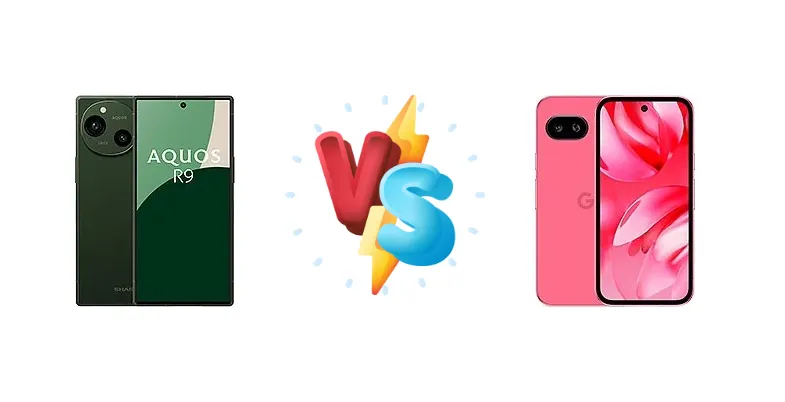
The mid-range smartphone market is fiercely competitive, and the Sharp Aquos R9 and Google Pixel 9a represent compelling options. The Aquos R9 focuses on delivering a strong Qualcomm chipset experience, while the Pixel 9a leverages Google’s Tensor G4 for AI-powered features and optimized battery performance. This comparison dissects their key differences to determine which device best suits your needs.
🏆 Quick Verdict
For the average user prioritizing all-day battery life and seamless software integration, the Google Pixel 9a emerges as the winner. Its Tensor G4 chipset, coupled with exceptional battery endurance (52:19h), outweighs the Aquos R9’s slightly faster CPU clock speed. However, gamers and power users may find the Aquos R9’s Snapdragon 7+ Gen 3 more appealing.
| Network |
|---|
| 2G bands | GSM 850 / 900 / 1800 / 1900 | GSM 850 / 900 / 1800 / 1900 |
| 3G bands | HSDPA 850 / 900 / 1900 / 2100 | HSDPA 800 / 850 / 900 / 1700(AWS) / 1900 / 2100 |
| 4G bands | LTE | 1, 2, 3, 4, 5, 7, 8, 12, 14, 17, 18, 19, 20, 21, 26, 28, 32, 38, 39, 40, 41, 42, 66, 75 - International |
| 5G bands | SA/NSA | 1, 2, 3, 5, 7, 8, 12, 20, 26, 28, 38, 40, 41, 66, 75, 77, 78, 79 SA/NSA/Sub6 - International |
| Speed | HSPA, LTE, 5G | HSPA, LTE, 5G |
| Technology | GSM / HSPA / LTE / 5G | GSM / HSPA / LTE / 5G |
| Launch |
|---|
| Announced | 2024, July 18 | 2025, March 19 |
| Status | Available. Released 2024, September | Available. Released 2025, April 10 |
| Body |
|---|
| Build | Glass front (Gorilla Glass 5), glass back (Gorilla Glass Victus 2), aluminum frame | Glass front (Gorilla Glass 3), aluminum frame, plastic back |
| Dimensions | 156 x 75 x 8.9 mm (6.14 x 2.95 x 0.35 in) | 154.7 x 73.3 x 8.9 mm (6.09 x 2.89 x 0.35 in) |
| SIM | Nano-SIM + eSIM | Nano-SIM + eSIM |
| Weight | 195 g (6.88 oz) | 186 g (6.56 oz) |
| Display |
|---|
| Protection | Corning Gorilla Glass 5 | Corning Gorilla Glass 3, Mohs level 4 |
| Resolution | 1080 x 2340 pixels, 19.5:9 ratio (~396 ppi density) | 1080 x 2424 pixels, 20:9 ratio (~422 ppi density) |
| Size | 6.5 inches, 103.7 cm2 (~88.6% screen-to-body ratio) | 6.3 inches, 94.7 cm2 (~83.5% screen-to-body ratio) |
| Type | PRO IGZO LTPO OLED, 240Hz, Dolby Vision, HDR, 1500 nits (HBM), 2000 nits (peak) | P-OLED, HDR, 120Hz, 1800 nits (HBM), 2700 nits (peak) |
| Platform |
|---|
| CPU | Octa-core (1x2.8 GHz Cortex-X4 & 4x2.6 GHz Cortex-A720 & 3x1.9 GHz Cortex-A520) | Octa-core (1x3.1 GHz Cortex-X4 & 3x2.6 GHz Cortex-A720 & 4x1.9 GHz Cortex-A520) |
| Chipset | Qualcomm SM7675-AB Snapdragon 7+ Gen 3 (4 nm) | Google Tensor G4 (4 nm) |
| GPU | Adreno 732 | Mali-G715 MP7 |
| OS | Android 14, up to 3 major Android upgrades | Android 15, upgradable to Android 16, up to 7 major Android upgrades |
| Memory |
|---|
| Card slot | microSDXC | No |
| Internal | 256GB 12GB RAM | 128GB 8GB RAM, 256GB 8GB RAM |
| Main Camera |
|---|
| Dual | 50.3 MP, f/1.9, 23mm (wide), 1/1.55", dual pixel PDAF, OIS
50.3 MP, f/2.2, 13mm, 122˚ (ultrawide), 1/2.55", PDAF | 48 MP, f/1.7, 25mm (wide), 1/2.0", 0.8µm, dual pixel PDAF, OIS
13 MP, f/2.2, 120˚ (ultrawide), 1/3.1", 1.12µm |
| Features | Leica lens, LED flash, HDR, panorama | Dual-LED flash, Pixel Shift, Ultra HDR, panorama, Best Take |
| Video | 4K@30fps, 1080p@30/60fps, gyro-EIS | 4K@30/60fps, 1080p@30/60/120/240fps, gyro-EIS, OIS |
| Selfie camera |
|---|
| Features | - | HDR, panorama |
| Single | 50.3 MP, f/2.2, 23mm (wide), 1/2.88", AF | 13 MP, f/2.2, 20mm (ultrawide), 1/3.1", 1.12µm |
| Video | Yes | 4K@30fps, 1080p@30fps |
| Sound |
|---|
| 35mm jack | No | No |
| Loudspeaker | Yes, with stereo speakers | Yes, with stereo speakers |
| Comms |
|---|
| Bluetooth | 5.4, A2DP, LE | 5.3, A2DP, LE |
| NFC | Yes | Yes |
| Positioning | GPS, GLONASS, GALILEO, BDS | GPS (L1+L5), GLONASS, GALILEO, BDS, QZSS, NavIC |
| Radio | No | No |
| USB | USB Type-C | USB Type-C 3.2 |
| WLAN | Wi-Fi 802.11 a/b/g/n/ac/6/7 | Wi-Fi 802.11 a/b/g/n/ac/6e, dual/tri-band (market/region dependent) |
| Features |
|---|
| Sensors | Fingerprint (side-mounted), accelerometer, gyro, proximity, compass | Fingerprint (under display, optical), accelerometer, gyro, proximity, compass, barometer |
| Battery |
|---|
| Charging | - | 23W wired, PD3.0
7.5W wireless
Bypass charging |
| Type | 5000 mAh | Li-Po 5100 mAh |
| Misc |
|---|
| Colors | Snow White, Forest Green | Obsidian, Porcelain, Iris, Peony |
| Models | SH-M28SG | GXQ96, GTF7P, G3Y12 |
| Price | About 550 EUR | $ 348.12 / C$ 479.99 / £ 345.00 / € 381.99 / ₹ 41,990 |
| SAR EU | - | 0.99 W/kg (head) 1.39 W/kg (body) |
| EU LABEL |
|---|
| Battery | - | 52:19h endurance, 1000 cycles |
| Energy | - | Class B |
| Free fall | - | Class A (270 falls) |
| Repairability | - | Class B |
Sharp Aquos R9
- Potentially stronger GPU performance for gaming.
- Snapdragon 7+ Gen 3 offers a raw processing power advantage.
- Likely to have a high refresh rate display.
- Battery life is currently unknown and may be lower than the Pixel 9a.
- Camera performance is unconfirmed and may not match Pixel’s computational photography.
Google Pixel 9a
- Exceptional battery life (52:19h endurance).
- Google Tensor G4 excels in AI-powered features.
- Fast charging with PD3.0 and wireless charging support.
- CPU clock speed is slightly lower than the Aquos R9.
- GPU performance may be less impressive for demanding games.
Display Comparison
Display specifications are currently unavailable for the Sharp Aquos R9. However, given its positioning, we anticipate a high-refresh-rate OLED panel. The Pixel 9a, while lacking detailed display specs, benefits from Google’s color calibration expertise, promising accurate and vibrant visuals. The absence of LTPO technology on either device suggests both will likely rely on adaptive refresh rate scaling rather than variable refresh rates for power efficiency. Bezels are expected to be minimal on both, aligning with current design trends.
Camera Comparison
Camera details for the Aquos R9 are currently unknown. The Pixel 9a, leveraging Google’s computational photography prowess, is expected to deliver exceptional image quality, particularly in challenging lighting conditions. The Tensor G4’s image signal processor (ISP) excels at noise reduction and dynamic range optimization. Without sensor size or aperture information for the Aquos R9, it’s difficult to assess its low-light performance. The Pixel’s strength lies in its software processing, consistently producing excellent results even with potentially smaller sensors. We anticipate the Pixel 9a will prioritize image quality over megapixel count, focusing on detail and accuracy.
Performance
Both the Aquos R9 and Pixel 9a utilize a 4nm process, indicating comparable efficiency. However, the CPU architectures differ. The Pixel 9a’s Tensor G4 boasts a slightly higher peak clock speed (3.1 GHz Cortex-X4) compared to the Aquos R9’s Snapdragon 7+ Gen 3 (2.8 GHz Cortex-X4). While the Aquos R9 has more Cortex-A720 cores (4 vs 3), the Tensor G4’s dedicated AI processing unit provides a significant advantage in tasks like image processing and voice recognition. The Snapdragon 7+ Gen 3 is known for its strong GPU performance, potentially giving the Aquos R9 an edge in graphically intensive games. Both devices likely utilize LPDDR5x RAM, ensuring fast data transfer speeds.
Battery Life
The Google Pixel 9a’s battery performance is a standout feature, boasting an impressive 52:19h endurance and 12:42h active use score. This suggests a highly optimized power management system and efficient chipset. The 23W wired charging with PD3.0 and 7.5W wireless charging provide convenient options. The inclusion of bypass charging minimizes heat generation during charging, potentially extending battery lifespan. The Aquos R9’s battery capacity is unknown, but its Snapdragon 7+ Gen 3, while powerful, may not match the Pixel 9a’s efficiency. Without specific charging wattage details, it’s difficult to compare charging speeds directly.
Buying Guide
Buy the Sharp Aquos R9 if you need a phone optimized for sustained performance in demanding applications like gaming or video editing, and value a raw processing power advantage. Buy the Google Pixel 9a if you prioritize exceptional battery life, Google’s AI features, and a consistently smooth software experience, even if it means sacrificing a small amount of peak CPU performance.
Frequently Asked Questions
❓ Does the Google Tensor G4 in the Pixel 9a get hot during extended gaming sessions?
While the Tensor G4 is powerful, it's known to prioritize sustained performance over peak clock speeds. Google has implemented thermal management strategies to prevent overheating, but some throttling may occur during prolonged, graphically intensive gaming. The Pixel 9a’s efficiency helps mitigate this issue compared to more power-hungry chipsets.
❓ How does the Snapdragon 7+ Gen 3 in the Aquos R9 handle multitasking compared to the Tensor G4?
The Snapdragon 7+ Gen 3 is a capable performer, and its octa-core architecture should handle multitasking effectively. However, the Tensor G4’s dedicated AI cores can accelerate certain tasks, such as background app optimization and intelligent resource allocation, potentially leading to a smoother multitasking experience in specific scenarios.
❓ Does the Pixel 9a support features like Call Screen and Magic Eraser?
Yes, the Google Pixel 9a fully supports Google’s signature AI-powered features, including Call Screen, Magic Eraser, and Photo Unblur. These features leverage the Tensor G4’s machine learning capabilities to enhance the user experience and provide unique functionalities not found on other Android devices.
❓ What type of charging protocol does the Sharp Aquos R9 support?
Charging specifications for the Sharp Aquos R9 are currently unavailable. However, given its market positioning, it is likely to support standard USB-PD charging, but the wattage remains unknown. The Pixel 9a’s 23W PD3.0 charging offers a faster and more versatile charging solution.