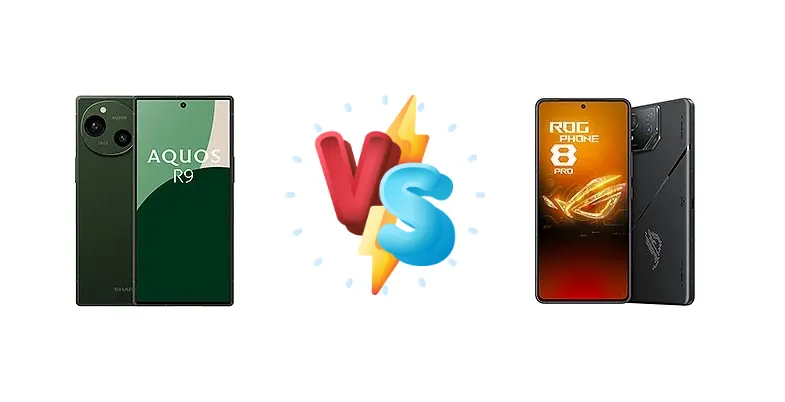
The smartphone landscape offers a spectrum of choices, from all-out flagships to more balanced performers. The Asus ROG Phone 8 Pro aims for the top spot with its Snapdragon 8 Gen 3, while the Sharp Aquos R9 takes a more pragmatic approach with the Snapdragon 7+ Gen 3. This comparison dissects their strengths and weaknesses to determine which device best suits your needs.
🏆 Quick Verdict
For the average user prioritizing a blend of performance, efficiency, and value, the Sharp Aquos R9 emerges as the stronger contender. While the ROG Phone 8 Pro boasts superior raw power, its higher price and focus on gaming features aren't essential for everyone, making the Aquos R9 a more sensible all-rounder.
| Network |
|---|
| 2G bands | GSM 850 / 900 / 1800 / 1900 | GSM 850 / 900 / 1800 / 1900 |
| 3G bands | HSDPA 850 / 900 / 1900 / 2100 | HSDPA 850 / 900 / 1700(AWS) / 1800 / 1900 / 2100 - International |
| 4G bands | LTE | 1, 2, 3, 4, 5, 7, 8, 12, 17, 18, 19, 20, 25, 26, 28, 32, 34, 38, 39, 40, 41, 42, 43, 48, 66 - International |
| 5G bands | SA/NSA | 1, 2, 3, 5, 7, 8, 12, 18, 20, 25, 26, 28, 38, 40, 41, 48, 66, 77, 78, 79 SA/NSA/Sub6 - International |
| Speed | HSPA, LTE, 5G | HSPA, LTE (Up to 7CA), 5G |
| Technology | GSM / HSPA / LTE / 5G | GSM / CDMA / HSPA / LTE / 5G |
| Launch |
|---|
| Announced | 2024, July 18 | 2024, January 08 |
| Status | Available. Released 2024, September | Available. Released 2024, January 18 |
| Body |
|---|
| Build | Glass front (Gorilla Glass 5), glass back (Gorilla Glass Victus 2), aluminum frame | Glass front (Gorilla Glass Victus 2), glass back (Gorilla Glass), aluminum frame |
| Dimensions | 156 x 75 x 8.9 mm (6.14 x 2.95 x 0.35 in) | 163.8 x 76.8 x 8.9 mm (6.45 x 3.02 x 0.35 in) |
| SIM | Nano-SIM + eSIM | Nano-SIM + Nano-SIM |
| Weight | 195 g (6.88 oz) | 225 g (7.94 oz) |
| Display |
|---|
| Protection | Corning Gorilla Glass 5 | Corning Gorilla Glass Victus 2 |
| Resolution | 1080 x 2340 pixels, 19.5:9 ratio (~396 ppi density) | 1080 x 2400 pixels, 20:9 ratio (~388 ppi density) |
| Size | 6.5 inches, 103.7 cm2 (~88.6% screen-to-body ratio) | 6.78 inches, 111.0 cm2 (~88.2% screen-to-body ratio) |
| Type | PRO IGZO LTPO OLED, 240Hz, Dolby Vision, HDR, 1500 nits (HBM), 2000 nits (peak) | LTPO AMOLED, 1B colors, 165Hz, HDR10, 1600 nits (HBM), 2500 nits (peak) |
| Platform |
|---|
| CPU | Octa-core (1x2.8 GHz Cortex-X4 & 4x2.6 GHz Cortex-A720 & 3x1.9 GHz Cortex-A520) | Octa-core (1x3.3 GHz Cortex-X4 & 3x3.2 GHz Cortex-A720 & 2x3.0 GHz Cortex-A720 & 2x2.3 GHz Cortex-A520) |
| Chipset | Qualcomm SM7675-AB Snapdragon 7+ Gen 3 (4 nm) | Qualcomm SM8650-AB Snapdragon 8 Gen 3 (4 nm) |
| GPU | Adreno 732 | Adreno 750 |
| OS | Android 14, up to 3 major Android upgrades | Android 14, up to 2 major Android upgrades |
| Memory |
|---|
| Card slot | microSDXC | No |
| Internal | 256GB 12GB RAM | 512GB 16GB RAM, 1TB 24GB RAM |
| Main Camera |
|---|
| Dual | 50.3 MP, f/1.9, 23mm (wide), 1/1.55", dual pixel PDAF, OIS
50.3 MP, f/2.2, 13mm, 122˚ (ultrawide), 1/2.55", PDAF | - |
| Features | Leica lens, LED flash, HDR, panorama | LED flash, HDR, panorama |
| Triple | - | 50 MP, f/1.9, 24mm (wide), 1/1.56", 1.0µm, PDAF, gimbal OIS
32 MP, f/2.4, (telephoto), 1/3.2", 0.7µm, PDAF, OIS, 3x optical zoom
13 MP, f/2.2, 13mm, 120˚ (ultrawide) |
| Video | 4K@30fps, 1080p@30/60fps, gyro-EIS | 8K@24fps, 4K@30/60fps, 1080p@30/60/120/240fps, 720p@480fps; gyro-EIS, HDR10+ |
| Selfie camera |
|---|
| Features | - | Panorama, HDR |
| Single | 50.3 MP, f/2.2, 23mm (wide), 1/2.88", AF | 32 MP, f/2.5, 22mm (wide), 1/3.2", 0.7µm |
| Video | Yes | 1080p@30fps |
| Sound |
|---|
| 35mm jack | No | Yes |
| Loudspeaker | Yes, with stereo speakers | Yes, with stereo speakers |
| Comms |
|---|
| Bluetooth | 5.4, A2DP, LE | 5.4, A2DP, LE, aptX HD, aptX Adaptive, aptX Lossless |
| NFC | Yes | Yes |
| Positioning | GPS, GLONASS, GALILEO, BDS | GPS (L1+L5), BDS (B1I+B1c+B2a), GALILEO (E1+E5a), QZSS (L1+L5), NavIC (L5), GLONASS |
| Radio | No | No |
| USB | USB Type-C | USB Type-C (side), DisplayPort 1.4; USB Type-C (bottom), OTG |
| WLAN | Wi-Fi 802.11 a/b/g/n/ac/6/7 | Wi-Fi 802.11 a/b/g/n/ac/6e/7, tri-band, Wi-Fi Direct |
| Features |
|---|
| Sensors | Fingerprint (side-mounted), accelerometer, gyro, proximity, compass | Fingerprint (under display, optical), accelerometer, gyro, proximity, compass |
| Battery |
|---|
| Charging | - | 65W wired, PD3.0, PPS, QC5, 100% in 39 min - International
30W wired, PD3.0, PPS - India
15W wireless (Qi)
10W reverse wired |
| Type | 5000 mAh | 5500 mAh |
| Misc |
|---|
| Colors | Snow White, Forest Green | Phantom Black |
| Models | SH-M28SG | AI2401, AI2401_A, AI2401_D |
| Price | About 550 EUR | $ 1,157.98 / £ 1,693.75 / € 632.66 |
Sharp Aquos R9
- More affordable price point
- Excellent performance for everyday tasks
- Potentially better thermal management due to lower power draw
- Less powerful chipset compared to the ROG Phone 8 Pro
- Limited information on camera capabilities
Asus ROG Phone 8 Pro
- Top-tier Snapdragon 8 Gen 3 performance
- Exceptionally bright and likely LTPO display
- Fast 65W wired charging and wireless charging
- Significantly higher price
- Gaming-focused features may be unnecessary for some users
Display Comparison
The Asus ROG Phone 8 Pro boasts a significantly brighter display, reaching a measured 1765 nits, ensuring excellent visibility even in direct sunlight. While the Aquos R9’s display specs are not provided, the ROG Phone’s brightness advantage is substantial. The ROG Phone likely utilizes an LTPO panel for adaptive refresh rates, contributing to power efficiency. Bezels are expected to be minimal on both devices, reflecting current flagship trends. Color accuracy is likely high on both, but the ROG Phone’s higher peak brightness provides a more vibrant and impactful viewing experience.
Camera Comparison
Detailed camera specifications for the Aquos R9 are unavailable, making a direct comparison challenging. However, the ROG Phone 8 Pro is expected to feature a versatile camera system with a focus on both photo and video capabilities. Sensor size and lens apertures are key factors; a larger sensor generally captures more light, resulting in better low-light performance. Optical Image Stabilization (OIS) is crucial for sharp photos and stable videos. Image processing algorithms play a significant role in the final image quality. Without specific details on the Aquos R9’s camera, it’s difficult to assess its capabilities, but the ROG Phone’s likely higher-end components give it an edge.
Performance
The core difference lies in the chipsets. The Asus ROG Phone 8 Pro’s Snapdragon 8 Gen 3 (4nm) features a 1x3.3 GHz Cortex-X4 prime core, alongside 3x3.2 GHz Cortex-A720 cores and 2x3.0 GHz Cortex-A720 cores, plus 2x2.3 GHz Cortex-A520 cores. This configuration delivers significantly higher peak performance compared to the Sharp Aquos R9’s Snapdragon 7+ Gen 3 (4nm) with its 1x2.8 GHz Cortex-X4, 4x2.6 GHz Cortex-A720, and 3x1.9 GHz Cortex-A520 cores. The ROG Phone’s CPU clock speeds are consistently higher across all core types. Both utilize a 4nm process, but the 8 Gen 3’s architectural improvements and higher clock speeds translate to a noticeable performance gap, particularly in demanding tasks and gaming. The ROG Phone will likely feature faster LPDDR5x RAM, further enhancing performance. Thermal management will be crucial for the ROG Phone to sustain peak performance, while the Aquos R9’s lower power draw may result in less throttling.
Battery Life
The Asus ROG Phone 8 Pro shines in battery performance, achieving an active use score of 14:43h. This demonstrates excellent power efficiency despite its powerful chipset and bright display. The ROG Phone 8 Pro supports 65W wired charging (International) and 30W (India), reaching 100% in 39 minutes (International). It also offers 15W wireless charging and 10W reverse wired charging. The Aquos R9’s battery capacity and charging speed are not specified, but the ROG Phone’s faster charging and longer battery life provide a clear advantage for users who prioritize these features.
Buying Guide
Buy the Sharp Aquos R9 if you need a phone that delivers excellent everyday performance, solid battery life, and a smooth user experience without breaking the bank. It’s ideal for users who enjoy mobile gaming but don’t demand the absolute highest frame rates or specialized gaming features. Buy the Asus ROG Phone 8 Pro if you are a dedicated mobile gamer who prioritizes maximum performance, customizable gaming controls, and a long-lasting battery for extended gaming sessions, and are willing to pay a premium for those features.
Frequently Asked Questions
❓ Does the Snapdragon 7+ Gen 3 in the Aquos R9 struggle with demanding games like Genshin Impact?
While the Snapdragon 7+ Gen 3 is a capable chip, it won't deliver the same peak frame rates as the Snapdragon 8 Gen 3 in the ROG Phone 8 Pro. Genshin Impact will likely be playable at medium to high settings, but you may experience occasional frame drops during intense combat scenarios. It's perfectly adequate for most mobile games, but hardcore gamers will prefer the ROG Phone.
❓ How does the ROG Phone 8 Pro's thermal management hold up during extended gaming sessions?
The ROG Phone 8 Pro incorporates advanced cooling solutions, including vapor chambers and graphite sheets, to mitigate thermal throttling. However, sustained peak performance will still generate heat. The phone's software allows for customizable fan control and performance profiles to balance performance and temperature. Expect some heat buildup during prolonged gaming, but the ROG Phone is designed to handle it better than most phones.
❓ Is the 30W charging speed in the Indian variant of the ROG Phone 8 Pro a significant drawback?
The 30W charging speed in the Indian variant is slower than the 65W offered in other regions. While still reasonably fast, it will take longer to fully charge the device. The difference is approximately 15-20 minutes to reach 100%, which may be a concern for users who frequently need a quick top-up.