
Sharp Aquos R9 Pro vs Xiaomi 14 Pro: A Deep Dive into Snapdragon Power and Charging Speed
| Phones Images | |||||
|---|---|---|---|---|---|
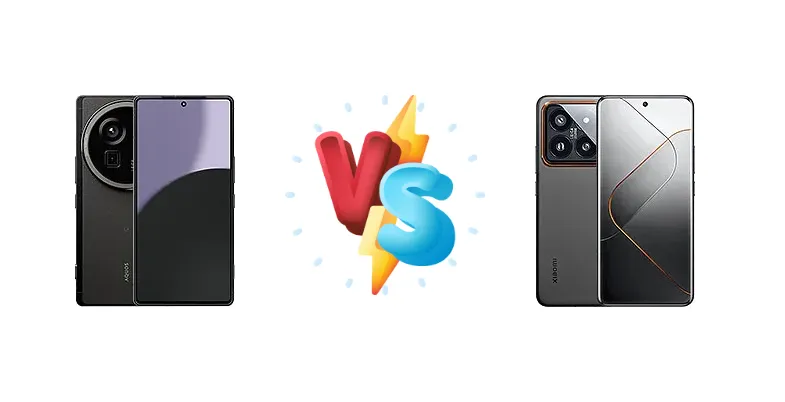
|
🏆 Quick Verdict
For the average user prioritizing speed and convenience, the Xiaomi 14 Pro is the clear winner. Its Snapdragon 8 Gen 3 chipset and blazing-fast 120W charging significantly outperform the Aquos R9 Pro's Snapdragon 8s Gen 3 and 32W charging. However, the Aquos R9 Pro offers a compelling alternative for those seeking a more measured approach.
| PHONES | ||
|---|---|---|
| Phone Names | Sharp Aquos R9 pro | Xiaomi 14 Pro |
| Network | ||
|---|---|---|
| 2G bands | GSM 850 / 900 / 1800 / 1900 | GSM 850 / 900 / 1800 / 1900 |
| 3G bands | HSDPA 850 / 900 / 1900 / 2100 | HSDPA 800 / 850 / 900 / 1700(AWS) / 1900 / 2100 |
| 4G bands | LTE | 1, 3, 4, 5, 7, 8, 18, 19, 26, 28, 34, 38, 39, 40, 41, 42, 48, 66 |
| 5G bands | SA/NSA | 1, 3, 5, 7, 8, 28, 38, 40, 41, 48, 66, 77, 78, 79 SA/NSA |
| Speed | HSPA, LTE, 5G | HSPA, LTE, 5G |
| Technology | GSM / HSPA / LTE / 5G | GSM / CDMA / HSPA / CDMA2000 / LTE / 5G |
| Launch | ||
|---|---|---|
| Announced | 2024, October 29 | 2023, October 26 |
| Status | Available. Released 2025, February | Available. Released 2023, November 01 |
| Body | ||
|---|---|---|
| Build | - | Glass front, aluminum frame or titanium frame, glass back |
| Dimensions | 162 x 78 x 9.3 mm (6.38 x 3.07 x 0.37 in) | 161.4 x 75.3 x 8.5 mm |
| SIM | Nano-SIM + eSIM | Nano-SIM + Nano-SIM |
| Weight | 220 g (7.76 oz) | 223 g or 230 g (7.87 oz) |
| Display | ||
|---|---|---|
| Protection | Corning Gorilla Glass Victus 2 | Shatterproof glass |
| Resolution | 1440 x 3120 pixels, 19.5:9 ratio (~513 ppi density) | 1440 x 3200 pixels, 20:9 ratio (~522 ppi density) |
| Size | 6.7 inches, 110.2 cm2 (~87.2% screen-to-body ratio) | 6.73 inches, 108.9 cm2 (~89.6% screen-to-body ratio) |
| Type | PRO IGZO LTPO OLED, 1B colors, 240Hz, Dolby Vision, HDR, 1000 nits (HBM), 2000 nits (peak) | LTPO AMOLED, 68B colors, 120Hz, Dolby Vision, HDR10+, 3000 nits (peak) |
| Platform | ||
|---|---|---|
| CPU | Octa-core (1x3.0 GHz Cortex-X4 & 4x2.8 GHz Cortex-A720 & 3x2.0 GHz Cortex-A520) | Octa-core (1x3.3 GHz Cortex-X4 & 3x3.2 GHz Cortex-A720 & 2x3.0 GHz Cortex-A720 & 2x2.3 GHz Cortex-A520) |
| Chipset | Qualcomm SM8635 Snapdragon 8s Gen 3 (4 nm) | Qualcomm SM8650-AB Snapdragon 8 Gen 3 (4 nm) |
| GPU | Adreno 735 | Adreno 750 |
| OS | Android 14, up to 3 major Android upgrades | Android 14, HyperOS |
| Memory | ||
|---|---|---|
| Card slot | No | No |
| Internal | 512GB 12GB RAM | 256GB 12GB RAM, 512GB 16GB RAM, 1TB 16GB RAM |
| Main Camera | ||
|---|---|---|
| Features | Leica lens, color spectrum sensor, LED flash, HDR, panorama | Laser AF, color spectrum sensor, Leica lens, Dual-LED dual-tone flash, HDR, panorama |
| Triple | 50.3 MP, f/1.8, 23mm (wide), 1/0.98", dual pixel PDAF, OIS 50.3 MP, f/2.6, 65mm (telephoto), 1/1.56", dual pixel PDAF, OIS, 2.8x optical zoom 50.3 MP, f/2.2, 13mm, 122˚ (ultrawide), 1/2.5", PDAF | 50 MP, f/1.4-f/4.0, 23mm (wide), 1/1.31", 1.2µm, dual pixel PDAF, OIS 50 MP, f/2.0, 75mm (telephoto), PDAF (10cm - ∞), OIS, 3.2x optical zoom 50 MP, f/2.2, 14mm, 115˚ (ultrawide), AF |
| Video | 4K@30/60fps, 1080p@30/60fps, gyro-EIS, Dolby Vision HDR | 8K@24fps (HDR), 4K@24/30/60fps (HDR10+, 10-bit Dolby Vision HDR, 10-bit LOG), 1080p@30/60/120/240/960fps, 720p@1920fps, gyro-EIS |
| Selfie camera | ||
|---|---|---|
| Features | - | HDR, panorama |
| Single | 50.3 MP, f/2.2, 23mm (wide), PDAF | 32 MP, f/2.0, 22mm (wide), 0.7µm |
| Video | 1080p@30/60fps, gyro-EIS | 4K@30/60fps, 1080p@30/60fps, gyro-EIS |
| Sound | ||
|---|---|---|
| 35mm jack | No | No |
| Loudspeaker | Yes, with stereo speakers | Yes, with stereo speakers |
| Comms | ||
|---|---|---|
| Bluetooth | 5.4, A2DP, LE, aptX HD, aptX Adaptive | 5.4, A2DP, LE, aptX HD, aptX Adaptive |
| Infrared port | - | Yes |
| NFC | Yes | Yes |
| Positioning | GPS, GLONASS, GALILEO, BDS | GPS (L1+L5), GLONASS (G1), BDS (B1I+B1c+B2a), GALILEO (E1+E5a), QZSS (L1+L5), NavIC (L5) |
| Radio | No | No |
| USB | USB Type-C 3.2, Display Port 1.4 | USB Type-C 3.2 Gen 2, OTG |
| WLAN | Wi-Fi 802.11 a/b/g/n/ac/6e/7 | Wi-Fi 802.11 a/b/g/n/ac/6e/7, dual-band, Wi-Fi Direct |
| Features | ||
|---|---|---|
| Sensors | Fingerprint (under display, ultrasonic), accelerometer, gyro, proximity, compass | Fingerprint (under display, optical), accelerometer, proximity, gyro, compass, barometer |
| Battery | ||
|---|---|---|
| Charging | 32W wired, Qi 15W wireless | 120W wired, PD3.0, QC4, 100% in 18 min 50W wireless, 100% in 40 min 10W reverse wireless |
| Type | 5000 mAh | Li-Po 4880 mAh |
| Misc | ||
|---|---|---|
| Colors | Black | Black, Silver, Titanium, Green |
| Models | SH-54E, SH-M30 | 23116PN5BC |
| Price | About 1000 EUR | About 650 EUR |
Sharp Aquos R9 pro
- Potentially more efficient chipset (Snapdragon 8s Gen 3)
- Likely excellent color accuracy in display
- May offer a more refined software experience
- Significantly slower charging speeds (32W)
- Less powerful chipset compared to the Xiaomi 14 Pro
- Limited wireless charging capabilities
Xiaomi 14 Pro
- Blazing-fast 120W wired charging
- Powerful Snapdragon 8 Gen 3 chipset
- 50W wireless charging and 10W reverse wireless charging
- Potentially higher power consumption
- Aggressive image processing may not appeal to all users
- Software experience can be feature-rich but sometimes bloated
Display Comparison
While both devices likely employ high-quality OLED panels (data not provided), the focus here is on performance. The lack of display specs prevents a detailed comparison, but Xiaomi's history suggests a high-refresh-rate LTPO panel for adaptive refresh rates and power savings. Sharp typically prioritizes color accuracy, so expect a well-calibrated display on the R9 Pro. Without nit brightness or resolution data, it's difficult to declare a clear winner.
Camera Comparison
Without detailed camera specifications, a direct comparison is limited. However, Xiaomi flagships consistently prioritize camera innovation, often featuring large sensors and advanced image processing algorithms. The Aquos R9 Pro, while likely capable, typically focuses on a more natural image processing style. The Xiaomi 14 Pro’s image processing will likely be more aggressive, aiming for vibrant, shareable photos. The absence of sensor size data makes it impossible to definitively state which device has the superior camera system.
Performance
The Xiaomi 14 Pro’s Snapdragon 8 Gen 3 (4nm) represents a significant step up from the Aquos R9 Pro’s Snapdragon 8s Gen 3 (4nm). The 8 Gen 3 boasts a higher peak CPU clock speed of 3.3 GHz versus 3.0 GHz on the 8s Gen 3, and a more robust GPU configuration. The Xiaomi’s CPU core arrangement (1x3.3GHz Cortex-X4, 3x3.2GHz Cortex-A720, 2x3.0GHz Cortex-A720, 2x2.3GHz Cortex-A520) provides a performance advantage over the Aquos’ (1x3.0 GHz Cortex-X4 & 4x2.8 GHz Cortex-A720 & 3x2.0 GHz Cortex-A520). This translates to faster app loading, smoother multitasking, and higher frame rates in demanding games. The Xiaomi 14 Pro will likely exhibit less thermal throttling under sustained load.
Battery Life
The charging disparity is the most significant difference. The Xiaomi 14 Pro’s 120W wired charging, capable of a full charge in just 18 minutes, is a game-changer for users who value speed. The Aquos R9 Pro’s 32W wired charging is comparatively slow. Furthermore, the Xiaomi 14 Pro offers 50W wireless charging (40 minutes to full) and 10W reverse wireless charging, features absent or significantly slower on the Aquos R9 Pro (15W wireless). While battery capacity isn’t specified, the faster charging of the Xiaomi 14 Pro effectively mitigates any potential capacity disadvantage.
Buying Guide
Buy the Sharp Aquos R9 Pro if you value a balanced experience with a focus on efficiency and potentially longer software support, and aren't heavily reliant on the absolute fastest charging speeds. Buy the Xiaomi 14 Pro if you demand top-tier performance, need the quickest possible charging, and appreciate a feature-rich, cutting-edge smartphone experience.