
Sony Xperia 1 VII vs. Sharp Aquos R9 Pro: A Flagship Showdown
| Phones Images | |||||
|---|---|---|---|---|---|
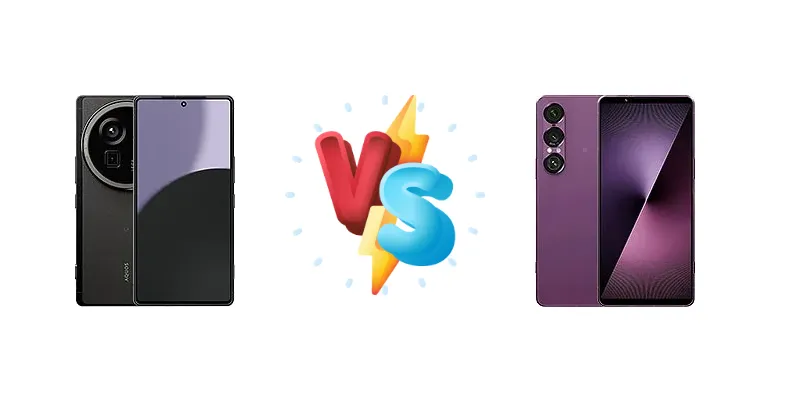
|
🏆 Quick Verdict
For the average user prioritizing sustained performance and exceptional battery life, the Sony Xperia 1 VII emerges as the winner. Its Snapdragon 8 Elite chipset and impressive 43:30h endurance significantly outperform the Aquos R9 Pro, despite the latter’s competitive price point.
| PHONES | ||
|---|---|---|
| Phone Names | Sharp Aquos R9 pro | Sony Xperia 1 VII |
| Network | ||
|---|---|---|
| 2G bands | GSM 850 / 900 / 1800 / 1900 | GSM 850 / 900 / 1800 / 1900 |
| 3G bands | HSDPA 850 / 900 / 1900 / 2100 | HSDPA 800 / 850 / 900 / 1700(AWS) / 1900 / 2100 |
| 4G bands | LTE | 1, 2, 3, 4, 5, 7, 8, 12, 13, 17, 19, 20, 25, 26, 28, 32, 34, 38, 39, 40, 41, 66 - Europe |
| 5G bands | SA/NSA | 1, 3, 5, 7, 8, 20, 28, 38, 40, 41, 75, 77, 78 SA/NSA/Sub6 - Europe |
| Speed | HSPA, LTE, 5G | HSPA, LTE, 5G |
| Technology | GSM / HSPA / LTE / 5G | GSM / HSPA / LTE / 5G |
| Launch | ||
|---|---|---|
| Announced | 2024, October 29 | 2025, May 13 |
| Status | Available. Released 2025, February | Available. Released 2025, June 04 |
| Body | ||
|---|---|---|
| Build | - | Glass front (Gorilla Glass Victus 2), glass back (Gorilla Glass Victus), aluminum frame |
| Dimensions | 162 x 78 x 9.3 mm (6.38 x 3.07 x 0.37 in) | 162 x 74 x 8.2 mm (6.38 x 2.91 x 0.32 in) |
| SIM | Nano-SIM + eSIM | · Nano-SIM + eSIM· Nano-SIM + Nano-SIM |
| Weight | 220 g (7.76 oz) | 197 g (6.95 oz) |
| Display | ||
|---|---|---|
| Protection | Corning Gorilla Glass Victus 2 | Corning Gorilla Glass Victus 2, Mohs level 5 |
| Resolution | 1440 x 3120 pixels, 19.5:9 ratio (~513 ppi density) | 1080 x 2340 pixels, 19.5:9 ratio (~396 ppi density) |
| Size | 6.7 inches, 110.2 cm2 (~87.2% screen-to-body ratio) | 6.5 inches, 103.7 cm2 (~86.5% screen-to-body ratio) |
| Type | PRO IGZO LTPO OLED, 1B colors, 240Hz, Dolby Vision, HDR, 1000 nits (HBM), 2000 nits (peak) | LTPO OLED, 1B colors, 120Hz, HDR BT.2020 |
| Platform | ||
|---|---|---|
| CPU | Octa-core (1x3.0 GHz Cortex-X4 & 4x2.8 GHz Cortex-A720 & 3x2.0 GHz Cortex-A520) | Octa-core (2x4.32 GHz Oryon V2 Phoenix L + 6x3.53 GHz Oryon V2 Phoenix M) |
| Chipset | Qualcomm SM8635 Snapdragon 8s Gen 3 (4 nm) | Qualcomm SM8750-AB Snapdragon 8 Elite (3 nm) |
| GPU | Adreno 735 | Adreno 830 |
| OS | Android 14, up to 3 major Android upgrades | Android 15, up to 4 major Android upgrades |
| Memory | ||
|---|---|---|
| Card slot | No | microSDXC (uses shared SIM slot) |
| Internal | 512GB 12GB RAM | 256GB 12GB RAM, 512GB 12GB RAM |
| Main Camera | ||
|---|---|---|
| Features | Leica lens, color spectrum sensor, LED flash, HDR, panorama | Zeiss optics, Zeiss T* lens coating, color spectrum sensor, LED flash, panorama, HDR, eye tracking |
| Triple | 50.3 MP, f/1.8, 23mm (wide), 1/0.98", dual pixel PDAF, OIS 50.3 MP, f/2.6, 65mm (telephoto), 1/1.56", dual pixel PDAF, OIS, 2.8x optical zoom 50.3 MP, f/2.2, 13mm, 122˚ (ultrawide), 1/2.5", PDAF | 48 MP, f/1.9, 24mm (wide), 1/1.35", 1.12µm, dual pixel PDAF, OIS 12 MP, f/2.3, 85mm (telephoto), f/3.5, 170mm (telephoto), 1/3.5", 1.0µm, dual pixel PDAF, 3.5x-7.1x continuous optical zoom, OIS, 4cm macro @ 120mm, no AF 48 MP, f/2.0, 16mm (ultrawide), 1/1.56", 1.0µm, PDAF |
| Video | 4K@30/60fps, 1080p@30/60fps, gyro-EIS, Dolby Vision HDR | 4K@24/30/60/120fps HDR, 1080p@30/60/120fps; 5-axis gyro-EIS, OIS |
| Selfie camera | ||
|---|---|---|
| Features | - | HDR |
| Single | 50.3 MP, f/2.2, 23mm (wide), PDAF | 12 MP, f/2.0, 24mm (wide), 1/2.9", 1.22µm |
| Video | 1080p@30/60fps, gyro-EIS | 4K@30/60fps, 1080p@30/60fps, 5-axis gyro-EIS |
| Sound | ||
|---|---|---|
| 35mm jack | No | Yes |
| Loudspeaker | Yes, with stereo speakers | Yes, with stereo speakers |
| Comms | ||
|---|---|---|
| Bluetooth | 5.4, A2DP, LE, aptX HD, aptX Adaptive | 6.0, A2DP, LE Audio, aptX HD, aptX Adaptive, aptX Lossless |
| NFC | Yes | Yes |
| Positioning | GPS, GLONASS, GALILEO, BDS | GPS, GLONASS, BDS, GALILEO, QZSS |
| Radio | No | No |
| USB | USB Type-C 3.2, Display Port 1.4 | USB Type-C 3.2, OTG, video output |
| WLAN | Wi-Fi 802.11 a/b/g/n/ac/6e/7 | Wi-Fi 802.11 a/b/g/n/ac/6e/7, tri-band, Wi-Fi Direct, DLNA |
| Features | ||
|---|---|---|
| Sensors | Fingerprint (under display, ultrasonic), accelerometer, gyro, proximity, compass | Fingerprint (side-mounted), accelerometer, gyro, proximity, barometer, compass |
| Battery | ||
|---|---|---|
| Charging | 32W wired, Qi 15W wireless | 30W wired, PD3.0, PPS, 50% in 30 min 15W wireless Reverse wireless |
| Type | 5000 mAh | 5000 mAh |
| Misc | ||
|---|---|---|
| Colors | Black | Moss Green, Orchid Purple, Slate Black |
| Models | SH-54E, SH-M30 | XQ-FS54, XQFS54EUKCG.GC, XQFS54EUKCV.GC, XQFS54EUKCB.GC, PDX256 |
| Price | About 1000 EUR | € 1,338.99 / $ 1,394.99 / £ 1,149.94 |
| EU LABEL | ||
|---|---|---|
| Battery | - | 43:30h endurance, 1400 cycles |
| Energy | - | Class B |
| Free fall | - | Class B (181 falls) |
| Repairability | - | Class D |
Sharp Aquos R9 pro
- Potentially lower price point
- Snapdragon 8s Gen 3 offers strong performance
- 32W wired charging is competitive
- Likely lower sustained performance than Xperia 1 VII
- Battery life likely inferior to Xperia 1 VII
- Limited information available on camera capabilities
Sony Xperia 1 VII
- Snapdragon 8 Elite delivers top-tier performance
- Exceptional battery life (43:30h endurance)
- Fast 30W charging with PD3.0/PPS
- Higher price tag
- May not be as readily available as the Aquos R9 Pro
- Sony's software can be polarizing
Display Comparison
The Sony Xperia 1 VII boasts a significantly brighter display, reaching a measured 1475 nits, crucial for outdoor visibility. While the Aquos R9 Pro’s display specs are currently unavailable, Sony’s history suggests a focus on color accuracy and potentially a high refresh rate. The Xperia 1 VII’s brightness advantage is a tangible benefit for users frequently exposed to direct sunlight. The absence of LTPO information for the Aquos R9 Pro suggests it may not dynamically adjust refresh rates for power saving like the Xperia 1 VII likely does.
Camera Comparison
Without detailed camera specifications for the Aquos R9 Pro, a direct comparison is limited. However, Sony’s Xperia line is renowned for its camera prowess, and the 1 VII likely features advanced image processing algorithms and potentially a larger sensor than the Aquos R9 Pro. The Xperia 1 VII’s image processing will likely prioritize color accuracy and dynamic range, while the Aquos R9 Pro may lean towards a more vibrant, consumer-friendly look. The absence of information regarding OIS and lens apertures on the Aquos R9 Pro makes it difficult to assess its low-light performance relative to the Xperia 1 VII.
Performance
The core difference lies in the chipsets: the Sony Xperia 1 VII utilizes the Qualcomm SM8750-AB Snapdragon 8 Elite (3nm), featuring Oryon V2 Phoenix CPU cores clocked up to 4.32 GHz. This contrasts with the Sharp Aquos R9 Pro’s Snapdragon 8s Gen 3 (4nm). The 3nm process of the Snapdragon 8 Elite offers superior transistor density and power efficiency, translating to higher sustained performance and reduced thermal throttling. The Oryon cores, designed by Qualcomm, are expected to deliver a noticeable performance uplift over the Cortex cores in the 8s Gen 3, particularly in demanding tasks. The Aquos R9 Pro’s 8s Gen 3 is still a capable chip, but the Xperia 1 VII holds a clear advantage in raw processing power.
Battery Life
The Sony Xperia 1 VII’s battery performance is a standout feature, offering an impressive 43:30h endurance and a 15:32h active use score. This is significantly better than what is typically seen in flagship devices. While both phones support 15W wireless charging, the Xperia 1 VII’s 30W wired charging with PD3.0 and PPS allows for a 50% charge in just 30 minutes. The Aquos R9 Pro’s 32W wired charging is comparable, but the Xperia 1 VII’s superior battery endurance and faster charging protocol provide a more convenient user experience. The Xperia 1 VII also offers reverse wireless charging, a feature absent on the Aquos R9 Pro.
Buying Guide
Buy the Sharp Aquos R9 Pro if you need a powerful flagship experience at a potentially lower price, and are comfortable with slightly less sustained performance and a more standard battery life. Buy the Sony Xperia 1 VII if you prioritize top-tier processing power, extended battery endurance for all-day use, and a premium multimedia experience, and are willing to pay a premium for it.