
Sharp Aquos R9 Pro vs Motorola Edge 50 Ultra: A Deep Dive into Snapdragon 8s Gen 3 Performance
| Phones Images | |||||
|---|---|---|---|---|---|
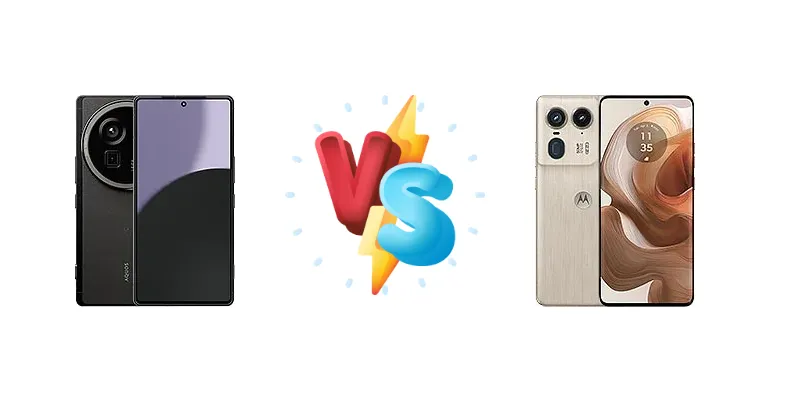
|
🏆 Quick Verdict
For the average user prioritizing convenience and speed, the Motorola Edge 50 Ultra emerges as the winner. Its significantly faster 125W wired and 50W wireless charging, coupled with a measured 1473 nits peak brightness, outweigh the Aquos R9 Pro’s more conservative approach to power delivery and display intensity.
| PHONES | ||
|---|---|---|
| Phone Names | Sharp Aquos R9 pro | Motorola Edge 50 Ultra |
| Network | ||
|---|---|---|
| 2G bands | GSM 850 / 900 / 1800 / 1900 | GSM 850 / 900 / 1800 / 1900 |
| 3G bands | HSDPA 850 / 900 / 1900 / 2100 | HSDPA 850 / 900 / 1700(AWS) / 1900 / 2100 |
| 4G bands | LTE | 1, 2, 3, 4, 5, 7, 8, 12, 13, 17, 18, 19, 20, 25, 26, 28, 32, 38, 39, 40, 41, 42, 43, 66 |
| 5G bands | SA/NSA | 1, 2, 3, 5, 7, 8, 20, 26, 28, 38, 40, 41, 66, 71, 75, 77, 78 SA/NSA/Sub6 |
| Speed | HSPA, LTE, 5G | HSPA, LTE, 5G |
| Technology | GSM / HSPA / LTE / 5G | GSM / HSPA / LTE / 5G |
| Launch | ||
|---|---|---|
| Announced | 2024, October 29 | 2024, April 16 |
| Status | Available. Released 2025, February | Available. Released 2024, May 15 |
| Body | ||
|---|---|---|
| Build | - | Glass front (Gorilla Glass Victus), wooden back or silicone polymer back (eco leather), aluminum frame |
| Dimensions | 162 x 78 x 9.3 mm (6.38 x 3.07 x 0.37 in) | 161.1 x 72.4 x 8.6 mm (6.34 x 2.85 x 0.34 in) |
| SIM | Nano-SIM + eSIM | Nano-SIM + eSIM |
| Weight | 220 g (7.76 oz) | 197 g (6.95 oz) |
| Display | ||
|---|---|---|
| Protection | Corning Gorilla Glass Victus 2 | Corning Gorilla Glass Victus |
| Resolution | 1440 x 3120 pixels, 19.5:9 ratio (~513 ppi density) | 1220 x 2712 pixels, 20:9 ratio (~446 ppi density) |
| Size | 6.7 inches, 110.2 cm2 (~87.2% screen-to-body ratio) | 6.7 inches, 107.4 cm2 (~92.1% screen-to-body ratio) |
| Type | PRO IGZO LTPO OLED, 1B colors, 240Hz, Dolby Vision, HDR, 1000 nits (HBM), 2000 nits (peak) | P-OLED, 1B colors, 144Hz, HDR10+, 2500 nits (peak) |
| Platform | ||
|---|---|---|
| CPU | Octa-core (1x3.0 GHz Cortex-X4 & 4x2.8 GHz Cortex-A720 & 3x2.0 GHz Cortex-A520) | Octa-core (1x3.0 GHz Cortex-X4 & 4x2.8 GHz Cortex-A720 & 3x2.0 GHz Cortex-A520) |
| Chipset | Qualcomm SM8635 Snapdragon 8s Gen 3 (4 nm) | Qualcomm SM8635 Snapdragon 8s Gen 3 (4 nm) |
| GPU | Adreno 735 | Adreno 735 |
| OS | Android 14, up to 3 major Android upgrades | Android 14, upgradable to Android 16, up to 3 major Android upgrades |
| Memory | ||
|---|---|---|
| Card slot | No | No |
| Internal | 512GB 12GB RAM | 512GB 12GB RAM, 512GB 16GB RAM, 1TB 16GB RAM |
| Main Camera | ||
|---|---|---|
| Features | Leica lens, color spectrum sensor, LED flash, HDR, panorama | Laser AF, Dual-LED flash, HDR, panorama |
| Triple | 50.3 MP, f/1.8, 23mm (wide), 1/0.98", dual pixel PDAF, OIS 50.3 MP, f/2.6, 65mm (telephoto), 1/1.56", dual pixel PDAF, OIS, 2.8x optical zoom 50.3 MP, f/2.2, 13mm, 122˚ (ultrawide), 1/2.5", PDAF | 50 MP, f/1.6, 23mm (wide), 1/1.3", 1.2µm, multi-directional PDAF, OIS 64 MP, f/2.4, 72mm (periscope telephoto), 1/2.0", 0.7µm, PDAF, OIS, 3x optical zoom 50 MP, f/2.0, 12mm, 122˚ (ultrawide), 1/2.76", 0.64µm, PDAF |
| Video | 4K@30/60fps, 1080p@30/60fps, gyro-EIS, Dolby Vision HDR | 4K@30/60fps, 1080p@30/60/120/240/960fps, 10-bit HDR10+, gyro-EIS |
| Selfie camera | ||
|---|---|---|
| Features | - | HDR |
| Single | 50.3 MP, f/2.2, 23mm (wide), PDAF | 50 MP, f/1.9, 21mm (wide), 1/2.76", 0.64µm, PDAF |
| Video | 1080p@30/60fps, gyro-EIS | 4K@30/60fps, 1080p@30/60/120fps, HDR |
| Sound | ||
|---|---|---|
| 35mm jack | No | No |
| Loudspeaker | Yes, with stereo speakers | Yes, with stereo speakers |
| Comms | ||
|---|---|---|
| Bluetooth | 5.4, A2DP, LE, aptX HD, aptX Adaptive | 5.4, A2DP, LE |
| NFC | Yes | Yes |
| Positioning | GPS, GLONASS, GALILEO, BDS | GPS, GLONASS, GALILEO, BDS, NavIC |
| Radio | No | No |
| USB | USB Type-C 3.2, Display Port 1.4 | USB Type-C 3.1 Gen2, OTG, DisplayPort 1.4 |
| WLAN | Wi-Fi 802.11 a/b/g/n/ac/6e/7 | Wi-Fi 802.11 a/b/g/n/ac/6e/7, tri-band, Wi-Fi Direct |
| Features | ||
|---|---|---|
| Sensors | Fingerprint (under display, ultrasonic), accelerometer, gyro, proximity, compass | Fingerprint (under display, optical), accelerometer, gyro, proximity, compass |
| Battery | ||
|---|---|---|
| Charging | 32W wired, Qi 15W wireless | 125W wired 50W wireless 10W reverse wireless |
| Type | 5000 mAh | 4500 mAh |
| Misc | ||
|---|---|---|
| Colors | Black | Forest Grey, Nordic Wood, Peach Fuzz |
| Models | SH-54E, SH-M30 | - |
| Price | About 1000 EUR | $ 939.00 / C$ 1,299.00 / £ 490.00 / € 609.90 / ₹ 59,999 |
Sharp Aquos R9 pro
- Potentially more efficient due to slower charging.
- May offer a more understated design aesthetic.
- Snapdragon 8s Gen 3 provides excellent performance.
- Significantly slower charging speeds (32W wired).
- Display brightness likely lower than the Edge 50 Ultra.
- Limited information available regarding camera capabilities.
Motorola Edge 50 Ultra
- Ultra-fast 125W wired charging.
- High peak display brightness (1473 nits).
- Strong battery life (12:56h active use).
- May run warmer under sustained load.
- Potentially more expensive.
- Motorola’s software can be divisive for some users.
Display Comparison
The Motorola Edge 50 Ultra boasts a substantial advantage in display technology, achieving a measured peak brightness of 1473 nits. This is crucial for outdoor visibility, a scenario where the Aquos R9 Pro’s unspecified brightness will likely fall short. While both devices likely utilize OLED panels, the Edge 50 Ultra’s higher peak brightness suggests a more advanced panel capable of delivering a more vibrant and impactful visual experience. The absence of refresh rate data for the Aquos R9 Pro leaves a question mark regarding its smoothness compared to potentially adaptive refresh rates on the Motorola.
Camera Comparison
Without detailed camera specifications for the Aquos R9 Pro, a direct comparison is limited. However, the Motorola Edge 50 Ultra is expected to feature a high-resolution primary sensor (likely exceeding 50MP) with optical image stabilization (OIS). The Snapdragon 8s Gen 3’s ISP is capable of excellent image processing, and Motorola’s software optimizations typically prioritize natural-looking images. The absence of information regarding the Aquos R9 Pro’s sensor size and OIS capabilities makes it difficult to assess its photographic prowess, but it’s unlikely to surpass the Edge 50 Ultra without significant hardware advantages.
Performance
Both the Sharp Aquos R9 Pro and the Motorola Edge 50 Ultra are powered by the Qualcomm SM8635 Snapdragon 8s Gen 3 (4 nm) chipset, featuring an octa-core CPU configuration with 1x3.0 GHz Cortex-X4, 4x2.8 GHz Cortex-A720, and 3x2.0 GHz Cortex-A520 cores. This means raw processing power will be nearly identical. However, the Motorola Edge 50 Ultra’s superior thermal management – a common strength of Motorola’s engineering – could allow it to sustain peak performance for longer durations during demanding tasks like gaming. The Aquos R9 Pro’s thermal performance remains unknown, potentially leading to more aggressive throttling under sustained load.
Battery Life
The Motorola Edge 50 Ultra’s 125W wired charging is a game-changer, allowing for a full charge in under 30 minutes. This is dramatically faster than the Aquos R9 Pro’s 32W wired charging. Furthermore, the Edge 50 Ultra supports 50W wireless charging and 10W reverse wireless charging, offering greater flexibility. The Edge 50 Ultra also boasts an active use battery score of 12:56h, indicating strong real-world endurance. While the Aquos R9 Pro’s battery capacity is unknown, its slower charging speeds suggest it may require more frequent top-ups, even with comparable battery life.
Buying Guide
Buy the Sharp Aquos R9 Pro if you prioritize a more understated design and are comfortable with slower charging speeds. It’s a solid choice for users who value efficiency and don’t demand the absolute fastest replenishment. Buy the Motorola Edge 50 Ultra if you demand rapid charging – both wired and wireless – and a display that remains easily visible even in direct sunlight. This phone is geared towards power users and those who frequently rely on their smartphone throughout the day.