
Sharp Aquos R9 Pro vs. Asus ROG Phone 8 Pro: A Detailed Comparison
| Phones Images | |||||
|---|---|---|---|---|---|
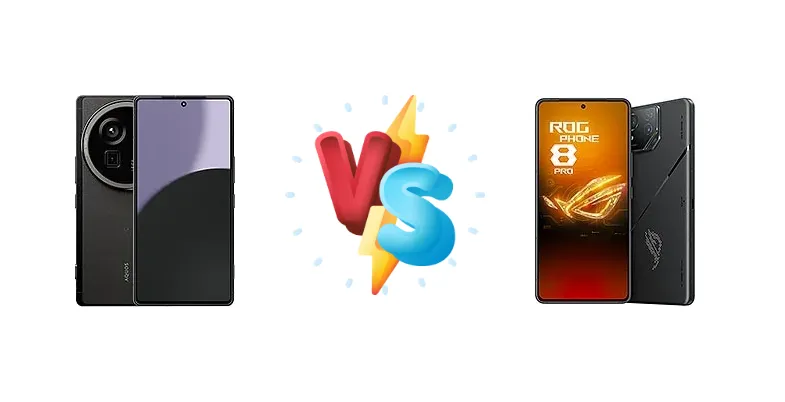
|
🏆 Quick Verdict
For the average user prioritizing a balanced experience, the Asus ROG Phone 8 Pro emerges as the stronger contender. Its superior Snapdragon 8 Gen 3 chipset, significantly faster charging, and longer battery life outweigh the Aquos R9 Pro’s more efficient processor. However, the Aquos R9 Pro offers a compelling alternative for those seeking a more streamlined experience.
| PHONES | ||
|---|---|---|
| Phone Names | Sharp Aquos R9 pro | Asus ROG Phone 8 Pro |
| Network | ||
|---|---|---|
| 2G bands | GSM 850 / 900 / 1800 / 1900 | GSM 850 / 900 / 1800 / 1900 |
| 3G bands | HSDPA 850 / 900 / 1900 / 2100 | HSDPA 850 / 900 / 1700(AWS) / 1800 / 1900 / 2100 - International |
| 4G bands | LTE | 1, 2, 3, 4, 5, 7, 8, 12, 17, 18, 19, 20, 25, 26, 28, 32, 34, 38, 39, 40, 41, 42, 43, 48, 66 - International |
| 5G bands | SA/NSA | 1, 2, 3, 5, 7, 8, 12, 18, 20, 25, 26, 28, 38, 40, 41, 48, 66, 77, 78, 79 SA/NSA/Sub6 - International |
| Speed | HSPA, LTE, 5G | HSPA, LTE (Up to 7CA), 5G |
| Technology | GSM / HSPA / LTE / 5G | GSM / CDMA / HSPA / LTE / 5G |
| Launch | ||
|---|---|---|
| Announced | 2024, October 29 | 2024, January 08 |
| Status | Available. Released 2025, February | Available. Released 2024, January 18 |
| Body | ||
|---|---|---|
| Build | - | Glass front (Gorilla Glass Victus 2), glass back (Gorilla Glass), aluminum frame |
| Dimensions | 162 x 78 x 9.3 mm (6.38 x 3.07 x 0.37 in) | 163.8 x 76.8 x 8.9 mm (6.45 x 3.02 x 0.35 in) |
| SIM | Nano-SIM + eSIM | Nano-SIM + Nano-SIM |
| Weight | 220 g (7.76 oz) | 225 g (7.94 oz) |
| Display | ||
|---|---|---|
| Protection | Corning Gorilla Glass Victus 2 | Corning Gorilla Glass Victus 2 |
| Resolution | 1440 x 3120 pixels, 19.5:9 ratio (~513 ppi density) | 1080 x 2400 pixels, 20:9 ratio (~388 ppi density) |
| Size | 6.7 inches, 110.2 cm2 (~87.2% screen-to-body ratio) | 6.78 inches, 111.0 cm2 (~88.2% screen-to-body ratio) |
| Type | PRO IGZO LTPO OLED, 1B colors, 240Hz, Dolby Vision, HDR, 1000 nits (HBM), 2000 nits (peak) | LTPO AMOLED, 1B colors, 165Hz, HDR10, 1600 nits (HBM), 2500 nits (peak) |
| Platform | ||
|---|---|---|
| CPU | Octa-core (1x3.0 GHz Cortex-X4 & 4x2.8 GHz Cortex-A720 & 3x2.0 GHz Cortex-A520) | Octa-core (1x3.3 GHz Cortex-X4 & 3x3.2 GHz Cortex-A720 & 2x3.0 GHz Cortex-A720 & 2x2.3 GHz Cortex-A520) |
| Chipset | Qualcomm SM8635 Snapdragon 8s Gen 3 (4 nm) | Qualcomm SM8650-AB Snapdragon 8 Gen 3 (4 nm) |
| GPU | Adreno 735 | Adreno 750 |
| OS | Android 14, up to 3 major Android upgrades | Android 14, up to 2 major Android upgrades |
| Memory | ||
|---|---|---|
| Card slot | No | No |
| Internal | 512GB 12GB RAM | 512GB 16GB RAM, 1TB 24GB RAM |
| Main Camera | ||
|---|---|---|
| Features | Leica lens, color spectrum sensor, LED flash, HDR, panorama | LED flash, HDR, panorama |
| Triple | 50.3 MP, f/1.8, 23mm (wide), 1/0.98", dual pixel PDAF, OIS 50.3 MP, f/2.6, 65mm (telephoto), 1/1.56", dual pixel PDAF, OIS, 2.8x optical zoom 50.3 MP, f/2.2, 13mm, 122˚ (ultrawide), 1/2.5", PDAF | 50 MP, f/1.9, 24mm (wide), 1/1.56", 1.0µm, PDAF, gimbal OIS 32 MP, f/2.4, (telephoto), 1/3.2", 0.7µm, PDAF, OIS, 3x optical zoom 13 MP, f/2.2, 13mm, 120˚ (ultrawide) |
| Video | 4K@30/60fps, 1080p@30/60fps, gyro-EIS, Dolby Vision HDR | 8K@24fps, 4K@30/60fps, 1080p@30/60/120/240fps, 720p@480fps; gyro-EIS, HDR10+ |
| Selfie camera | ||
|---|---|---|
| Features | - | Panorama, HDR |
| Single | 50.3 MP, f/2.2, 23mm (wide), PDAF | 32 MP, f/2.5, 22mm (wide), 1/3.2", 0.7µm |
| Video | 1080p@30/60fps, gyro-EIS | 1080p@30fps |
| Sound | ||
|---|---|---|
| 35mm jack | No | Yes |
| Loudspeaker | Yes, with stereo speakers | Yes, with stereo speakers |
| Comms | ||
|---|---|---|
| Bluetooth | 5.4, A2DP, LE, aptX HD, aptX Adaptive | 5.4, A2DP, LE, aptX HD, aptX Adaptive, aptX Lossless |
| NFC | Yes | Yes |
| Positioning | GPS, GLONASS, GALILEO, BDS | GPS (L1+L5), BDS (B1I+B1c+B2a), GALILEO (E1+E5a), QZSS (L1+L5), NavIC (L5), GLONASS |
| Radio | No | No |
| USB | USB Type-C 3.2, Display Port 1.4 | USB Type-C (side), DisplayPort 1.4; USB Type-C (bottom), OTG |
| WLAN | Wi-Fi 802.11 a/b/g/n/ac/6e/7 | Wi-Fi 802.11 a/b/g/n/ac/6e/7, tri-band, Wi-Fi Direct |
| Features | ||
|---|---|---|
| Sensors | Fingerprint (under display, ultrasonic), accelerometer, gyro, proximity, compass | Fingerprint (under display, optical), accelerometer, gyro, proximity, compass |
| Battery | ||
|---|---|---|
| Charging | 32W wired, Qi 15W wireless | 65W wired, PD3.0, PPS, QC5, 100% in 39 min - International 30W wired, PD3.0, PPS - India 15W wireless (Qi) 10W reverse wired |
| Type | 5000 mAh | 5500 mAh |
| Misc | ||
|---|---|---|
| Colors | Black | Phantom Black |
| Models | SH-54E, SH-M30 | AI2401, AI2401_A, AI2401_D |
| Price | About 1000 EUR | $ 1,157.98 / £ 1,693.75 / € 632.66 |
Sharp Aquos R9 pro
- Potentially more power-efficient chipset (Snapdragon 8s Gen 3)
- Likely more compact form factor
- Refined, less gamer-centric design
- Inferior chipset performance compared to Snapdragon 8 Gen 3
- Slower charging speeds (32W vs 65W)
- Limited battery life information
Asus ROG Phone 8 Pro
- Superior performance with Snapdragon 8 Gen 3
- Significantly faster 65W charging
- Excellent battery life (14:43h active use)
- Larger and heavier form factor
- Aggressive gaming aesthetic may not appeal to all
- Higher price point
Display Comparison
The Asus ROG Phone 8 Pro boasts a significantly brighter display, reaching a measured 1765 nits, ensuring excellent visibility even in direct sunlight. While the Aquos R9 Pro’s display specifications are not provided, the ROG Phone’s brightness advantage is substantial. The ROG Phone 8 Pro likely utilizes an LTPO panel for adaptive refresh rates, contributing to power efficiency, a feature not confirmed for the Aquos R9 Pro. The ROG Phone’s display is geared towards immersive gaming and media consumption, while the Aquos R9 Pro’s display quality remains an unknown quantity.
Camera Comparison
Detailed camera specifications for the Sharp Aquos R9 Pro are unavailable, making a direct comparison challenging. However, the Asus ROG Phone 8 Pro’s camera system is expected to deliver strong performance, leveraging advanced image processing algorithms. The ROG Phone 8 Pro’s camera is capable of both high-quality photo and video capture, though its primary focus isn’t solely on camera prowess. Without knowing the sensor size, aperture, or OIS capabilities of the Aquos R9 Pro, it’s difficult to assess its photographic capabilities relative to the ROG Phone 8 Pro.
Performance
The Asus ROG Phone 8 Pro’s Snapdragon 8 Gen 3 (4nm) chipset represents a clear performance advantage over the Sharp Aquos R9 Pro’s Snapdragon 8s Gen 3 (4nm). The 8 Gen 3 features a faster prime core (3.3 GHz vs 3.0 GHz) and a more robust GPU configuration. This translates to noticeably faster application loading, smoother multitasking, and higher sustained frame rates in demanding games. The ROG Phone 8 Pro’s CPU architecture also benefits from a broader range of Cortex-A720 cores (3x3.2 GHz + 2x3.0 GHz) compared to the Aquos R9 Pro (4x2.8 GHz). Both devices utilize a 4nm process, but the architectural improvements in the 8 Gen 3 provide a tangible performance boost.
Battery Life
The Asus ROG Phone 8 Pro excels in battery performance, achieving an active use score of 14:43h. This, combined with its 65W wired charging (international) – capable of a full charge in 39 minutes – provides a significant advantage over the Sharp Aquos R9 Pro’s 32W wired charging. While both devices support 15W wireless charging, the ROG Phone 8 Pro’s faster wired charging is crucial for minimizing downtime. The Aquos R9 Pro’s battery capacity is unknown, but the ROG Phone 8 Pro’s combination of capacity and charging speed makes it the clear winner for users who demand all-day battery life and quick top-ups.
Buying Guide
Buy the Sharp Aquos R9 Pro if you need a flagship experience with a focus on efficiency and a potentially more manageable form factor. It’s ideal for users who want strong performance without the aggressive gaming aesthetic. Buy the Asus ROG Phone 8 Pro if you prioritize raw gaming power, extended battery life during intense sessions, and the fastest possible charging speeds. It’s the clear choice for mobile gamers and power users.