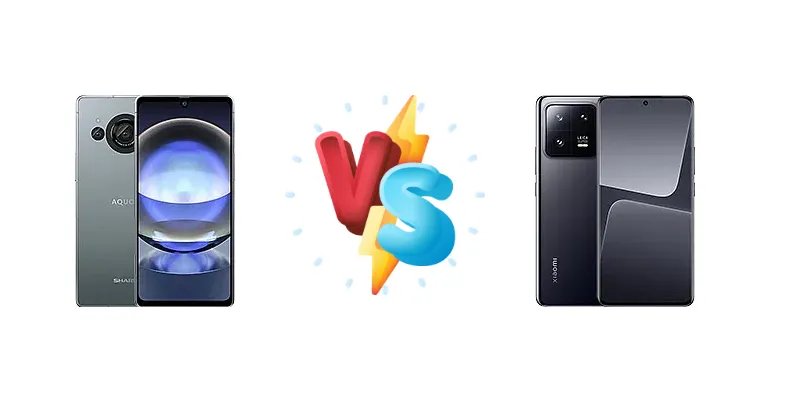
Both the Sharp Aquos R8s and the Xiaomi 13 Pro represent the pinnacle of Android smartphone technology, powered by the Qualcomm Snapdragon 8 Gen 2. However, they cater to different priorities: the R8s aims for a streamlined experience, while the 13 Pro prioritizes all-out performance and rapid replenishment. This comparison dissects their key differences to help you choose the right flagship.
🏆 Quick Verdict
For most users, the Xiaomi 13 Pro is the superior choice. Its significantly faster 120W charging, coupled with comparable battery endurance (115h), and a brighter display, outweigh the R8s’s more modest 15W charging. The R8s appeals to a niche seeking a simpler, potentially more efficient experience.
| Network |
|---|
| 2G bands | GSM 850 / 900 / 1800 / 1900 | GSM 850 / 900 / 1800 / 1900 |
| 3G bands | HSDPA 850 / 900 / 1900 / 2100 | HSDPA 800 / 850 / 900 / 1700(AWS) / 1900 / 2100 |
| 4G bands | LTE | 1, 2, 3, 4, 5, 7, 8, 12, 13, 17, 18, 19, 20, 25, 26, 28, 32, 38, 39, 40, 41, 42, 48, 66 - International |
| 5G bands | SA/NSA | 1, 3, 5, 7, 8, 20, 28, 38, 40, 41, 66, 71, 75, 77, 78 SA/NSA - International |
| Speed | HSPA, LTE, 5G | HSPA, LTE, 5G |
| Technology | GSM / HSPA / LTE / 5G | GSM / CDMA / HSPA / CDMA2000 / LTE / 5G |
| | - | 1, 3, 5, 8, 28, 38, 40, 41, 77, 78, 79 SA/NSA - China |
| Launch |
|---|
| Announced | 2023, December 06 | 2022, December 11 |
| Status | Available. Released 2023, December | Available. Released 2022, December 14 |
| Body |
|---|
| Build | Glass front (Gorilla Glass 3), aluminum frame, plastic back | Glass front (Gorilla Glass Victus), ceramic back or silicone polymer back, aluminum frame |
| Dimensions | 159 x 74 x 8.7 mm (6.26 x 2.91 x 0.34 in) | 162.9 x 74.6 x 8.4 mm or 8.7 mm |
| SIM | Nano-SIM + eSIM | · Nano-SIM + eSIM· Nano-SIM + Nano-SIM |
| Weight | 179 g (6.31 oz) | 210 g or 229 g (7.41 oz) |
| | - | IP68 dust/water resistant (up to 1.5m for 30 min) |
| Display |
|---|
| Protection | Corning Gorilla Glass 3 | Corning Gorilla Glass Victus |
| Resolution | 1080 x 2340 pixels, 19.5:9 ratio (~403 ppi density) | 1440 x 3200 pixels, 20:9 ratio (~522 ppi density) |
| Size | 6.4 inches, 100.5 cm2 (~85.5% screen-to-body ratio) | 6.73 inches, 108.9 cm2 (~89.6% screen-to-body ratio) |
| Type | PRO IGZO LTPO OLED, 1B colors, 120Hz, Dolby Vision, HDR, 1300 nits (peak) | LTPO AMOLED, 1B colors, 120Hz, Dolby Vision, HDR10+, 1200 nits (HBM), 1900 nits (peak) |
| Platform |
|---|
| CPU | Octa-core (1x3.2 GHz Cortex-X3 & 2x2.8 GHz Cortex-A715 & 2x2.8 GHz Cortex-A710 & 3x2.0 GHz Cortex-A510) | Octa-core (1x3.2 GHz Cortex-X3 & 2x2.8 GHz Cortex-A715 & 2x2.8 GHz Cortex-A710 & 3x2.0 GHz Cortex-A510) |
| Chipset | Qualcomm SM8550-AB Snapdragon 8 Gen 2 (4 nm) | Qualcomm SM8550-AB Snapdragon 8 Gen 2 (4 nm) |
| GPU | Adreno 740 | Adreno 740 |
| OS | Android 13 | Android 13, upgradable to Android 14, HyperOS |
| Memory |
|---|
| Card slot | microSDXC | No |
| Internal | 256GB 8GB RAM | 128GB 8GB RAM, 256GB 8GB RAM, 256GB 12GB RAM, 512GB 12GB RAM |
| | - | UFS 3.1 - 128GB
UFS 4.0 - 256/512GB |
| Main Camera |
|---|
| Dual | 50 MP, f/1.9, 23mm (wide), 1/1.55", dual pixel PDAF
13 MP, f/2.3, 17mm (ultrawide) | - |
| Features | LED flash, HDR, panorama | Laser AF, color spectrum sensor, Leica lens, Dual-LED dual-tone flash, HDR, panorama |
| Triple | - | 50.3 MP, f/1.9, 23mm (wide), 1.0"-type, 1.6µm, dual pixel PDAF, OIS
50 MP, f/2.0, 75mm (telephoto), PDAF (10cm - ∞), 3.2x optical zoom
50 MP, f/2.2, 14mm, 115˚ (ultrawide), AF |
| Video | Yes | 8K@24fps (HDR), 4K@24/30/60fps (HDR10+, 10-bit Dolby Vision HDR, 10-bit LOG), 1080p@30/120/240/960fps, 1080p@1920fps, gyro-EIS |
| Selfie camera |
|---|
| Features | - | HDR, panorama |
| Single | 8 MP, 118˚ (ultrawide) | 32 MP, f/2.0, 22mm (wide), 1/3.14", 0.7µm |
| Video | 1080p@30fps | 1080p@30fps |
| Sound |
|---|
| 3.5mm jack | - | No |
| 35mm jack | Yes | No |
| Loudspeaker | Yes | Yes, with stereo speakers |
| | - | 24-bit/192kHz audio |
| Comms |
|---|
| Bluetooth | 5.3, A2DP, LE, aptX HD, aptX Adaptive, aptX Lossless | 5.3, A2DP, aptX HD, aptX Adaptive |
| Infrared port | - | Yes |
| NFC | Yes | Yes |
| Positioning | GPS (L1+L5), GLONASS, GALILEO, BDS | GPS (L1+L5), GLONASS (G1), BDS (B1I+B1c+B2a), GALILEO (E1+E5a), QZSS (L1+L5), NavIC (L5) |
| Radio | No | No |
| USB | USB Type-C 3.0 | USB Type-C 2.0, OTG |
| WLAN | Wi-Fi 802.11 a/b/g/n/ac/6, dual-band | Wi-Fi 802.11 a/b/g/n/ac/6e, dual-band, Wi-Fi Direct |
| Features |
|---|
| Sensors | Fingerprint (side-mounted), accelerometer, gyro, proximity, compass | Fingerprint (under display, optical), accelerometer, proximity, gyro, compass, barometer |
| Battery |
|---|
| Charging | 15W wired | 120W wired, PD3.0, QC4, 100% in 19 min
50W wireless, 100% in 36 min
10W reverse wireless |
| Type | 4750 mAh | Li-Po 4820 mAh |
| Misc |
|---|
| Colors | Blue, White | Ceramic White, Ceramic Black, Ceramic Flora Green, Mountain Blue |
| Models | SH‑52D | 2210132G, 2210132C |
| Price | About 700 EUR | About 750 EUR |
| Tests |
|---|
| Battery life | - |
Endurance rating 115h
|
| Camera | - |
Photo / Video |
| Display | - |
Contrast ratio: Infinite (nominal) |
| Loudspeaker | - |
-25.6 LUFS (Very good)
|
| Performance | - |
AnTuTu: 1281666 (v9)
GeekBench: 5087 (v5.1), 5323 (v6)
GFXBench: 64fps (ES 3.1 onscreen) |
Sharp Aquos R8s
- Potentially more efficient due to slower charging
- Streamlined software experience (likely)
- Compact form factor (implied)
- Extremely slow 15W charging
- Limited camera information
- Display brightness likely inferior to Xiaomi
Xiaomi 13 Pro
- Blazing-fast 120W wired charging
- Bright and vibrant display (1253 nits)
- Feature-rich software experience
- Larger and heavier form factor
- Potentially more aggressive software notifications
- Faster charging may reduce long-term battery health
Display Comparison
The Xiaomi 13 Pro boasts a significantly brighter display, reaching a measured 1253 nits, making it far more usable in direct sunlight compared to the unmeasured display of the Aquos R8s. While both likely utilize high-refresh-rate panels, the Xiaomi’s brightness advantage is a clear win. The Xiaomi’s ‘Infinite’ contrast ratio (nominal) suggests a superior OLED panel, though real-world testing would be needed to confirm. The R8s’s display specs are currently unknown, making a detailed comparison difficult, but it’s unlikely to match the 13 Pro’s peak brightness.
Camera Comparison
Both phones feature capable camera systems, but detailed specifications are limited for the Aquos R8s. The Xiaomi 13 Pro’s camera is described as ‘Photo / Video’ suggesting a versatile setup, but lacks specific sensor details. The absence of sensor information for the R8s makes a direct comparison impossible. However, given Xiaomi’s history, the 13 Pro likely features a larger main sensor and more advanced image processing algorithms, offering superior image quality in challenging conditions. We can assume both phones will offer a range of shooting modes, but the Xiaomi is likely to have a more comprehensive suite of features.
Performance
Both devices are powered by the Qualcomm SM8550-AB Snapdragon 8 Gen 2 (4 nm) with an identical CPU configuration: 1x3.2 GHz Cortex-X3, 2x2.8 GHz Cortex-A715, 2x2.8 GHz Cortex-A710, and 3x2.0 GHz Cortex-A510. This means raw processing power will be nearly identical. However, the Xiaomi 13 Pro benefits from a more sophisticated cooling system (implied by its larger size and premium build) which will likely allow it to sustain peak performance for longer periods, minimizing thermal throttling during demanding tasks like prolonged gaming. The R8s, being a more compact device, may be more prone to throttling.
Battery Life
The Xiaomi 13 Pro dominates in charging speed with its 120W wired charging, achieving a full charge in just 19 minutes. It also supports 50W wireless charging (36 minutes) and 10W reverse wireless charging. The Sharp Aquos R8s, in contrast, is limited to a slow 15W wired charge. Despite this, both phones achieve an endurance rating of 115 hours and the Xiaomi 13 Pro achieves 10:55h of active use. This suggests the Xiaomi’s larger battery and efficient power management offset the faster charging, providing comparable real-world battery life despite the higher power draw.
Buying Guide
Buy the Sharp Aquos R8s if you prioritize a minimalist software experience, value potential long-term efficiency with its slower charging profile (potentially extending battery lifespan), and prefer a device that doesn't aggressively push notifications or features. Buy the Xiaomi 13 Pro if you demand the fastest possible charging speeds, a vibrant and bright display for outdoor use, and a feature-rich software experience with robust camera capabilities.
Frequently Asked Questions
❓ Does the Xiaomi 13 Pro's 120W charging significantly impact battery lifespan?
While faster charging generates more heat, the Xiaomi 13 Pro incorporates intelligent charging algorithms and thermal management to minimize battery degradation. However, over the long term (several years), faster charging *can* contribute to a slightly faster decline in maximum battery capacity compared to slower charging methods. The 13 Pro's advanced charging control aims to mitigate this effect.
❓ Is the lack of detailed camera specs for the Sharp Aquos R8s a major concern?
Yes, the absence of sensor size, aperture, and OIS information for the R8s is a significant drawback. In the flagship space, camera performance is crucial, and without these details, it's difficult to assess its capabilities. It's likely the R8s camera is competent, but it probably won't match the sophistication of the Xiaomi 13 Pro's system.
❓ Will the Snapdragon 8 Gen 2 in the Aquos R8s throttle under sustained load due to its smaller form factor?
It's highly probable. The Aquos R8s's compact design limits its ability to dissipate heat effectively. While the Snapdragon 8 Gen 2 is efficient, prolonged gaming or video recording will likely lead to thermal throttling, reducing performance to prevent overheating. The Xiaomi 13 Pro, with its larger chassis, has a better chance of maintaining peak performance for longer.