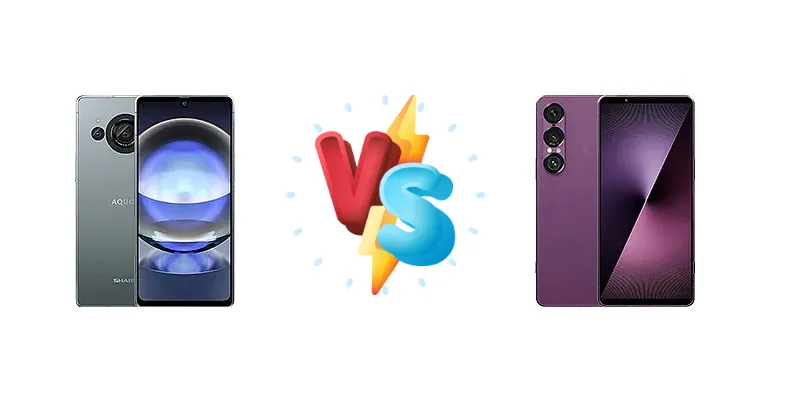
The Sony Xperia 1 VII represents Sony’s continued commitment to a premium, creator-focused smartphone experience, while the Sharp Aquos R8s aims to deliver flagship-level performance at a potentially more accessible price point. This comparison dissects the core differences between these two Android contenders, focusing on their processing power, display capabilities, and battery endurance.
🏆 Quick Verdict
For the average user prioritizing longevity and a refined experience, the Sony Xperia 1 VII emerges as the winner. Its Snapdragon 8 Elite chipset and exceptional battery endurance, backed by 30W fast charging, outweigh the Aquos R8s’s value proposition. However, the R8s remains a strong contender for budget-conscious buyers.
| Network |
|---|
| 2G bands | GSM 850 / 900 / 1800 / 1900 | GSM 850 / 900 / 1800 / 1900 |
| 3G bands | HSDPA 850 / 900 / 1900 / 2100 | HSDPA 800 / 850 / 900 / 1700(AWS) / 1900 / 2100 |
| 4G bands | LTE | 1, 2, 3, 4, 5, 7, 8, 12, 13, 17, 19, 20, 25, 26, 28, 32, 34, 38, 39, 40, 41, 66 - Europe |
| 5G bands | SA/NSA | 1, 3, 5, 7, 8, 20, 28, 38, 40, 41, 75, 77, 78 SA/NSA/Sub6 - Europe |
| Speed | HSPA, LTE, 5G | HSPA, LTE, 5G |
| Technology | GSM / HSPA / LTE / 5G | GSM / HSPA / LTE / 5G |
| Launch |
|---|
| Announced | 2023, December 06 | 2025, May 13 |
| Status | Available. Released 2023, December | Available. Released 2025, June 04 |
| Body |
|---|
| Build | Glass front (Gorilla Glass 3), aluminum frame, plastic back | Glass front (Gorilla Glass Victus 2), glass back (Gorilla Glass Victus), aluminum frame |
| Dimensions | 159 x 74 x 8.7 mm (6.26 x 2.91 x 0.34 in) | 162 x 74 x 8.2 mm (6.38 x 2.91 x 0.32 in) |
| SIM | Nano-SIM + eSIM | · Nano-SIM + eSIM· Nano-SIM + Nano-SIM |
| Weight | 179 g (6.31 oz) | 197 g (6.95 oz) |
| Display |
|---|
| Protection | Corning Gorilla Glass 3 | Corning Gorilla Glass Victus 2, Mohs level 5 |
| Resolution | 1080 x 2340 pixels, 19.5:9 ratio (~403 ppi density) | 1080 x 2340 pixels, 19.5:9 ratio (~396 ppi density) |
| Size | 6.4 inches, 100.5 cm2 (~85.5% screen-to-body ratio) | 6.5 inches, 103.7 cm2 (~86.5% screen-to-body ratio) |
| Type | PRO IGZO LTPO OLED, 1B colors, 120Hz, Dolby Vision, HDR, 1300 nits (peak) | LTPO OLED, 1B colors, 120Hz, HDR BT.2020 |
| Platform |
|---|
| CPU | Octa-core (1x3.2 GHz Cortex-X3 & 2x2.8 GHz Cortex-A715 & 2x2.8 GHz Cortex-A710 & 3x2.0 GHz Cortex-A510) | Octa-core (2x4.32 GHz Oryon V2 Phoenix L + 6x3.53 GHz Oryon V2 Phoenix M) |
| Chipset | Qualcomm SM8550-AB Snapdragon 8 Gen 2 (4 nm) | Qualcomm SM8750-AB Snapdragon 8 Elite (3 nm) |
| GPU | Adreno 740 | Adreno 830 |
| OS | Android 13 | Android 15, up to 4 major Android upgrades |
| Memory |
|---|
| Card slot | microSDXC | microSDXC (uses shared SIM slot) |
| Internal | 256GB 8GB RAM | 256GB 12GB RAM, 512GB 12GB RAM |
| Main Camera |
|---|
| Dual | 50 MP, f/1.9, 23mm (wide), 1/1.55", dual pixel PDAF
13 MP, f/2.3, 17mm (ultrawide) | - |
| Features | LED flash, HDR, panorama | Zeiss optics, Zeiss T* lens coating, color spectrum sensor, LED flash, panorama, HDR, eye tracking |
| Triple | - | 48 MP, f/1.9, 24mm (wide), 1/1.35", 1.12µm, dual pixel PDAF, OIS
12 MP, f/2.3, 85mm (telephoto), f/3.5, 170mm (telephoto), 1/3.5", 1.0µm, dual pixel PDAF, 3.5x-7.1x continuous optical zoom, OIS, 4cm macro @ 120mm, no AF
48 MP, f/2.0, 16mm (ultrawide), 1/1.56", 1.0µm, PDAF |
| Video | Yes | 4K@24/30/60/120fps HDR, 1080p@30/60/120fps; 5-axis gyro-EIS, OIS |
| Selfie camera |
|---|
| Features | - | HDR |
| Single | 8 MP, 118˚ (ultrawide) | 12 MP, f/2.0, 24mm (wide), 1/2.9", 1.22µm |
| Video | 1080p@30fps | 4K@30/60fps, 1080p@30/60fps, 5-axis gyro-EIS |
| Sound |
|---|
| 35mm jack | Yes | Yes |
| Loudspeaker | Yes | Yes, with stereo speakers |
| Comms |
|---|
| Bluetooth | 5.3, A2DP, LE, aptX HD, aptX Adaptive, aptX Lossless | 6.0, A2DP, LE Audio, aptX HD, aptX Adaptive, aptX Lossless |
| NFC | Yes | Yes |
| Positioning | GPS (L1+L5), GLONASS, GALILEO, BDS | GPS, GLONASS, BDS, GALILEO, QZSS |
| Radio | No | No |
| USB | USB Type-C 3.0 | USB Type-C 3.2, OTG, video output |
| WLAN | Wi-Fi 802.11 a/b/g/n/ac/6, dual-band | Wi-Fi 802.11 a/b/g/n/ac/6e/7, tri-band, Wi-Fi Direct, DLNA |
| Features |
|---|
| Sensors | Fingerprint (side-mounted), accelerometer, gyro, proximity, compass | Fingerprint (side-mounted), accelerometer, gyro, proximity, barometer, compass |
| Battery |
|---|
| Charging | 15W wired | 30W wired, PD3.0, PPS, 50% in 30 min
15W wireless
Reverse wireless |
| Type | 4750 mAh | 5000 mAh |
| Misc |
|---|
| Colors | Blue, White | Moss Green, Orchid Purple, Slate Black |
| Models | SH‑52D | XQ-FS54, XQFS54EUKCG.GC, XQFS54EUKCV.GC, XQFS54EUKCB.GC, PDX256 |
| Price | About 700 EUR | € 1,338.99 / $ 1,394.99 / £ 1,149.94 |
| EU LABEL |
|---|
| Battery | - | 43:30h endurance, 1400 cycles |
| Energy | - | Class B |
| Free fall | - | Class B (181 falls) |
| Repairability | - | Class D |
Sharp Aquos R8s
- Flagship Snapdragon 8 Gen 2 processor
- Potentially more affordable price
- Compact form factor (assumed based on Sharp's history)
- Slow 15W wired charging
- Limited battery endurance data
- Missing display specifications
Sony Xperia 1 VII
- Cutting-edge Snapdragon 8 Elite chipset (3nm)
- Exceptional battery life (43:30h endurance)
- Fast 30W wired charging with PD3.0/PPS
- Bright 1475 nits display
- Higher price point
- Larger size compared to potential R8s
- Sony's software experience isn't for everyone
Display Comparison
The Sony Xperia 1 VII boasts a significantly brighter display, reaching a measured peak of 1475 nits, ensuring excellent visibility even in direct sunlight. While the Aquos R8s’s display specifications are not provided, Sony’s history suggests a high-quality panel, but likely lacking the same peak brightness. The Xperia 1 VII’s display technology likely incorporates LTPO for adaptive refresh rates, contributing to power efficiency. The absence of detailed display specs for the R8s makes a direct comparison difficult, but the Xperia 1 VII clearly leads in measured brightness.
Camera Comparison
Without specific camera details for the Aquos R8s, a direct comparison is limited. However, Sony’s Xperia line is renowned for its camera capabilities, and the 1 VII likely features advanced image processing algorithms and potentially larger sensor sizes. The Xperia 1 VII’s image processing benefits from the increased processing power of the Snapdragon 8 Elite, enabling faster image capture and more sophisticated computational photography features. The Aquos R8s, while equipped with a capable Snapdragon 8 Gen 2, may not match the Xperia 1 VII’s image quality in challenging lighting conditions.
Performance
The core difference lies in the chipsets: the Xperia 1 VII utilizes the Qualcomm SM8750-AB Snapdragon 8 Elite (3nm), while the Aquos R8s features the SM8550-AB Snapdragon 8 Gen 2 (4nm). The 3nm process node of the Snapdragon 8 Elite offers substantial gains in power efficiency and transistor density compared to the 4nm node of the Gen 2. This translates to potentially lower thermal throttling during sustained workloads and improved overall performance. The Xperia 1 VII’s CPU, with its Oryon V2 Phoenix cores (2x4.32 GHz + 6x3.53 GHz), is architecturally superior to the Aquos R8s’s Cortex-X3 and A715/A710 configuration, promising faster processing speeds. The Xperia 1 VII’s superior chipset will benefit gamers, video editors, and power users.
Battery Life
The Sony Xperia 1 VII excels in battery performance, offering a remarkable 43:30h endurance and a 15:32h active use score. This is coupled with 30W wired charging (PD3.0, PPS) capable of delivering a 50% charge in just 30 minutes, alongside 15W wireless and reverse wireless charging. The Aquos R8s, limited to 15W wired charging, will take significantly longer to fully charge. While the Aquos R8s’s battery capacity isn’t specified, the Xperia 1 VII’s superior charging speed and endurance provide a clear advantage for users who demand all-day battery life and quick top-ups.
Buying Guide
Buy the Sharp Aquos R8s if you need a powerful phone with a flagship-tier processor but are unwilling to pay a premium for features like wireless charging or extended battery life. Buy the Sony Xperia 1 VII if you prioritize all-day battery life, faster charging speeds, and a more comprehensive feature set, even at a higher price point. The Xperia 1 VII caters to users who demand a premium, polished experience.
Frequently Asked Questions
❓ Does the Snapdragon 8 Gen 2 in the Aquos R8s suffer from significant thermal throttling during extended gaming sessions?
While the Snapdragon 8 Gen 2 is a powerful chip, its 4nm process is less efficient than the 3nm Snapdragon 8 Elite in the Xperia 1 VII. This means the Aquos R8s is more likely to experience thermal throttling during prolonged, demanding tasks like gaming, potentially leading to reduced performance over time. The Xperia 1 VII’s superior thermal management should maintain higher sustained performance.
❓ How does the 30W charging on the Xperia 1 VII compare to the 15W charging on the Aquos R8s in real-world usage?
The Xperia 1 VII’s 30W charging, utilizing PD3.0 and PPS, can deliver a 50% charge in approximately 30 minutes. The Aquos R8s’s 15W charging will take considerably longer – likely over an hour to reach 50% and over two hours for a full charge. This difference is significant for users who frequently need to quickly top up their battery.
❓ Is the lack of wireless charging on the Aquos R8s a major drawback?
For users accustomed to the convenience of wireless charging, the absence of this feature on the Aquos R8s is a notable omission. The Xperia 1 VII offers both 15W wireless charging and reverse wireless charging, providing greater flexibility and convenience. If wireless charging is a priority, the Xperia 1 VII is the clear choice.