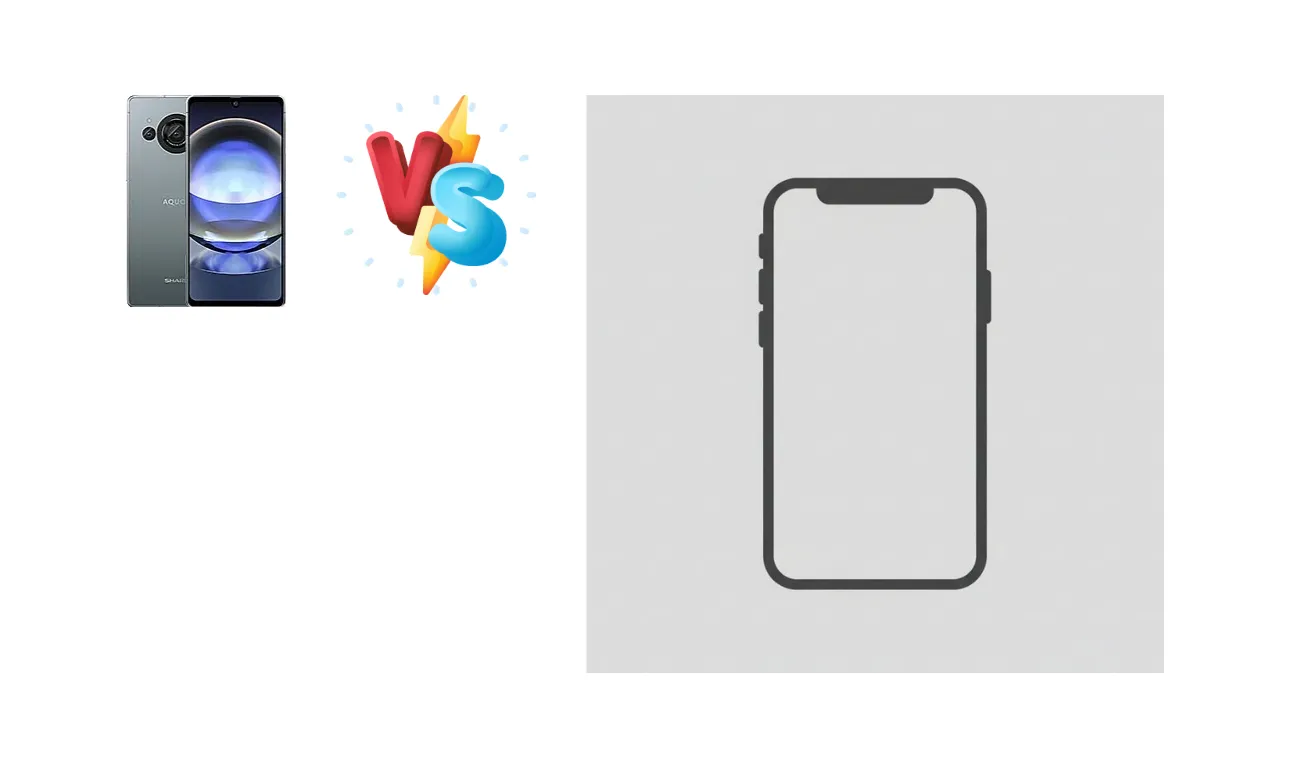
The Sharp Aquos R8s and Samsung Galaxy S23+ both leverage the potent Snapdragon 8 Gen 2, but cater to different philosophies. The R8s aims for a focused, streamlined experience, while the S23+ represents Samsung’s all-rounder approach. This comparison dissects their key differences, focusing on performance, battery, and charging to determine which device delivers the best value.
🏆 Quick Verdict
For most users, the Samsung Galaxy S23+ is the superior choice. Its significantly faster 45W charging, wireless charging capabilities, and proven endurance rating of 111 hours outweigh the R8s’s marginal CPU clock speed advantage. While the R8s offers a clean software experience, the S23+'s broader feature set and convenience are more compelling.
| Network |
|---|
| 2G bands | GSM 850 / 900 / 1800 / 1900 | GSM 850 / 900 / 1800 / 1900 - SIM 1 & SIM 2 (Dual SIM model only) |
| 3G bands | HSDPA 850 / 900 / 1900 / 2100 | HSDPA 850 / 900 / 1700(AWS) / 1900 / 2100 |
| 4G bands | LTE | 1, 2, 3, 4, 5, 7, 8, 12, 13, 17, 18, 19, 20, 25, 26, 28, 32, 38, 39, 40, 41, 66 - International |
| 5G bands | SA/NSA | 1, 2, 3, 5, 7, 8, 12, 20, 25, 28, 38, 40, 41, 66, 75, 77, 78 SA/NSA/Sub6 - International |
| Speed | HSPA, LTE, 5G | HSPA, LTE-A (up to 7CA), 5G |
| Technology | GSM / HSPA / LTE / 5G | GSM / CDMA / HSPA / EVDO / LTE / 5G |
| | - | 1, 7, 28, 41, 66, 71, 78, 258, 260, 261 SA/NSA/Sub6/mmWave - USA |
| Launch |
|---|
| Announced | 2023, December 06 | 2023, February 01 |
| Status | Available. Released 2023, December | Available. Released 2023, February 17 |
| Body |
|---|
| Build | Glass front (Gorilla Glass 3), aluminum frame, plastic back | Glass front (Gorilla Glass Victus 2), glass back (Gorilla Glass Victus 2), aluminum frame |
| Dimensions | 159 x 74 x 8.7 mm (6.26 x 2.91 x 0.34 in) | 157.8 x 76.2 x 7.6 mm (6.21 x 3.00 x 0.30 in) |
| SIM | Nano-SIM + eSIM | Nano-SIM and eSIM or Dual SIM (2 Nano-SIMs and eSIM, dual stand-by) |
| Weight | 179 g (6.31 oz) | 196 g (6.91 oz) |
| | - | IP68 dust/water resistant (up to 1.5m for 30 min)
Armor aluminum frame with tougher drop and scratch resistance (advertised) |
| Display |
|---|
| Protection | Corning Gorilla Glass 3 | Corning Gorilla Glass Victus 2 |
| Resolution | 1080 x 2340 pixels, 19.5:9 ratio (~403 ppi density) | 1080 x 2340 pixels, 19.5:9 ratio (~393 ppi density) |
| Size | 6.4 inches, 100.5 cm2 (~85.5% screen-to-body ratio) | 6.6 inches, 105.3 cm2 (~87.6% screen-to-body ratio) |
| Type | PRO IGZO LTPO OLED, 1B colors, 120Hz, Dolby Vision, HDR, 1300 nits (peak) | Dynamic AMOLED 2X, 120Hz, HDR10+, 1200 nits (HBM), 1750 nits (peak) |
| | - | Always-on display |
| Platform |
|---|
| CPU | Octa-core (1x3.2 GHz Cortex-X3 & 2x2.8 GHz Cortex-A715 & 2x2.8 GHz Cortex-A710 & 3x2.0 GHz Cortex-A510) | Octa-core (1x3.36 GHz Cortex-X3 & 2x2.8 GHz Cortex-A715 & 2x2.8 GHz Cortex-A710 & 3x2.0 GHz Cortex-A510) |
| Chipset | Qualcomm SM8550-AB Snapdragon 8 Gen 2 (4 nm) | Qualcomm SM8550-AC Snapdragon 8 Gen 2 (4 nm) |
| GPU | Adreno 740 | Adreno 740 |
| OS | Android 13 | Android 13, One UI 5.1 |
| Memory |
|---|
| Card slot | microSDXC | No |
| Internal | 256GB 8GB RAM | 256GB 8GB RAM, 512GB 8GB RAM |
| | - | UFS 4.0 |
| Main Camera |
|---|
| Dual | 50 MP, f/1.9, 23mm (wide), 1/1.55", dual pixel PDAF
13 MP, f/2.3, 17mm (ultrawide) | - |
| Features | LED flash, HDR, panorama | LED flash, auto-HDR, panorama |
| Triple | - | 50 MP, f/1.8, 24mm (wide), 1/1.56", 1.0µm, Dual Pixel PDAF, OIS
10 MP, f/2.4, 70mm (telephoto), 1/3.94", 1.0µm, PDAF, OIS, 3x optical zoom
12 MP, f/2.2, 13mm, 120˚ (ultrawide), 1/2.55" 1.4µm, Super Steady video |
| Video | Yes | 8K@24/30fps, 4K@30/60fps, 1080p@30/60/240fps, 1080p@960fps, HDR10+, stereo sound rec., gyro-EIS |
| Selfie camera |
|---|
| Features | - | Dual video call, Auto-HDR, HDR10+ |
| Single | 8 MP, 118˚ (ultrawide) | 12 MP, f/2.2, 26mm (wide), Dual Pixel PDAF |
| Video | 1080p@30fps | 4K@30/60fps, 1080p@30fps |
| Sound |
|---|
| 3.5mm jack | - | No |
| 35mm jack | Yes | - |
| Loudspeaker | Yes | Yes, with stereo speakers |
| | - | 32-bit/384kHz audio
Tuned by AKG |
| Comms |
|---|
| Bluetooth | 5.3, A2DP, LE, aptX HD, aptX Adaptive, aptX Lossless | 5.3, A2DP, LE |
| NFC | Yes | Yes |
| Positioning | GPS (L1+L5), GLONASS, GALILEO, BDS | GPS, GLONASS, BDS, GALILEO |
| Radio | No | No |
| USB | USB Type-C 3.0 | USB Type-C 3.2, OTG |
| WLAN | Wi-Fi 802.11 a/b/g/n/ac/6, dual-band | Wi-Fi 802.11 a/b/g/n/ac/6e, tri-band, Wi-Fi Direct |
| Features |
|---|
| Sensors | Fingerprint (side-mounted), accelerometer, gyro, proximity, compass | Fingerprint (under display, ultrasonic), accelerometer, gyro, proximity, compass, barometer |
| | - | Samsung DeX, Samsung Wireless DeX (desktop experience support)
Bixby natural language commands and dictation
Samsung Pay (Visa, MasterCard certified)
Ultra Wideband (UWB) support |
| Battery |
|---|
| Charging | 15W wired | 45W wired, PD3.0, 65% in 30 min (advertised)
15W wireless (Qi/PMA)
4.5W reverse wireless |
| Type | 4750 mAh | Li-Ion 4700 mAh, non-removable |
| Misc |
|---|
| Colors | Blue, White | Phantom Black, Cream, Green, Lavender, Graphite, Lime |
| Models | SH‑52D | SM-S916B, SM-S916B/DS, SM-S916U, SM-S916U1, SM-S916W, SM-S916N, SM-S9160, SM-S916E, SM-S916E/DS |
| Price | About 700 EUR | $ 780.00 / C$ 1,399.99 / £ 919.08 / € 1,185.89 / ₹ 94,999 |
| SAR | - | 0.95 W/kg (head) 1.04 W/kg (body) |
| SAR EU | - | 0.77 W/kg (head) 1.45 W/kg (body) |
| Tests |
|---|
| Battery life | - | Endurance rating 111h |
| Camera | - | Photo / Video |
| Display | - | Contrast ratio: Infinite (nominal) |
| Loudspeaker | - | -26.5 LUFS (Good) |
| Performance | - | AnTuTu: 1234077 (v9)
GeekBench: 5073 (v5.1)
GFXBench: 110fps (ES 3.1 onscreen) |
Sharp Aquos R8s
- Potentially cleaner software experience
- Snapdragon 8 Gen 2 performance
- May be more affordable
- Significantly slower 15W charging
- Lack of wireless charging
- Limited battery life information
Samsung Galaxy S23+
- 45W fast charging with PD3.0
- 15W wireless charging and reverse wireless
- Excellent 111-hour endurance rating
- Samsung’s One UI software can be bloated
- Potentially higher price point
- May require more frequent software updates
Display Comparison
While both phones utilize high-quality displays, the provided data lacks specifics on the Aquos R8s’s panel. The Galaxy S23+ boasts an 'Infinite' contrast ratio, suggesting a superior OLED panel with excellent black levels. Given Samsung’s display expertise, it’s likely the S23+ offers higher peak brightness and potentially better color accuracy. The absence of display details for the R8s makes a direct comparison difficult, but Samsung typically leads in display technology.
Camera Comparison
The provided data doesn’t detail camera specifications beyond the presence of photo/video capabilities. However, Samsung’s Galaxy S23+ is expected to have a more sophisticated camera system with larger sensors, optical image stabilization (OIS), and advanced image processing algorithms. The R8s likely offers a competent camera, but it’s unlikely to match the S23+’s versatility and image quality, particularly in low-light conditions. The absence of sensor size or aperture information for the R8s hinders a precise comparison.
Performance
Both devices are powered by the Qualcomm Snapdragon 8 Gen 2 (4nm), but the S23+ features a slightly higher clocked Cortex-X3 prime core at 3.36 GHz versus the R8s’s 3.2 GHz. This difference, while small, could translate to marginally faster single-core performance in demanding tasks. Both utilize the same Cortex-A715, A710, and A510 cores, ensuring similar multi-core performance. The 4nm process node ensures excellent thermal efficiency, minimizing throttling during sustained workloads. However, Samsung’s superior thermal management solutions, historically, may give it a slight edge in prolonged gaming sessions.
Battery Life
The Galaxy S23+’s 111-hour endurance rating demonstrates a significant advantage in battery life. While the R8s’s battery capacity is unknown, the S23+’s combination of efficient chipset and optimized software delivers exceptional longevity. Crucially, the S23+ supports 45W wired charging, achieving 65% charge in 30 minutes (advertised), alongside 15W wireless and 4.5W reverse wireless charging. The R8s is limited to a slow 15W wired charge, making it considerably less convenient for users who need quick top-ups.
Buying Guide
Buy the Sharp Aquos R8s if you prioritize a minimalist software experience and are comfortable with slower charging speeds. It’s ideal for users who value simplicity and don’t rely heavily on wireless charging or extensive camera features. Buy the Samsung Galaxy S23+ if you prefer a feature-rich flagship with fast wired and wireless charging, a more versatile camera system, and a longer-lasting battery, even if it means a more complex software environment.
Frequently Asked Questions
❓ Does the slower 15W charging on the Sharp Aquos R8s make it impractical for daily use?
The 15W charging is a significant drawback. While it will charge the device overnight, users accustomed to fast charging will find it frustratingly slow for quick top-ups. The S23+'s 45W charging is a game-changer for convenience.
❓ Is the slightly higher CPU clock speed on the Galaxy S23+ noticeable in real-world performance?
The 0.16 GHz difference in CPU clock speed is unlikely to be noticeable in most everyday tasks. Both phones are incredibly powerful, and the Snapdragon 8 Gen 2 handles demanding applications with ease. The difference might be measurable in synthetic benchmarks, but not in practical usage.
❓ How does Samsung's One UI software impact the user experience compared to a potentially cleaner experience on the Aquos R8s?
Samsung's One UI is feature-rich but can feel bloated to some users. It includes numerous customization options and pre-installed apps. The Aquos R8s likely offers a more streamlined and minimalist software experience, appealing to those who prefer a 'stock' Android feel. However, One UI has improved significantly in recent years and offers a polished experience for many.