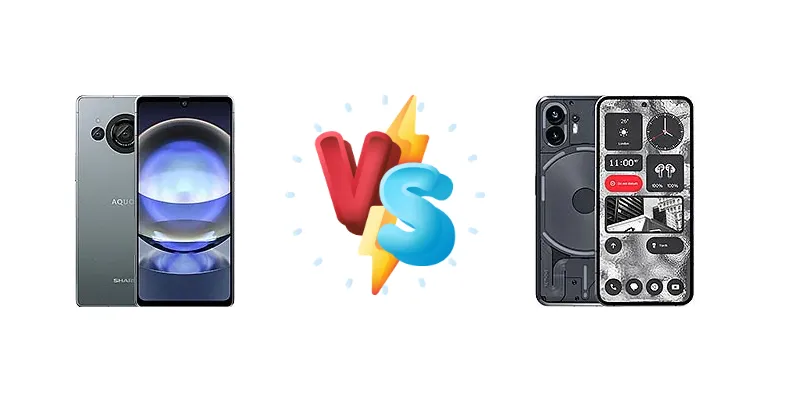
The Sharp Aquos R8s and Nothing Phone (2) represent distinct approaches to the flagship smartphone market. The R8s prioritizes raw processing power with the latest Snapdragon 8 Gen 2, while the Nothing Phone (2) focuses on a balanced experience with a unique design, fast charging, and impressive battery endurance. This comparison dissects their key differences to help you choose the right device.
🏆 Quick Verdict
For the average user prioritizing sustained performance and future-proofing, the Sharp Aquos R8s is the superior choice thanks to its Snapdragon 8 Gen 2. However, the Nothing Phone (2) offers a compelling alternative with significantly faster charging and longer battery life, making it ideal for users on the go.
| Network |
|---|
| 2G bands | GSM 850 / 900 / 1800 / 1900 | GSM 850 / 900 / 1800 / 1900 |
| 3G bands | HSDPA 850 / 900 / 1900 / 2100 | HSDPA 800 / 850 / 900 / 1700(AWS) / 1900 / 2100 |
| 4G bands | LTE | 1, 2, 3, 4, 5, 7, 8, 12, 17, 18, 19, 20, 25, 26, 28, 30, 32, 34, 38, 39, 40, 41, 42, 48, 66, 71 |
| 5G bands | SA/NSA | 1, 2, 3, 5, 7, 8, 12, 20, 25, 28, 30, 38, 40, 41, 66, 71, 75, 77, 78 SA/NSA |
| Speed | HSPA, LTE, 5G | HSPA, LTE, 5G |
| Technology | GSM / HSPA / LTE / 5G | GSM / HSPA / LTE / 5G |
| Launch |
|---|
| Announced | 2023, December 06 | 2023, July 11 |
| Status | Available. Released 2023, December | Available. Released 2023, July 17 |
| Body |
|---|
| Build | Glass front (Gorilla Glass 3), aluminum frame, plastic back | Glass front (Gorilla Glass 5), glass back (Gorilla Glass 5), aluminum frame |
| Dimensions | 159 x 74 x 8.7 mm (6.26 x 2.91 x 0.34 in) | 162.1 x 76.4 x 8.6 mm (6.38 x 3.01 x 0.34 in) |
| SIM | Nano-SIM + eSIM | Nano-SIM + Nano-SIM |
| Weight | 179 g (6.31 oz) | 201.2 g (7.09 oz) |
| Display |
|---|
| Protection | Corning Gorilla Glass 3 | Corning Gorilla Glass 5 |
| Resolution | 1080 x 2340 pixels, 19.5:9 ratio (~403 ppi density) | 1080 x 2412 pixels, 20:9 ratio (~394 ppi density) |
| Size | 6.4 inches, 100.5 cm2 (~85.5% screen-to-body ratio) | 6.7 inches, 108.0 cm2 (~87.2% screen-to-body ratio) |
| Type | PRO IGZO LTPO OLED, 1B colors, 120Hz, Dolby Vision, HDR, 1300 nits (peak) | LTPO OLED, 1B colors, 120Hz, 1920Hz PWM, HDR10+, 1600 nits (HBM), 1600 nits (peak) |
| Platform |
|---|
| CPU | Octa-core (1x3.2 GHz Cortex-X3 & 2x2.8 GHz Cortex-A715 & 2x2.8 GHz Cortex-A710 & 3x2.0 GHz Cortex-A510) | Octa-core (1x3.0 GHz Cortex-X2 & 3x2.5 GHz Cortex-A710 & 4x1.80 GHz Cortex-A510) |
| Chipset | Qualcomm SM8550-AB Snapdragon 8 Gen 2 (4 nm) | Qualcomm SM8475 Snapdragon 8+ Gen 1 (4 nm) |
| GPU | Adreno 740 | Adreno 730 |
| OS | Android 13 | Android 13, upgradable to Android 15, up to 3 major Android upgrades, Nothing OS 3.0 |
| Memory |
|---|
| Card slot | microSDXC | No |
| Internal | 256GB 8GB RAM | 128GB 8GB RAM, 256GB 12GB RAM, 512GB 12GB RAM |
| Main Camera |
|---|
| Dual | 50 MP, f/1.9, 23mm (wide), 1/1.55", dual pixel PDAF
13 MP, f/2.3, 17mm (ultrawide) | 50 MP, f/1.9, 24mm (wide), 1/1.56", 1.0µm, PDAF, OIS
50 MP, f/2.2, 114˚ (ultrawide), 1/2.76", 0.64µm, AF |
| Features | LED flash, HDR, panorama | LED flash, panorama, HDR |
| Video | Yes | 4K@30/60fps, 1080p@30/60fps, gyro-EIS, live HDR, OIS |
| Selfie camera |
|---|
| Features | - | HDR |
| Single | 8 MP, 118˚ (ultrawide) | 32 MP, f/2.5, (wide), 1/2.74", 0.8µm |
| Video | 1080p@30fps | 1080p@30fps |
| Sound |
|---|
| 35mm jack | Yes | No |
| Loudspeaker | Yes | Yes, with stereo speakers |
| Comms |
|---|
| Bluetooth | 5.3, A2DP, LE, aptX HD, aptX Adaptive, aptX Lossless | 5.3, A2DP, LE, aptX HD, aptX Adaptive |
| NFC | Yes | Yes |
| Positioning | GPS (L1+L5), GLONASS, GALILEO, BDS | GPS (L1+L5), GLONASS (L1), BDS (B1I+B1c), GALILEO (E1), QZSS (L1), NavIC |
| Radio | No | No |
| USB | USB Type-C 3.0 | USB Type-C 2.0, OTG |
| WLAN | Wi-Fi 802.11 a/b/g/n/ac/6, dual-band | Wi-Fi 802.11 a/b/g/n/ac/6, dual-band, Wi-Fi Direct |
| Features |
|---|
| Sensors | Fingerprint (side-mounted), accelerometer, gyro, proximity, compass | Fingerprint (under display, optical), accelerometer, proximity, gyro, compass |
| Battery |
|---|
| Charging | 15W wired | 45W wired, PD3.0, PPS, QC4, 100% in 55 min
15W wireless, 100% in 130 min
5W reverse wireless |
| Type | 4750 mAh | Li-Ion 4700 mAh |
| Misc |
|---|
| Colors | Blue, White | White, Dark Gray |
| Models | SH‑52D | A065 |
| Price | About 700 EUR | $ 379.99 / £ 370.00 |
Sharp Aquos R8s
- Superior processing power with Snapdragon 8 Gen 2
- More efficient CPU architecture for sustained performance
- Potential for better thermal management
- Significantly slower 15W charging
- Limited battery information
- Camera specs are currently unknown
Nothing Phone (2)
- Excellent battery life (14:21h active use, 103h endurance)
- Fast 45W wired charging with PD3.0, PPS, and QC4
- 15W wireless and 5W reverse wireless charging
- Less powerful Snapdragon 8+ Gen 1 chipset
- May throttle under sustained heavy load
- Glyph Interface is a polarizing design element
Display Comparison
The Nothing Phone (2) boasts a measured peak brightness of 998 nits, a respectable figure for outdoor visibility. While the Aquos R8s’ display specifications are not provided, Sharp historically focuses on color accuracy. The absence of LTPO information for the R8s suggests it may not have a variable refresh rate, potentially impacting battery life compared to the Phone (2)'s adaptive refresh rate. The Phone (2)'s Glyph Interface, while a design choice, doesn't directly impact display quality but adds a unique visual element.
Camera Comparison
Without detailed camera specifications for the Aquos R8s, a direct comparison is limited. However, the Nothing Phone (2) emphasizes both photo and video capabilities. The absence of sensor size information for the R8s makes it difficult to assess its low-light performance. The Phone (2)'s image processing is known for its natural color reproduction, while Sharp often leans towards more vibrant, saturated images. The lack of information regarding OIS on the R8s is a concern, as stabilization is crucial for sharp photos and smooth videos.
Performance
The Sharp Aquos R8s’ Snapdragon 8 Gen 2 (4nm) represents a significant leap in performance over the Nothing Phone (2)’s Snapdragon 8+ Gen 1 (4nm). The Gen 2 features a newer CPU architecture – Cortex-X3 vs Cortex-X2 – and a more efficient process node, translating to higher sustained performance and improved thermal management. The R8s’ CPU configuration (1x3.2 GHz Cortex-X3, 2x2.8 GHz Cortex-A715, 2x2.8 GHz Cortex-A710, 3x2.0 GHz Cortex-A510) is optimized for both peak performance and efficiency, while the Phone (2)'s (1x3.0 GHz Cortex-X2, 3x2.5 GHz Cortex-A710, 4x1.80 GHz Cortex-A510) is slightly less aggressive. This difference will be most noticeable in graphically intensive games and demanding applications.
Battery Life
The Nothing Phone (2) excels in battery performance, achieving an active use score of 14:21h and an endurance rating of 103h. This is significantly bolstered by its 45W wired charging (100% in 55 minutes), 15W wireless charging (100% in 130 minutes), and 5W reverse wireless charging. In contrast, the Aquos R8s is limited to 15W wired charging, a substantial disadvantage in terms of recharge speed. While the R8s’ battery capacity is unknown, the slower charging speed suggests it may need to be topped up more frequently, despite the efficiency gains of the Snapdragon 8 Gen 2.
Buying Guide
Buy the Sharp Aquos R8s if you demand the absolute best Android performance for demanding tasks like gaming or video editing, and aren't overly concerned with charging speed. Buy the Nothing Phone (2) if you value all-day battery life, rapid charging capabilities (both wired and wireless), and a distinctive, software-focused user experience.
Frequently Asked Questions
❓ Does the Snapdragon 8 Gen 2 in the Aquos R8s get noticeably hotter than the Snapdragon 8+ Gen 1 in the Nothing Phone (2) during extended gaming sessions?
While the Snapdragon 8 Gen 2 is more efficient, its higher peak performance can generate more heat under sustained load. However, the improved thermal design often found in flagship devices like the R8s should mitigate this, preventing significant throttling. The Phone (2) may throttle sooner, but will likely remain cooler overall.
❓ How does the 15W charging on the Aquos R8s compare to the 45W charging on the Nothing Phone (2) in a real-world scenario?
The 45W charging on the Nothing Phone (2) will fully charge the device in approximately 55 minutes, while the 15W charging on the Aquos R8s will take significantly longer – likely over two hours. This difference is substantial for users who frequently need to quickly top up their battery.
❓ Is the Glyph Interface on the Nothing Phone (2) a significant battery drain?
The Glyph Interface's impact on battery life is minimal. Nothing has optimized the system to be energy-efficient, and users can customize its behavior to minimize power consumption. It's unlikely to noticeably reduce overall battery endurance.