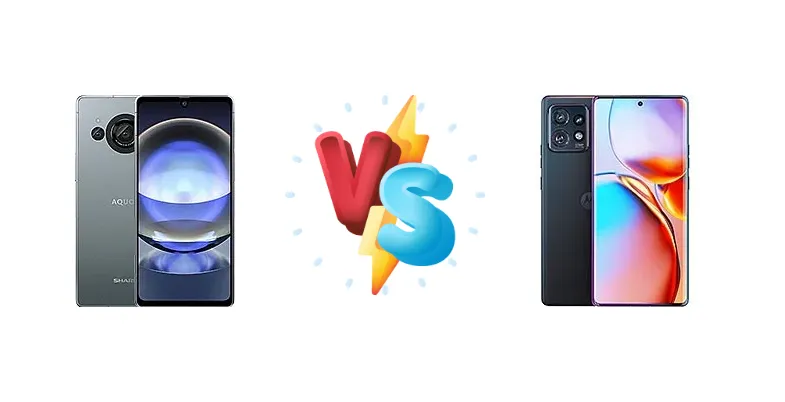
The Sharp Aquos R8s and Motorola Edge+ (2023) both center around Qualcomm’s Snapdragon 8 Gen 2, promising top-tier performance. However, they diverge significantly in charging capabilities and likely form factor, catering to different user priorities. This comparison dissects these differences to determine which device delivers the best overall experience.
🏆 Quick Verdict
For the average user prioritizing convenience and speed, the Motorola Edge+ (2023) is the clear winner. Its 68W wired and 15W wireless charging drastically outperform the R8s’ 15W wired-only solution. While the R8s may appeal to those seeking a potentially more compact design, the Edge+ offers a more complete flagship package.
| Network |
|---|
| 2G bands | GSM 850 / 900 / 1800 / 1900 | GSM 850 / 900 / 1800 / 1900 |
| 3G bands | HSDPA 850 / 900 / 1900 / 2100 | HSDPA 850 / 900 / 1700(AWS) / 1900 / 2100 |
| 4G bands | LTE | 1, 2, 3, 4, 5, 7, 8, 12, 13, 14, 17, 18, 20, 25, 26, 28, 29, 30, 38, 39, 40, 41, 41, 46, 48, 66, 71 |
| 5G bands | SA/NSA | 1, 2, 3, 5, 7, 12, 14, 20, 25, 26, 28, 29, 30, 38, 41, 41, 48, 66, 70, 71, 77, 78 SA/NSA/Sub6/mmWave |
| Speed | HSPA, LTE, 5G | HSPA, LTE, 5G |
| Technology | GSM / HSPA / LTE / 5G | GSM / HSPA / LTE / 5G |
| Launch |
|---|
| Announced | 2023, December 06 | 2023, May 02 |
| Status | Available. Released 2023, December | Available. Released 2023, May 19 |
| Body |
|---|
| Build | Glass front (Gorilla Glass 3), aluminum frame, plastic back | Glass front (Gorilla Glass Victus), glass back (Gorilla Glass Victus), aluminum frame |
| Dimensions | 159 x 74 x 8.7 mm (6.26 x 2.91 x 0.34 in) | 161.2 x 74 x 8.6 mm (6.35 x 2.91 x 0.34 in) |
| SIM | Nano-SIM + eSIM | Nano-SIM + eSIM |
| Weight | 179 g (6.31 oz) | 203 g (7.16 oz) |
| | - | IP68 dust/water resistant (up to 1.5m for 30 min) |
| Display |
|---|
| Protection | Corning Gorilla Glass 3 | Corning Gorilla Glass Victus |
| Resolution | 1080 x 2340 pixels, 19.5:9 ratio (~403 ppi density) | 1080 x 2400 pixels, 20:9 ratio (~395 ppi density) |
| Size | 6.4 inches, 100.5 cm2 (~85.5% screen-to-body ratio) | 6.67 inches, 107.4 cm2 (~90.0% screen-to-body ratio) |
| Type | PRO IGZO LTPO OLED, 1B colors, 120Hz, Dolby Vision, HDR, 1300 nits (peak) | OLED, 1B colors, 165Hz, HDR10+, Dolby Vision, 1300 nits (peak) |
| Platform |
|---|
| CPU | Octa-core (1x3.2 GHz Cortex-X3 & 2x2.8 GHz Cortex-A715 & 2x2.8 GHz Cortex-A710 & 3x2.0 GHz Cortex-A510) | Octa-core (1x3.2 GHz Cortex-X3 & 2x2.8 GHz Cortex-A715 & 2x2.8 GHz Cortex-A710 & 3x2.0 GHz Cortex-A510) |
| Chipset | Qualcomm SM8550-AB Snapdragon 8 Gen 2 (4 nm) | Qualcomm SM8550-AB Snapdragon 8 Gen 2 (4 nm) |
| GPU | Adreno 740 | Adreno 740 |
| OS | Android 13 | Android 13, upgradable to Android 14 |
| Memory |
|---|
| Card slot | microSDXC | No |
| Internal | 256GB 8GB RAM | 512GB 8GB RAM |
| | - | UFS 4.0 |
| Main Camera |
|---|
| Dual | 50 MP, f/1.9, 23mm (wide), 1/1.55", dual pixel PDAF
13 MP, f/2.3, 17mm (ultrawide) | - |
| Features | LED flash, HDR, panorama | Dual-LED flash, panorama, HDR |
| Triple | - | 50 MP, f/1.8, (wide), 1/1.55", 1.0µm, multi-directional PDAF, OIS
12 MP, f/1.6, (telephoto), 1/2.93", 1.22µm, PDAF, 2x optical zoom
50 MP, f/2.2, 114˚ (ultrawide), 1/2.76", 0.64µm, AF |
| Video | Yes | 8K@30fps, 4K@30/60fps, 1080p@30/60/120/240/960fps, 10-bit HDR10+, gyro-EIS |
| Selfie camera |
|---|
| Features | - | HDR |
| Single | 8 MP, 118˚ (ultrawide) | 60 MP, f/2.2, (wide), 1/2.8", 0.61µm |
| Video | 1080p@30fps | 4K@30/60fps, 1080p@30/60/120/240fps |
| Sound |
|---|
| 3.5mm jack | - | No |
| 35mm jack | Yes | No |
| Loudspeaker | Yes | Yes, with stereo speakers |
| Comms |
|---|
| Bluetooth | 5.3, A2DP, LE, aptX HD, aptX Adaptive, aptX Lossless | 5.3, A2DP, LE, aptX HD, aptX Adaptive |
| NFC | Yes | Yes |
| Positioning | GPS (L1+L5), GLONASS, GALILEO, BDS | GPS, GLONASS, GALILEO, BDS |
| Radio | No | No |
| USB | USB Type-C 3.0 | USB Type-C 3.2, OTG, DisplayPort 1.4 |
| WLAN | Wi-Fi 802.11 a/b/g/n/ac/6, dual-band | Wi-Fi 802.11 a/b/g/n/ac/6e/7, tri-band, Wi-Fi Direct |
| Features |
|---|
| Sensors | Fingerprint (side-mounted), accelerometer, gyro, proximity, compass | Fingerprint (under display, optical), accelerometer, gyro, proximity, compass, barometer |
| | - | Ready For 3.5 support |
| Battery |
|---|
| Charging | 15W wired | 68W wired
15W wireless
5W reverse wired
5W reverse wireless |
| Type | 4750 mAh | Li-Po 5100 mAh |
| Misc |
|---|
| Colors | Blue, White | Interstellar Black |
| Models | SH‑52D | - |
| Price | About 700 EUR | $ 298.99 |
Sharp Aquos R8s
- Potential for a more compact form factor.
- Likely excellent color accuracy (based on Sharp’s display history).
- Efficient Snapdragon 8 Gen 2 performance.
- Significantly slower 15W wired charging.
- No wireless or reverse charging support.
- Camera specs unknown, potentially less versatile.
Motorola Edge+ (2023)
- Blazing-fast 68W wired charging.
- Convenient 15W wireless and 5W reverse charging.
- Likely larger display for immersive viewing.
- Potentially larger and less pocketable design.
- May prioritize features over raw display accuracy.
- Thermal management needs to be efficient to handle sustained loads.
Display Comparison
Both devices utilize the Snapdragon 8 Gen 2, meaning display capabilities will largely depend on panel choices not specified in the provided data. However, given Sharp’s history with IGZO displays, the R8s may offer superior color accuracy and power efficiency. The Motorola Edge+ (2023) likely features a higher refresh rate panel, common in its segment, for smoother scrolling and gaming. Without specific nit brightness or resolution data, it’s difficult to definitively declare a winner, but the Edge+’s larger screen size (based on typical Motorola designs) could offer a more immersive viewing experience.
Camera Comparison
Camera specifications are absent from the provided data. However, given the flagship positioning of both devices, we can expect multi-camera systems. The Motorola Edge+ (2023) typically features a high-resolution main sensor, often with Optical Image Stabilization (OIS), for sharp and detailed photos. The R8s, known for its image processing, may prioritize color accuracy and dynamic range. Without sensor size or aperture information, a direct comparison is impossible. The inclusion of a telephoto lens on the Edge+ is probable, offering versatility beyond the R8s’ potential standard wide and ultrawide setup.
Performance
Both the Sharp Aquos R8s and Motorola Edge+ (2023) are powered by the Qualcomm SM8550-AB Snapdragon 8 Gen 2 (4 nm) chipset, featuring the same Octa-core CPU configuration (1x3.2 GHz Cortex-X3, 2x2.8 GHz Cortex-A715, 2x2.8 GHz Cortex-A710, and 3x2.0 GHz Cortex-A510). This means raw processing power will be virtually identical. Performance differences will likely stem from thermal management and RAM configuration (not specified). The 4nm process node ensures excellent thermal efficiency, minimizing throttling during sustained workloads like gaming. However, Motorola’s larger chassis in the Edge+ may provide a slight advantage in heat dissipation.
Battery Life
The most significant difference lies in charging. The Motorola Edge+ (2023) supports 68W wired charging, 15W wireless charging, and even 5W reverse wired/wireless charging. This allows for a full charge in under 40 minutes and convenient accessory charging. The Sharp Aquos R8s is limited to 15W wired charging, a substantial disadvantage. While battery capacity isn’t specified, the faster charging of the Edge+ effectively mitigates any potential capacity difference, providing more usable uptime throughout the day. The reverse charging capabilities of the Edge+ are a unique benefit for users with wireless earbuds or smartwatches.
Buying Guide
Buy the Sharp Aquos R8s if you prioritize a potentially smaller, more pocketable flagship experience and aren't heavily reliant on rapid charging. Buy the Motorola Edge+ (2023) if you value blazing-fast charging speeds, both wired and wireless, and appreciate the convenience of reverse wireless charging for accessories. The Edge+ is the better choice for power users and those constantly on the go.
Frequently Asked Questions
❓ Does the 15W charging on the Sharp Aquos R8s feel noticeably slow in 2024?
Yes, 15W charging is significantly slower than the 68W offered by the Motorola Edge+ (2023). Expect a full charge to take well over an hour, making it less convenient for users accustomed to faster charging speeds. This is a major drawback for those who frequently need to top up their battery quickly.
❓ Is the reverse wireless charging on the Motorola Edge+ (2023) actually useful?
Reverse wireless charging, while not a primary feature, is surprisingly useful for charging accessories like wireless earbuds or smartwatches. The 5W output isn't fast, but it's sufficient for a slow top-up and eliminates the need to carry extra cables for smaller devices.
❓ Will the Snapdragon 8 Gen 2 in either phone struggle with demanding games like Genshin Impact?
The Snapdragon 8 Gen 2 is a powerhouse and will handle Genshin Impact and other demanding games with ease on both devices. However, sustained gaming will generate heat. The Motorola Edge+ (2023)'s larger chassis may offer slightly better thermal management, potentially preventing more significant throttling over extended play sessions.