
Sharp Aquos R8s vs. Asus ROG Phone 7 Ultimate: A Detailed Comparison
| Phones Images | |||||
|---|---|---|---|---|---|
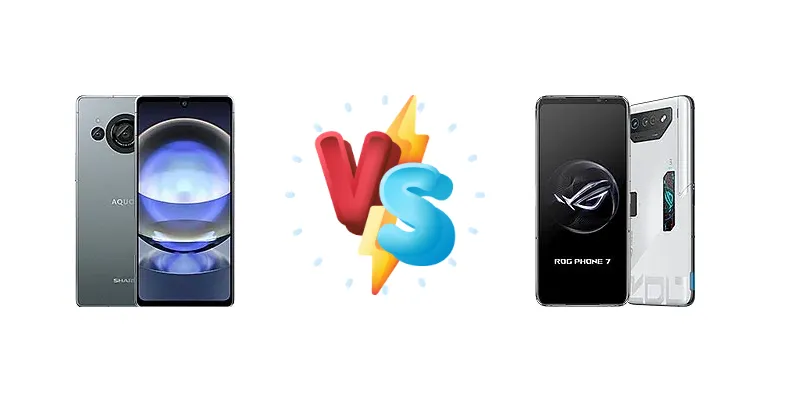
|
🏆 Quick Verdict
For the average user prioritizing a balanced, everyday experience in a compact form factor, the Sharp Aquos R8s is the better choice. However, gamers and power users will find the Asus ROG Phone 7 Ultimate’s superior charging speed and gaming-centric features invaluable.
| PHONES | ||
|---|---|---|
| Phone Names | Sharp Aquos R8s | Asus ROG Phone 7 Ultimate |
| Network | ||
|---|---|---|
| 2G bands | GSM 850 / 900 / 1800 / 1900 | GSM 850 / 900 / 1800 / 1900 |
| 3G bands | HSDPA 850 / 900 / 1900 / 2100 | HSDPA 800 / 850 / 900 / 1700(AWS) / 1900 / 2100 |
| 4G bands | LTE | 1, 2, 3, 4, 5, 7, 8, 12, 17, 18, 19, 20, 25, 26, 28, 32, 34, 38, 39, 40, 41, 42, 43, 48, 66 - International |
| 5G bands | SA/NSA | 1, 2, 3, 5, 7, 8, 12, 18, 20, 25, 26, 28, 38, 40, 41, 48, 66, 77, 78, 79 SA/NSA/Sub6 - International |
| Speed | HSPA, LTE, 5G | HSPA, LTE (Up to 7CA), 5G |
| Technology | GSM / HSPA / LTE / 5G | GSM / CDMA / HSPA / LTE / 5G |
| - | 1, 3, 5, 8, 28, 41, 77, 78, 79 SA/NSA/Sub6 - China | |
| Launch | ||
|---|---|---|
| Announced | 2023, December 06 | 2023, April 13 |
| Status | Available. Released 2023, December | Available. Released 2023, May |
| Body | ||
|---|---|---|
| Build | Glass front (Gorilla Glass 3), aluminum frame, plastic back | Glass front (Gorilla Glass Victus), glass back (Gorilla Glass 3), aluminum frame |
| Dimensions | 159 x 74 x 8.7 mm (6.26 x 2.91 x 0.34 in) | 173 x 77 x 10.3 mm (6.81 x 3.03 x 0.41 in) |
| SIM | Nano-SIM + eSIM | Nano-SIM + Nano-SIM |
| Weight | 179 g (6.31 oz) | 239 g (8.43 oz) |
| - | Built-in motorized cooling air vent (AeroActive Portal) IP54 water resistant 2" OLED display (on the back) Pressure sensitive zones (Gaming triggers) | |
| Display | ||
|---|---|---|
| Protection | Corning Gorilla Glass 3 | Corning Gorilla Glass Victus |
| Resolution | 1080 x 2340 pixels, 19.5:9 ratio (~403 ppi density) | 1080 x 2448 pixels (~395 ppi density) |
| Size | 6.4 inches, 100.5 cm2 (~85.5% screen-to-body ratio) | 6.78 inches, 109.5 cm2 (~82.2% screen-to-body ratio) |
| Type | PRO IGZO LTPO OLED, 1B colors, 120Hz, Dolby Vision, HDR, 1300 nits (peak) | AMOLED, 1B colors, 165Hz, HDR10+, 1000 nits (HBM), 1500 nits (peak) |
| Platform | ||
|---|---|---|
| CPU | Octa-core (1x3.2 GHz Cortex-X3 & 2x2.8 GHz Cortex-A715 & 2x2.8 GHz Cortex-A710 & 3x2.0 GHz Cortex-A510) | Octa-core (1x3.2 GHz Cortex-X3 & 2x2.8 GHz Cortex-A715 & 2x2.8 GHz Cortex-A710 & 3x2.0 GHz Cortex-A510) |
| Chipset | Qualcomm SM8550-AB Snapdragon 8 Gen 2 (4 nm) | Qualcomm SM8550-AB Snapdragon 8 Gen 2 (4 nm) |
| GPU | Adreno 740 | Adreno 740 |
| OS | Android 13 | Android 13, up to 2 major Android upgrades |
| Memory | ||
|---|---|---|
| Card slot | microSDXC | No |
| Internal | 256GB 8GB RAM | 512GB 16GB RAM |
| - | UFS 4.0 NTFS support for external storage | |
| Main Camera | ||
|---|---|---|
| Dual | 50 MP, f/1.9, 23mm (wide), 1/1.55", dual pixel PDAF 13 MP, f/2.3, 17mm (ultrawide) | - |
| Features | LED flash, HDR, panorama | LED flash, HDR, panorama |
| Triple | - | 50 MP, f/1.9, 24mm (wide), 1/1.56", 1.0µm, PDAF 13 MP, f/2.2, 13mm, 120˚ (ultrawide) 5 MP (macro) |
| Video | Yes | 8K@24fps, 4K@30/60fps, 1080p@30/60/120/240fps, 720p@480fps; gyro-EIS, HDR10+ |
| Selfie camera | ||
|---|---|---|
| Features | - | Panorama, HDR |
| Single | 8 MP, 118˚ (ultrawide) | 32 MP, f/2.5, 29mm (wide), 1/3.2", 0.7µm |
| Video | 1080p@30fps | 1080p@30fps |
| Sound | ||
|---|---|---|
| 3.5mm jack | - | Yes |
| 35mm jack | Yes | Yes |
| Loudspeaker | Yes | Yes, with stereo speakers (2 amplifiers) |
| - | 32-bit/384kHz audio | |
| Comms | ||
|---|---|---|
| Bluetooth | 5.3, A2DP, LE, aptX HD, aptX Adaptive, aptX Lossless | 5.3, A2DP, LE, aptX HD, aptX Adaptive, aptX Lossless |
| NFC | Yes | Yes |
| Positioning | GPS (L1+L5), GLONASS, GALILEO, BDS | GPS (L1+L5), GLONASS (L1), BDS (B1I+B1c+B2a), GALILEO (E1+E5a), QZSS (L1+L5), NavIC (L5) |
| Radio | No | No |
| USB | USB Type-C 3.0 | USB Type-C 3.1 (side), DisplayPort 1.4; USB Type-C 2.0 (bottom), OTG, accessory connector |
| WLAN | Wi-Fi 802.11 a/b/g/n/ac/6, dual-band | Wi-Fi 802.11 a/b/g/n/ac/6e/7, tri-band, Wi-Fi Direct |
| Features | ||
|---|---|---|
| Sensors | Fingerprint (side-mounted), accelerometer, gyro, proximity, compass | Fingerprint (under display, optical), accelerometer, gyro, proximity, compass |
| Battery | ||
|---|---|---|
| Charging | 15W wired | 65W wired, PD3.0, QC5, 100% in 42 min 10W reverse wired |
| Type | 4750 mAh | Li-Po 6000 mAh |
| Misc | ||
|---|---|---|
| Colors | Blue, White | Storm White |
| Models | SH‑52D | - |
| Price | About 700 EUR | About 780 EUR |
| Tests | ||
|---|---|---|
| Battery life | - | Endurance rating 131h |
| Camera | - | Photo / Video |
| Display | - | Contrast ratio: Infinite (nominal) |
| Loudspeaker | - | -25.5 LUFS (Very good) |
| Performance | - | AnTuTu: 1325105 (v9) GeekBench: 5139 (v5.5), 5567 (v6) GFXBench: 107fps (ES 3.1 onscreen) |
Sharp Aquos R8s
- Compact and pocketable design
- Premium Snapdragon 8 Gen 2 performance
- Potentially cleaner software experience
- Slow 15W charging
- Limited battery endurance information
- Camera specifications unknown
Asus ROG Phone 7 Ultimate
- 65W fast charging with multiple protocols
- Excellent 131-hour battery endurance
- Gaming-focused features and cooling
- Larger and heavier design
- Aggressive gaming aesthetic
- Potentially higher price
Display Comparison
Both devices utilize the Qualcomm Snapdragon 8 Gen 2, but their displays differ significantly. The ROG Phone 7 Ultimate boasts a measured peak brightness of 1095 nits, suggesting a more visible screen outdoors compared to the R8s (brightness data unavailable). While the R8s’ panel characteristics are unknown, the ROG Phone’s infinite contrast ratio (nominal) indicates a superior viewing experience with deeper blacks. The ROG Phone’s larger size also allows for a more immersive gaming experience, while the R8s likely prioritizes a higher pixel density for sharpness in a smaller footprint.
Camera Comparison
Both phones feature 'Photo / Video' capabilities, but detailed camera specifications are lacking for the R8s. The ROG Phone 7 Ultimate’s camera system is likely optimized for versatility, but without sensor size or aperture information, a direct comparison is difficult. The R8s may focus on computational photography to enhance image quality, while the ROG Phone might prioritize video recording features geared towards content creators. The absence of specific details makes it impossible to determine a clear winner in this category.
Performance
Both the Sharp Aquos R8s and Asus ROG Phone 7 Ultimate are powered by the Qualcomm SM8550-AB Snapdragon 8 Gen 2 (4nm). The CPU configuration is identical – a 1x3.2 GHz Cortex-X3, 2x2.8 GHz Cortex-A715, 2x2.8 GHz Cortex-A710, and 3x2.0 GHz Cortex-A510. This means raw processing power will be comparable. However, the ROG Phone 7 Ultimate benefits from a more robust cooling system designed to sustain peak performance for longer durations during demanding tasks like gaming. The R8s, while capable, may experience more thermal throttling under sustained load. RAM specifications are not provided for either device, but the ROG Phone likely utilizes faster LPDDR5x RAM to further enhance performance.
Battery Life
The Asus ROG Phone 7 Ultimate has an endurance rating of 131 hours, indicating excellent battery life. It also features significantly faster charging at 65W wired, supporting PD3.0 and QC5, achieving a 100% charge in just 42 minutes. The Sharp Aquos R8s, with only 15W wired charging, will take considerably longer to fully charge. While the R8s’ battery capacity is unknown, the ROG Phone’s faster charging and higher endurance rating provide a clear advantage for users who prioritize minimizing downtime.
Buying Guide
Buy the Sharp Aquos R8s if you need a premium smartphone that’s easy to handle and carry, prioritizing a clean software experience and a more understated aesthetic. Buy the Asus ROG Phone 7 Ultimate if you prefer a device specifically engineered for extended gaming sessions, demanding maximum performance, and don't mind a larger, more aggressive design.