
Sharp Aquos R5G vs. Samsung Galaxy S20+ 5G: A Head-to-Head Comparison
| Phones Images | |||||
|---|---|---|---|---|---|
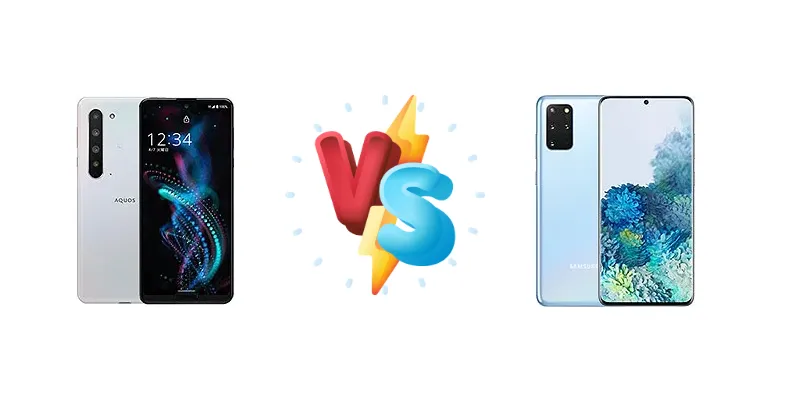
|
🏆 Quick Verdict
For most users, the Samsung Galaxy S20+ 5G offers a more well-rounded experience, particularly the USA variant with the Snapdragon 865. Its broader feature set, including wireless charging and reverse wireless charging, combined with Samsung’s established software support, outweighs the Aquos R5G’s slight performance edge in some benchmarks.
| PHONES | ||
|---|---|---|
| Phone Names | Sharp Aquos R5G | Samsung Galaxy S20+ 5G |
| Network | ||
|---|---|---|
| 2G bands | GSM 850 / 900 / 1800 / 1900 | GSM 850 / 900 / 1800 / 1900 |
| 3G bands | HSDPA 850 / 900 / 1900 / 2100 | HSDPA 850 / 900 / 1700(AWS) / 1900 / 2100 |
| 4G bands | 1, 3, 7, 8, 20, 28, 38, 41 | 1, 2, 3, 4, 5, 7, 8, 12, 13, 17, 18, 19, 20, 25, 26, 28, 32, 38, 39, 40, 41, 66 - SM-G986B |
| 5G bands | 1, 3, 28, 78 SA/NSA | 1, 3, 5, 7, 8, 28, 40, 77, 78 SA/NSA/Sub6 - SM-G986B |
| Speed | HSPA, LTE, 5G | HSPA 42.2/5.76 Mbps, LTE (7CA) Cat20 2000/200 Mbps, 5G (5+ Gbps DL) |
| Technology | GSM / HSPA / LTE / 5G | GSM / CDMA / HSPA / EVDO / LTE / 5G |
| Launch | ||
|---|---|---|
| Announced | 2020, February. Released 2020, February | 2020, February 11 |
| Status | Discontinued | Available. Released 2020, March 06 |
| Body | ||
|---|---|---|
| Build | - | Glass front (Gorilla Glass 6), glass back (Gorilla Glass 6), aluminum frame |
| Dimensions | 162 x 75 x 8.9 mm (6.38 x 2.95 x 0.35 in) | 161.9 x 73.7 x 7.8 mm (6.37 x 2.90 x 0.31 in) |
| SIM | Nano-SIM | · Nano-SIM + eSIM· Nano-SIM + Nano-SIM |
| Weight | 189 g (6.67 oz) | 188 g (6.63 oz) |
| IPX5/IP6X/IPX8 water/dust resistant (up to 1.5m for 30 min) | - | |
| Display | ||
|---|---|---|
| Protection | - | Corning Gorilla Glass 6 |
| Resolution | 1440 x 3168 pixels (~544 ppi density) | 1440 x 3200 pixels, 20:9 ratio (~525 ppi density) |
| Size | 6.4 inches, 99.5 cm2 (~81.9% screen-to-body ratio) | 6.7 inches, 108.0 cm2 (~90.5% screen-to-body ratio) |
| Type | IGZO IPS LCD, 1B colors, 120Hz, Dolby Vision | Dynamic AMOLED 2X, 120Hz, HDR10+, 1200 nits (peak) |
| Platform | ||
|---|---|---|
| CPU | Octa-core (1x2.84 GHz Cortex-A77 & 3x2.42 GHz Cortex-A77 & 4x1.80 GHz Cortex-A55) | Octa-core (2x2.73 GHz Mongoose M5 & 2x2.50 GHz Cortex-A76 & 4x2.0 GHz Cortex-A55) - GlobalOcta-core (1x2.84 GHz Cortex-A77 & 3x2.42 GHz Cortex-A77 & 4x1.80 GHz Cortex-A55) - USA |
| Chipset | Qualcomm SM8250 Snapdragon 865 5G (7 nm+) | Exynos 990 (7 nm+) - GlobalQualcomm SM8250 Snapdragon 865 5G (7 nm+) - USA |
| GPU | Adreno 650 | Mali-G77 MP11 - GlobalAdreno 650 - USA |
| OS | Android 10 | Android 10, upgradable to Android 13, One UI 5.1 |
| Memory | ||
|---|---|---|
| Card slot | No | microSDXC (uses shared SIM slot) |
| Internal | 256GB 12GB RAM | 128GB 8GB RAM, 128GB 12GB RAM, 256GB 12GB RAM, 512GB 12GB RAM |
| UFS 3.0 | - | |
| Main Camera | ||
|---|---|---|
| Features | LED flash, panorama | LED flash, auto-HDR, panorama |
| Triple | 12 MP, f/1.7, 26mm (wide), 1.4µm, dual pixel PDAF, OIS 12 MP, f/2.7, 52mm (telephoto), 1.0µm, PDAF, 2x optical zoom, OIS 48 MP, f/2.9, 19mm (ultrawide), 0.8µm TOF 3D (depth) | 12 MP, f/1.8, 26mm (wide), 1/1.76", 1.8µm, dual pixel PDAF, OIS 64 MP, f/2.0, 29mm (telephoto), 1/1.72", 0.8µm, PDAF, OIS, 1.1x optical zoom, 3x hybrid zoom 12 MP, f/2.2, 13mm, 120˚ (ultrawide), 1/2.55" 1.4µm, Super Steady video 0.3 MP, TOF 3D, f/1.0, (depth) |
| Video | 8K@30fps, 1080p@30fps | 8K@24fps, 4K@30/60fps, 1080p@30/60/240fps, 720p@960fps, HDR10+, stereo sound rec., gyro-EIS & OIS |
| Selfie camera | ||
|---|---|---|
| Features | - | HDR |
| Single | 16 MP, f/2.0, 26mm (wide), 0.7µm | 10 MP, f/2.2, 26mm (wide), 1/3.24", 1.22µm, dual pixel PDAF |
| Video | 1080p@30fps | 4K@30/60fps, 1080p@30fps |
| Sound | ||
|---|---|---|
| 3.5mm jack | No | No |
| 35mm jack | No | No |
| Loudspeaker | Yes, with stereo speakers | Yes, with stereo speakers |
| 24-bit/192kHz audio | - | |
| Comms | ||
|---|---|---|
| Bluetooth | 5.1, A2DP, LE, aptX HD, aptX Adaptive | 5.0, A2DP, LE |
| NFC | Yes | Yes |
| Positioning | GPS (L1+L5), GLONASS, BDS, GALILEO, QZSS | GPS, GLONASS, BDS, GALILEO |
| Radio | No | FM radio (Snapdragon model only; market/operator dependent) |
| USB | USB Type-C 3.1 | USB Type-C 3.2, OTG |
| WLAN | Wi-Fi 802.11 a/b/g/n/ac/ax/6, dual-band, Wi-Fi Direct | Wi-Fi 802.11 a/b/g/n/ac/6, dual-band, Wi-Fi Direct |
| Features | ||
|---|---|---|
| Sensors | Fingerprint (front-mounted), accelerometer, gyro, proximity, compass | Fingerprint (under display, ultrasonic), accelerometer, gyro, proximity, compass, barometer |
| Battery | ||
|---|---|---|
| Charging | - | 25W wired, PD3.0 15W wireless (Qi) 4.5W reverse wireless |
| Type | Li-Ion 3730 mAh | Li-Ion 4500 mAh |
| Misc | ||
|---|---|---|
| Colors | Glare Black, Aurora White | Cosmic Black, Cosmic Grey, Cloud Blue, Cloud White, Aura Red, Aura Blue |
| Models | SH-51A, SHG01, SH-R50 | SM-G986, SM-G986F, SM-G986F/DS, SM-G986U, SM-G986U1, SM-G9860, SM-G986B/DS, SM-G986N, SM-G986B, SM-G986W, SCG02 |
| Price | About 700 EUR | $ 174.17 / C$ 684.99 / € 299.97 |
| SAR | - | 1.08 W/kg (head) 1.02 W/kg (body) |
| SAR EU | - | 1.09 W/kg (head) 1.57 W/kg (body) |
Sharp Aquos R5G
- Consistent Snapdragon 865 performance
- Clean Android experience
- Potentially better sustained performance due to thermal efficiency
- Limited regional availability
- Lacks wireless charging
- Potentially shorter software support lifecycle
Samsung Galaxy S20+ 5G
- Versatile camera system
- Vibrant Dynamic AMOLED 2X display
- Wireless and reverse wireless charging
- Exynos 990 can suffer from thermal throttling (Global variant)
- Samsung’s One UI can be bloated
- Software updates can be slower than some competitors
Display Comparison
Both devices utilize 7nm+ fabrication, but diverge significantly in display technology. While specific nit brightness data isn't provided, Samsung’s Galaxy S20+ 5G is known for its vibrant Dynamic AMOLED 2X display, offering excellent color accuracy and peak brightness. The Aquos R5G, while likely offering good color reproduction, doesn’t benefit from Samsung’s display expertise. The S20+’s 120Hz refresh rate (though often dynamically adjusted) provides a smoother visual experience than the Aquos R5G’s standard 60Hz panel. Bezels are comparable, but Samsung’s curved display adds a premium aesthetic.
Camera Comparison
Detailed camera specs are limited, but the Aquos R5G likely focuses on computational photography leveraging the Snapdragon’s ISP. The Galaxy S20+ 5G boasts a more versatile camera system, including a higher resolution main sensor (though resolution isn’t specified in the provided data) and advanced features like Single Take. While both phones likely offer good image quality in ideal conditions, Samsung’s image processing tends towards more saturated colors, while Sharp typically aims for a more natural look. The presence of OIS on both devices is expected, but the S20+’s wider range of lenses provides greater creative flexibility.
Performance
The core performance difference lies in the chipset. The Aquos R5G consistently features the Qualcomm Snapdragon 865 5G, utilizing a Cortex-A77 prime core clocked at 2.84 GHz. The Galaxy S20+ 5G, however, shipped with either the Exynos 990 (globally) or the Snapdragon 865 (USA). The Exynos 990’s Mongoose M5 cores, while clocked slightly higher at 2.73 GHz, are generally less efficient than the Snapdragon’s Cortex-A77. This translates to potentially more thermal throttling under sustained load on the Exynos variant. Both phones utilize LPDDR5 RAM, but the Snapdragon’s superior GPU and thermal management give it an edge in gaming and demanding applications. The USA S20+ 5G, mirroring the Aquos R5G’s Snapdragon 865, offers comparable performance.
Battery Life
Battery capacity isn’t specified for either device, but the Galaxy S20+ 5G offers a clear advantage with its 25W wired charging, supporting PD3.0 for faster charging speeds. The addition of 15W wireless charging (Qi) and 4.5W reverse wireless charging further enhances its usability. The Aquos R5G lacks these wireless charging capabilities, relying solely on wired charging, which is likely slower. While a larger battery capacity on the Aquos R5G could offset the slower charging, the S20+’s charging speed provides a more convenient user experience.
Buying Guide
Buy the Sharp Aquos R5G if you prioritize raw, sustained CPU performance and a clean Android experience, and are comfortable with a potentially limited software update lifecycle and regional availability. Buy the Samsung Galaxy S20+ 5G if you value a feature-rich ecosystem, a vibrant display, wireless charging capabilities, and a more robust software support commitment, even if it means potentially dealing with the Exynos chipset’s thermal limitations (outside the USA).