
Sharp Aquos R5G vs Samsung Galaxy S20: A Head-to-Head Showdown
| Phones Images | |||||
|---|---|---|---|---|---|
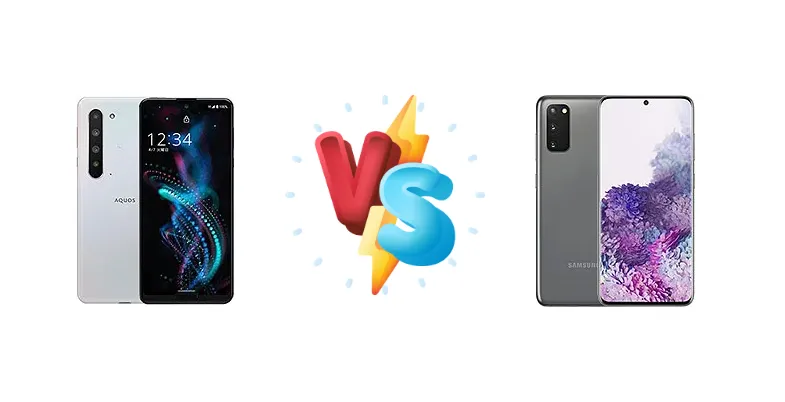
|
🏆 Quick Verdict
The Galaxy S20 offers a more polished and feature-rich experience with its established ecosystem and refined software. However, the Aquos R5G's unique display and powerful Snapdragon 865 chipset provide a compelling alternative, especially for those seeking a less mainstream device. The S20 wins on overall usability.
| PHONES | ||
|---|---|---|
| Phone Names | Sharp Aquos R5G | Samsung Galaxy S20 |
| Network | ||
|---|---|---|
| 2G bands | GSM 850 / 900 / 1800 / 1900 | GSM 850 / 900 / 1800 / 1900 |
| 3G bands | HSDPA 850 / 900 / 1900 / 2100 | HSDPA 850 / 900 / 1700(AWS) / 1900 / 2100 |
| 4G bands | 1, 3, 7, 8, 20, 28, 38, 41 | 1, 2, 3, 4, 5, 7, 8, 12, 13, 17, 18, 19, 20, 25, 26, 28, 32, 38, 39, 40, 41, 66 |
| 5G bands | 1, 3, 28, 78 SA/NSA | - |
| Speed | HSPA, LTE, 5G | HSPA 42.2/5.76 Mbps, LTE (7CA) Cat20 2000/200 Mbps |
| Technology | GSM / HSPA / LTE / 5G | GSM / CDMA / HSPA / EVDO / LTE |
| - | CDMA2000 1xEV-DO | |
| Launch | ||
|---|---|---|
| Announced | 2020, February. Released 2020, February | 2020, February 11 |
| Status | Discontinued | Available. Released 2020, March 06 |
| Body | ||
|---|---|---|
| Build | - | Glass front (Gorilla Glass 6), glass back (Gorilla Glass 6), aluminum frame |
| Dimensions | 162 x 75 x 8.9 mm (6.38 x 2.95 x 0.35 in) | 151.7 x 69.1 x 7.9 mm (5.97 x 2.72 x 0.31 in) |
| SIM | Nano-SIM | · Nano-SIM + eSIM· Nano-SIM + Nano-SIM |
| Weight | 189 g (6.67 oz) | 163 g (5.75 oz) |
| IPX5/IP6X/IPX8 water/dust resistant (up to 1.5m for 30 min) | IP68 dust/water resistant (up to 1.5m for 30 min) | |
| Display | ||
|---|---|---|
| Protection | - | Corning Gorilla Glass 6 |
| Resolution | 1440 x 3168 pixels (~544 ppi density) | 1440 x 3200 pixels, 20:9 ratio (~563 ppi density) |
| Size | 6.4 inches, 99.5 cm2 (~81.9% screen-to-body ratio) | 6.2 inches, 93.8 cm2 (~89.5% screen-to-body ratio) |
| Type | IGZO IPS LCD, 1B colors, 120Hz, Dolby Vision | Dynamic AMOLED 2X, 120Hz, HDR10+, 1200 nits (peak) |
| - | Always-on display 120Hz@FHD/60Hz@QHD refresh rate | |
| Platform | ||
|---|---|---|
| CPU | Octa-core (1x2.84 GHz Cortex-A77 & 3x2.42 GHz Cortex-A77 & 4x1.80 GHz Cortex-A55) | Octa-core (2x2.73 GHz Mongoose M5 & 2x2.50 GHz Cortex-A76 & 4x2.0 GHz Cortex-A55) - GlobalOcta-core (1x2.84 GHz Cortex-A77 & 3x2.42 GHz Cortex-A77 & 4x1.80 GHz Cortex-A55) - USA |
| Chipset | Qualcomm SM8250 Snapdragon 865 5G (7 nm+) | Exynos 990 (7 nm+) - GlobalQualcomm SM8250 Snapdragon 865 5G (7 nm+) - USA |
| GPU | Adreno 650 | Mali-G77 MP11 - GlobalAdreno 650 - USA |
| OS | Android 10 | Android 10, upgradable to Android 13, One UI 5 |
| Memory | ||
|---|---|---|
| Card slot | No | microSDXC (uses shared SIM slot) |
| Internal | 256GB 12GB RAM | 128GB 8GB RAM |
| UFS 3.0 | UFS 3.0 | |
| Main Camera | ||
|---|---|---|
| Features | LED flash, panorama | LED flash, auto-HDR, panorama |
| Triple | 12 MP, f/1.7, 26mm (wide), 1.4µm, dual pixel PDAF, OIS 12 MP, f/2.7, 52mm (telephoto), 1.0µm, PDAF, 2x optical zoom, OIS 48 MP, f/2.9, 19mm (ultrawide), 0.8µm TOF 3D (depth) | 12 MP, f/1.8, 26mm (wide), 1/1.76", 1.8µm, dual pixel PDAF, OIS 64 MP, f/2.0, 29mm (telephoto), 1/1.72", 0.8µm, PDAF, OIS, 1.1x optical zoom, 3x hybrid zoom 12 MP, f/2.2, 13mm, 120˚ (ultrawide), 1/2.55" 1.4µm, Super Steady video |
| Video | 8K@30fps, 1080p@30fps | 8K@24fps, 4K@30/60fps, 1080p@30/60/240fps, 720p@960fps, HDR10+, stereo sound rec., gyro-EIS & OIS |
| Selfie camera | ||
|---|---|---|
| Features | - | HDR |
| Single | 16 MP, f/2.0, 26mm (wide), 0.7µm | 10 MP, f/2.2, 26mm (wide), 1/3.24", 1.22µm, dual pixel PDAF |
| Video | 1080p@30fps | 4K@30/60fps, 1080p@30fps |
| Sound | ||
|---|---|---|
| 3.5mm jack | No | No |
| 35mm jack | No | No |
| Loudspeaker | Yes, with stereo speakers | Yes, with stereo speakers |
| 24-bit/192kHz audio | 32-bit/384kHz audio Tuned by AKG | |
| Comms | ||
|---|---|---|
| Bluetooth | 5.1, A2DP, LE, aptX HD, aptX Adaptive | 5.0, A2DP, LE |
| NFC | Yes | Yes |
| Positioning | GPS (L1+L5), GLONASS, BDS, GALILEO, QZSS | GPS, GLONASS, BDS, GALILEO |
| Radio | No | FM radio (Snapdragon model only; market/operator dependent) |
| USB | USB Type-C 3.1 | USB Type-C 3.2, OTG |
| WLAN | Wi-Fi 802.11 a/b/g/n/ac/ax/6, dual-band, Wi-Fi Direct | Wi-Fi 802.11 a/b/g/n/ac/6, dual-band, Wi-Fi Direct |
| Features | ||
|---|---|---|
| Sensors | Fingerprint (front-mounted), accelerometer, gyro, proximity, compass | Fingerprint (under display, ultrasonic), accelerometer, gyro, proximity, compass, barometer |
| - | Samsung DeX, Samsung Wireless DeX (desktop experience support) ANT+ Bixby natural language commands and dictation Samsung Pay (Visa, MasterCard certified) | |
| Battery | ||
|---|---|---|
| Charging | - | 25W wired, PD3.0 15W wireless (Qi) 4.5W reverse wireless |
| Type | Li-Ion 3730 mAh | Li-Ion 4000 mAh |
| Misc | ||
|---|---|---|
| Colors | Glare Black, Aurora White | Cosmic Grey, Cloud Blue, Cloud Pink, Cloud White, Aura Red |
| Models | SH-51A, SHG01, SH-R50 | SM-G980, SM-G980F, SM-G980F/DS |
| Price | About 700 EUR | $ 252.72 / C$ 249.99 / £ 185.00 / € 185.00 |
| SAR | - | 0.76 W/kg (head) 1.01 W/kg (body) |
| SAR EU | - | 0.28 W/kg (head) 1.52 W/kg (body) |
| Tests | ||
|---|---|---|
| Battery life | - | Endurance rating 71h |
| Camera | - | Photo / Video |
| Display | - | Contrast ratio: Infinite (nominal) |
| Loudspeaker | - | -23.9 LUFS (Very good) |
| Performance | - | AnTuTu: 525029 (v8) GeekBench: 12557 (v4.4), 2750 (v5.1) GFXBench: 44fps (ES 3.1 onscreen) |
Sharp Aquos R5G
- Unique IGZO Display
- Powerful Snapdragon 865
- High Refresh Rate
- Compact Design
- Less Common Brand
- Limited Software Updates
- Less Versatile Camera
Samsung Galaxy S20
- Excellent AMOLED Display
- Versatile Camera System
- Established Ecosystem
- Regular Software Updates
- Older Chipset (compared to newer phones)
- Battery Life Could Be Better
- Plastic Back (on some models)
Display Comparison
The Aquos R5G boasts a truly exceptional 6.5-inch IGZO display with a 120Hz refresh rate and incredible brightness. While the Galaxy S20's Dynamic AMOLED display is also excellent, the R5G's technology offers superior color accuracy and clarity. The S20's display is still vibrant and sharp, but the R5G takes the crown here.
Camera Comparison
The Galaxy S20's camera system is more versatile, offering a wider range of features and shooting modes. While the Aquos R5G's camera is capable, it lacks the S20's telephoto lens and advanced software processing. The S20 consistently delivers excellent image quality across various conditions.
Performance
Both phones are powered by high-end chipsets. The Aquos R5G utilizes the Snapdragon 865 5G, while the Galaxy S20 uses either the Exynos 990 or Snapdragon 865 (region dependent). The Snapdragon 865 generally offers slightly better performance and efficiency. Both phones handle demanding tasks and games with ease, but the R5G has a slight edge.
Battery Life
The Galaxy S20 has a slightly larger battery and generally offers better battery life, achieving the stated 71h endurance rating. The Aquos R5G's battery life is respectable, but not as impressive as the S20's. Charging speeds are comparable, with both supporting fast wired and wireless charging.
Buying Guide
The Sharp Aquos R5G is ideal for tech enthusiasts who appreciate a unique display and raw processing power, and don't mind a less common brand. The Samsung Galaxy S20 is a better choice for users who prioritize a seamless Android experience, a wider range of apps, and a strong brand reputation.