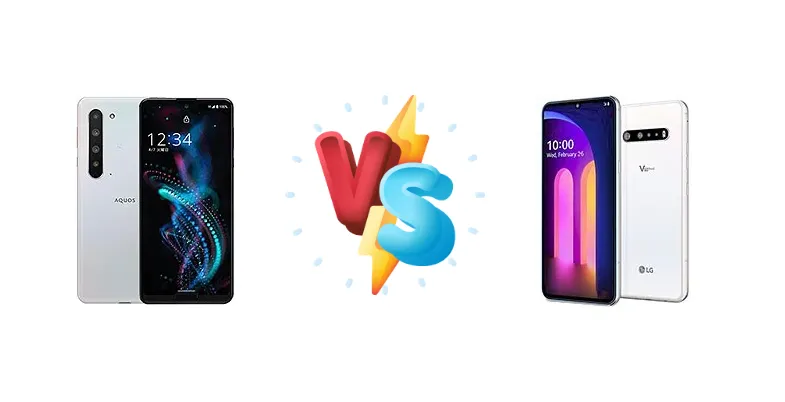
The Sharp Aquos R5G and LG V60 ThinQ 5G UW were both contenders in the premium Android space, boasting powerful Snapdragon 865 processors and 5G connectivity. But which phone truly delivers the best experience? We're diving deep into a head-to-head comparison to help you decide.
🏆 Quick Verdict
The LG V60 ThinQ 5G UW edges out the Aquos R5G thanks to its more versatile camera system, slightly better battery life, and inclusion of wireless charging. While the R5G boasts a unique, high-refresh-rate display, the V60's overall package provides a more well-rounded flagship experience.
| Network |
|---|
| 2G bands | GSM 850 / 900 / 1800 / 1900 | GSM 850 / 900 / 1800 / 1900 |
| 3G bands | HSDPA 850 / 900 / 1900 / 2100 | HSDPA 850 / 900 / 1700(AWS) / 1900 / 2100 |
| 4G bands | 1, 3, 7, 8, 20, 28, 38, 41 | 2, 3, 4, 5, 7, 12, 13, 20, 28, 46, 48, 66 |
| 5G bands | 1, 3, 28, 78 SA/NSA | 260, 261 mmWave |
| Speed | HSPA, LTE, 5G | HSPA 42.2/5.76 Mbps, LTE (7CA) Cat22, 5G |
| Technology | GSM / HSPA / LTE / 5G | GSM / CDMA / HSPA / EVDO / LTE / 5G |
| | - | CDMA2000 1xEV-DO |
| Launch |
|---|
| Announced | 2020, February. Released 2020, February | 2020, February 26. Released 2020, April 02 |
| Status | Discontinued | Discontinued |
| Body |
|---|
| Build | - | Glass front (Gorilla Glass 5), glass back (Gorilla Glass 6), aluminum frame |
| Dimensions | 162 x 75 x 8.9 mm (6.38 x 2.95 x 0.35 in) | 169.3 x 77.6 x 8.9 mm (6.67 x 3.06 x 0.35 in) |
| SIM | Nano-SIM | Nano-SIM (pre-installed) |
| Weight | 189 g (6.67 oz) | 218 g (7.69 oz) |
| | IPX5/IP6X/IPX8 water/dust resistant (up to 1.5m for 30 min) | IP68 dust/water resistant (up to 1.5m for 30 min)
MIL-STD-810G compliant*
Method 516.6, Procedure IV "Transit Drop"
*does not guarantee ruggedness or use in extreme conditions |
| Display |
|---|
| Protection | - | Corning Gorilla Glass 5 |
| Resolution | 1440 x 3168 pixels (~544 ppi density) | 1080 x 2460 pixels (~395 ppi density) |
| Size | 6.4 inches, 99.5 cm2 (~81.9% screen-to-body ratio) | 6.8 inches, 109.8 cm2 (~83.6% screen-to-body ratio) |
| Type | IGZO IPS LCD, 1B colors, 120Hz, Dolby Vision | P-OLED, HDR10+ |
| | - | Always-on display |
| Platform |
|---|
| CPU | Octa-core (1x2.84 GHz Cortex-A77 & 3x2.42 GHz Cortex-A77 & 4x1.80 GHz Cortex-A55) | Octa-core (1x2.84 GHz Cortex-A77 & 3x2.42 GHz Cortex-A77 & 4x1.80 GHz Cortex-A55) |
| Chipset | Qualcomm SM8250 Snapdragon 865 5G (7 nm+) | Qualcomm SM8250 Snapdragon 865 5G (7 nm+) |
| GPU | Adreno 650 | Adreno 650 |
| OS | Android 10 | Android 10, upgradable to Android 13 |
| Memory |
|---|
| Card slot | No | microSDXC (uses shared SIM slot) - dual-SIM model |
| Internal | 256GB 12GB RAM | 128GB 8GB RAM |
| | UFS 3.0 | UFS 2.1 |
| Main Camera |
|---|
| Dual | - | 64 MP, f/1.8, 27mm (standard), 1/1.72", 0.8µm, dual pixel PDAF, OIS
13 MP, f/1.9, 12mm (ultrawide), 1/3.4", 1.0µm
0.3 MP, TOF 3D, f/1.4, (depth) |
| Features | LED flash, panorama | Dual-LED dual-tone flash, HDR, panorama |
| Triple | 12 MP, f/1.7, 26mm (wide), 1.4µm, dual pixel PDAF, OIS
12 MP, f/2.7, 52mm (telephoto), 1.0µm, PDAF, 2x optical zoom, OIS
48 MP, f/2.9, 19mm (ultrawide), 0.8µm
TOF 3D (depth) | - |
| Video | 8K@30fps, 1080p@30fps | 8K@30fps, 4K@30/60fps, 1080p, HDR10+, 24-bit/192kHz stereo sound rec., gyro-EIS |
| Selfie camera |
|---|
| Features | - | HDR |
| Single | 16 MP, f/2.0, 26mm (wide), 0.7µm | 10 MP, f/1.9, 30mm (standard), 1/3.1", 1.22µm |
| Video | 1080p@30fps | 4K@30fps, gyro-EIS |
| Sound |
|---|
| 3.5mm jack | No | Yes |
| 35mm jack | No | Yes |
| Loudspeaker | Yes, with stereo speakers | Yes, with stereo speakers |
| | 24-bit/192kHz audio | 32-bit/192kHz audio
24-bit/192kHz audio recording |
| Comms |
|---|
| Bluetooth | 5.1, A2DP, LE, aptX HD, aptX Adaptive | 5.1, A2DP, LE, aptX HD |
| NFC | Yes | Yes |
| Positioning | GPS (L1+L5), GLONASS, BDS, GALILEO, QZSS | GPS, GLONASS, GALILEO, BDS |
| Radio | No | FM radio (USA model only) |
| USB | USB Type-C 3.1 | USB Type-C 3.1, OTG |
| WLAN | Wi-Fi 802.11 a/b/g/n/ac/ax/6, dual-band, Wi-Fi Direct | Wi-Fi 802.11 a/b/g/n/ac/6, dual-band, Wi-Fi Direct, DLNA |
| Features |
|---|
| Sensors | Fingerprint (front-mounted), accelerometer, gyro, proximity, compass | Fingerprint (under display, optical), accelerometer, gyro, proximity, compass, barometer |
| Battery |
|---|
| Charging | - | Wired, PD2.0, QC4
Wireless |
| Type | Li-Ion 3730 mAh | Li-Po 5000 mAh |
| Misc |
|---|
| Colors | Glare Black, Aurora White | Classy Blue, Classy White |
| Models | SH-51A, SHG01, SH-R50 | LM-V600VML, LMV600VML |
| Price | About 700 EUR | About 870 EUR |
| SAR | - | 0.85 W/kg (head) 1.12 W/kg (body) |
Sharp Aquos R5G
- Unique 120Hz display
- Compact and lightweight design
- Powerful Snapdragon 865 processor
- Limited camera versatility
- No wireless charging
- Less common availability
LG V60 ThinQ 5G UW
- Versatile camera system (ultra-wide, telephoto)
- Slightly better battery life
- Wireless charging support
- Expandable storage (microSD)
- Larger and heavier than the R5G
- Design feels dated
- LG's exit from the smartphone market creates uncertainty
Display Comparison
Both phones feature excellent OLED displays, but the Aquos R5G stands out with its 120Hz refresh rate, offering noticeably smoother scrolling and animations. The V60 has a slightly larger screen size, which some may prefer for media consumption. Color accuracy is generally comparable on both.
Camera Comparison
The LG V60 ThinQ 5G UW has a more versatile camera system, including a dedicated ultra-wide lens and a periscope telephoto lens for impressive zoom capabilities. The Aquos R5G's camera is capable, but lacks the versatility of the V60. Both capture good quality images in well-lit conditions, but the V60 generally performs better in low light.
Performance
Powered by the same Snapdragon 865 chipset, both phones deliver flagship-level performance. Expect snappy app loading, seamless multitasking, and smooth gaming experiences. Real-world performance differences are minimal.
Battery Life
The LG V60 ThinQ 5G UW generally offers slightly better battery life than the Aquos R5G, thanks to its larger battery capacity. Both phones support fast wired charging, but the V60 also includes wireless charging, a feature absent on the R5G.
Buying Guide
The Sharp Aquos R5G is ideal for users prioritizing a super-smooth, high-refresh-rate display and a compact form factor. The LG V60 ThinQ 5G UW is a better choice for those who value a versatile camera system, longer battery life, and the convenience of wireless charging.
Frequently Asked Questions
❓ Is the Sharp Aquos R5G worth buying now?
Given its limited availability and lack of wireless charging, the R5G is harder to recommend now. However, its unique display and compact size remain appealing to some.
❓ Will LG continue to support the V60 ThinQ with software updates?
LG has exited the smartphone market, so future software updates are uncertain. However, the V60 already received several updates during its lifespan.