
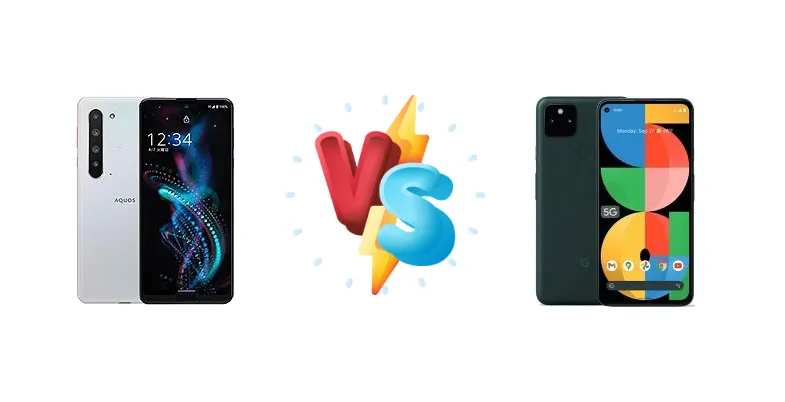
Sharp Aquos R5G vs. Google Pixel 5a 5G: A Deep Dive into Performance and Value
| Phones Images | |||||
|---|---|---|---|---|---|
|
🏆 Quick Verdict
For users prioritizing raw processing power and demanding tasks, the Sharp Aquos R5G is the clear winner. However, the Google Pixel 5a 5G offers a more balanced package with excellent software support, a bright display, and comparable battery life, making it the better choice for the average user.
| PHONES | ||
|---|---|---|
| Phone Names | Sharp Aquos R5G | Google Pixel 5a 5G |
| Network | ||
|---|---|---|
| 2G bands | GSM 850 / 900 / 1800 / 1900 | GSM 850 / 900 / 1800 / 1900 |
| 3G bands | HSDPA 850 / 900 / 1900 / 2100 | HSDPA 850 / 900 / 1700(AWS) / 1900 / 2100 |
| 4G bands | 1, 3, 7, 8, 20, 28, 38, 41 | 1, 2, 3, 4, 5, 7, 8, 12, 13, 14, 17, 18, 19, 20, 25, 26, 28, 29, 30, 32, 38, 39, 40, 41, 42, 46, 48, 66, 71 |
| 5G bands | 1, 3, 28, 78 SA/NSA | 1, 2, 5, 12, 25, 28, 41, 66, 71, 77, 78 SA/NSA/Sub6 |
| Speed | HSPA, LTE, 5G | HSPA, LTE, 5G |
| Technology | GSM / HSPA / LTE / 5G | GSM / HSPA / EVDO / LTE / 5G |
| - | CDMA2000 1xEV-DO | |
| Launch | ||
|---|---|---|
| Announced | 2020, February. Released 2020, February | 2021, August 17 |
| Status | Discontinued | Available. Released 2021, August 26 |
| Body | ||
|---|---|---|
| Build | - | Glass front (Gorilla Glass 3), aluminum frame, aluminum back |
| Dimensions | 162 x 75 x 8.9 mm (6.38 x 2.95 x 0.35 in) | 156.2 x 73.2 x 8.8 mm (6.15 x 2.88 x 0.35 in) |
| SIM | Nano-SIM | Nano-SIM + eSIM |
| Weight | 189 g (6.67 oz) | 183 g (6.46 oz) |
| IPX5/IP6X/IPX8 water/dust resistant (up to 1.5m for 30 min) | IP67 dust/water resistant (up to 1m for 30 min) | |
| Display | ||
|---|---|---|
| Protection | - | Corning Gorilla Glass 3 |
| Resolution | 1440 x 3168 pixels (~544 ppi density) | 1080 x 2400 pixels, 20:9 ratio (~415 ppi density) |
| Size | 6.4 inches, 99.5 cm2 (~81.9% screen-to-body ratio) | 6.34 inches, 97.0 cm2 (~84.9% screen-to-body ratio) |
| Type | IGZO IPS LCD, 1B colors, 120Hz, Dolby Vision | OLED, HDR |
| - | Always-on display | |
| Platform | ||
|---|---|---|
| CPU | Octa-core (1x2.84 GHz Cortex-A77 & 3x2.42 GHz Cortex-A77 & 4x1.80 GHz Cortex-A55) | Octa-core (1x2.4 GHz Kryo 475 Prime & 1x2.2 GHz Kryo 475 Gold & 6x1.8 GHz Kryo 475 Silver) |
| Chipset | Qualcomm SM8250 Snapdragon 865 5G (7 nm+) | Qualcomm SM7250 Snapdragon 765G 5G (7 nm) |
| GPU | Adreno 650 | Adreno 620 |
| OS | Android 10 | Android 11, upgradable to Android 14 |
| Memory | ||
|---|---|---|
| Card slot | No | No |
| Internal | 256GB 12GB RAM | 128GB 6GB RAM |
| UFS 3.0 | - | |
| Main Camera | ||
|---|---|---|
| Dual | - | 12.2 MP, f/1.7, 27mm, (wide), 1/2.55", 1.4µm, dual pixel PDAF, OIS 16 MP, f/2.2, 119˚ (ultrawide), 1.0µm |
| Features | LED flash, panorama | LED flash, Pixel Shift, Auto-HDR, panorama |
| Single | - | 8 MP, f/2.0, 24mm (wide), 1.12µm |
| Triple | 12 MP, f/1.7, 26mm (wide), 1.4µm, dual pixel PDAF, OIS 12 MP, f/2.7, 52mm (telephoto), 1.0µm, PDAF, 2x optical zoom, OIS 48 MP, f/2.9, 19mm (ultrawide), 0.8µm TOF 3D (depth) | - |
| Video | 8K@30fps, 1080p@30fps | 4K@30/60fps, 1080p@30/60/120/240fps; gyro-EIS |
| Selfie camera | ||
|---|---|---|
| Features | - | HDR |
| Single | 16 MP, f/2.0, 26mm (wide), 0.7µm | 8 MP, f/2.0, 24mm (wide), 1.12µm |
| Video | 1080p@30fps | 1080p@30fps |
| Sound | ||
|---|---|---|
| 3.5mm jack | No | Yes |
| 35mm jack | No | Yes |
| Loudspeaker | Yes, with stereo speakers | Yes, with stereo speakers |
| 24-bit/192kHz audio | - | |
| Comms | ||
|---|---|---|
| Bluetooth | 5.1, A2DP, LE, aptX HD, aptX Adaptive | 5.0, A2DP, LE, aptX HD |
| NFC | Yes | Yes |
| Positioning | GPS (L1+L5), GLONASS, BDS, GALILEO, QZSS | GPS, GLONASS, GALILEO, QZSS, BDS |
| Radio | No | No |
| USB | USB Type-C 3.1 | USB Type-C 3.1 |
| WLAN | Wi-Fi 802.11 a/b/g/n/ac/ax/6, dual-band, Wi-Fi Direct | Wi-Fi 802.11 a/b/g/n/ac, dual-band, Wi-Fi Direct |
| Features | ||
|---|---|---|
| Sensors | Fingerprint (front-mounted), accelerometer, gyro, proximity, compass | Fingerprint (rear-mounted), accelerometer, gyro, proximity, compass, barometer |
| Battery | ||
|---|---|---|
| Charging | - | 18W wired, PD2.0 |
| Type | Li-Ion 3730 mAh | Li-Po 4680 mAh |
| Misc | ||
|---|---|---|
| Colors | Glare Black, Aurora White | Mostly Black |
| Models | SH-51A, SHG01, SH-R50 | G1F8F, G4S1M |
| Price | About 700 EUR | $ 189.00 / C$ 249.99 |
| Tests | ||
|---|---|---|
| Battery life | - | Endurance rating 122h |
| Display | - | Contrast ratio: Infinite (nominal) |
| Performance | - | AnTuTu: 291303 (v8) GeekBench: 1337 (v5.1) GFXBench: 19fps (ES 3.1 onscreen) |
Sharp Aquos R5G
- Significantly more powerful Snapdragon 865 processor
- Superior GPU performance for gaming
- Potentially faster storage speeds (depending on configuration)
- Likely less frequent software updates
- Unknown camera performance details
- Potential for higher thermal throttling under sustained load
Google Pixel 5a 5G
- Excellent camera image processing and software optimization
- Guaranteed software updates and long-term support
- Bright and vibrant display for outdoor use
- Less powerful Snapdragon 765G processor
- Lower GPU performance compared to the R5G
- Charging speed is relatively slow compared to some competitors
Display Comparison
The Google Pixel 5a 5G boasts a notably bright display, reaching a measured 861 nits. While the Aquos R5G’s display specs are unavailable, its market positioning suggests a high-quality panel, though likely not exceeding the Pixel 5a’s peak brightness. Both phones offer an 'infinite' contrast ratio, typical of OLED displays. The Pixel 5a’s brightness is particularly beneficial for outdoor visibility, a clear advantage for users frequently exposed to sunlight.
Camera Comparison
Without detailed camera specs for the Aquos R5G, a direct comparison is challenging. However, Google’s Pixel phones are renowned for their computational photography prowess. The Pixel 5a 5G leverages Google’s image processing algorithms to deliver consistently excellent photos, particularly in challenging lighting conditions. While the R5G may have higher resolution sensors, the Pixel 5a’s software optimization likely provides a more refined and user-friendly camera experience. The absence of information regarding OIS on the R5G suggests the Pixel 5a may have an advantage in video stabilization.
Performance
The core difference lies in the chipsets. The Sharp Aquos R5G’s Snapdragon 865, built on a 7nm+ process, features a more powerful CPU configuration – an octa-core setup with a prime Cortex-A77 clocked at 2.84 GHz – compared to the Pixel 5a 5G’s Snapdragon 765G (7nm) with its 2.4 GHz Kryo 475 Prime core. This translates to significantly faster processing speeds for the R5G, especially in demanding applications. The 865 also benefits from a more capable GPU, making it the superior choice for mobile gaming. However, the 765G’s efficiency contributes to the Pixel 5a’s excellent battery life.
Battery Life
Both devices share an endurance rating of 122 hours, indicating similar real-world battery performance despite potentially different battery capacities. The Pixel 5a 5G supports 18W wired charging with PD2.0, offering a convenient and relatively quick charging solution. Charging speed data for the Aquos R5G is unavailable, but the comparable endurance rating suggests it doesn’t significantly lag behind despite potentially having a different charging wattage.
Buying Guide
Buy the Sharp Aquos R5G if you need uncompromising performance for gaming, video editing, or other resource-intensive applications and are comfortable with potentially less frequent software updates. Buy the Google Pixel 5a 5G if you prefer a streamlined Android experience, exceptional camera image processing, and long-term software support, even if it means sacrificing some peak performance.