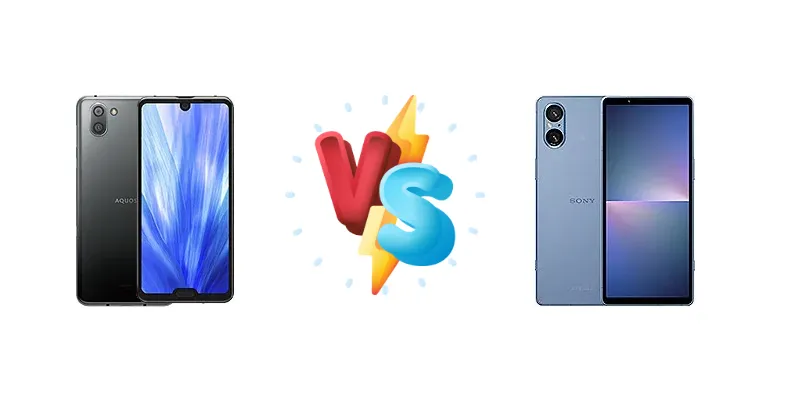
The smartphone market moves quickly. The Sharp Aquos R3, released in 2019, represented a peak in compact flagship design. Now, the Sony Xperia 5 V carries that torch, boasting a significantly newer chipset. This comparison examines whether the Aquos R3’s age is a fatal flaw, or if it still offers value against Sony’s current compact offering.
🏆 Quick Verdict
For most users, the Sony Xperia 5 V is the clear winner. Its Snapdragon 8 Gen 2 provides a substantial performance leap and superior efficiency, translating to longer battery life and smoother operation. While the Aquos R3 remains usable, the Xperia 5 V offers a modern experience justifying its higher price.
| Network |
|---|
| 2G bands | GSM 850 / 900 / 1800 / 1900 | GSM 850 / 900 / 1800 / 1900 |
| 3G bands | HSDPA 900 / 2100 | HSDPA 800 / 850 / 900 / 1700(AWS) / 1900 / 2100 |
| 4G bands | 1, 3, 7, 8, 28, 38 | 1, 2, 3, 4, 5, 7, 8, 12, 13, 17, 19, 20, 25, 26, 28, 29, 32, 34, 38, 39, 40, 41, 46, 66 - Europe |
| 5G bands | - | 1, 3, 5, 7, 8, 20, 28, 38, 40, 41, 77, 78 SA/NSA - Europe |
| Speed | HSPA 42.2/5.76 Mbps, LTE (3CA) Cat15 1024/50 Mbps | HSPA, LTE, 5G |
| Technology | GSM / HSPA / LTE | GSM / HSPA / LTE / 5G |
| Launch |
|---|
| Announced | 2019, August. Released 2019, August | 2023, September 01 |
| Status | Discontinued | Available. Released 2023, September 25 |
| Body |
|---|
| Build | - | Glass front (Gorilla Glass Victus 2), glass back, aluminum frame |
| Dimensions | 156 x 74 x 8.9 mm (6.14 x 2.91 x 0.35 in) | 154 x 68 x 8.6 mm (6.06 x 2.68 x 0.34 in) |
| SIM | Nano-SIM + Nano-SIM | · Nano-SIM + eSIM· Nano-SIM + Nano-SIM |
| Weight | 185 g (6.53 oz) | 182 g (6.42 oz) |
| | IPX5/IP6X/IPX8 water/dust resistant (up to 1.5m for 30 min) | - |
| Display |
|---|
| Protection | Corning Gorilla Glass 5 | Corning Gorilla Glass Victus 2 |
| Resolution | 1440 x 3120 pixels, 19.5:9 ratio (~554 ppi density) | 1080 x 2520 pixels, 21:9 ratio (~449 ppi density) |
| Size | 6.2 inches, 94.4 cm2 (~81.7% screen-to-body ratio) | 6.1 inches, 86.9 cm2 (~83.0% screen-to-body ratio) |
| Type | IGZO IPS LCD, 1B colors, 120Hz, HDR10, Dolby Vision | OLED, 1B colors, 120Hz, HDR10, BT.2020 |
| Platform |
|---|
| CPU | Octa-core (1x2.84 GHz Kryo 485 & 3x2.42 GHz Kryo 485 & 4x1.78 GHz Kryo 485) | Octa-core (1x3.2 GHz Cortex-X3 & 2x2.8 GHz Cortex-A715 & 2x2.8 GHz Cortex-A710 & 3x2.0 GHz Cortex-A510) |
| Chipset | Qualcomm SM8150 Snapdragon 855 (7 nm) | Qualcomm SM8550-AB Snapdragon 8 Gen 2 (4 nm) |
| GPU | Adreno 640 | Adreno 740 |
| OS | Android 9.0 (Pie), upgradable to Android 10 | Android 13, upgradable to Android 15 |
| Memory |
|---|
| Card slot | microSDXC (uses shared SIM slot) | microSDXC (uses shared SIM slot) |
| Internal | 128GB 6GB RAM | 128GB 8GB RAM, 256GB 8GB RAM |
| | UFS | - |
| Main Camera |
|---|
| Dual | 12.2 MP, f/1.7, (wide), 1/2.55", 1.4µm, dual pixel PDAF, OIS
20 MP, f/2.4, 125˚ (ultrawide), AF, OIS | 48 MP, f/1.9, 24mm (wide), 1/1.35", 1.12µm, dual pixel PDAF, OIS
12 MP, f/2.2, 16mm (ultrawide), 1/2.5", dual pixel PDAF |
| Features | Dual-LED flash, HDR, panorama | Zeiss optics, Zeiss T* lens coating, color spectrum sensor, LED flash, panorama, HDR, eye tracking |
| Video | 1080p@30fps | 4K@24/25/30/60/120fps HDR, 1080p@30/60/120fps; 5-axis gyro-EIS, OIS |
| Selfie camera |
|---|
| Features | - | HDR |
| Single | 16 MP, f/2.0 | 12 MP, f/2.0, 24mm (wide), 1/2.9", 1.25µm |
| Video | 1080p@30fps | 4K@30fps, 1080p@30/60fps, 5-axis gyro-EIS |
| Sound |
|---|
| 3.5mm jack | Yes | - |
| 35mm jack | Yes | Yes |
| Loudspeaker | Yes, with stereo speakers | Yes, with stereo speakers |
| | 24-bit/192kHz audio | - |
| Comms |
|---|
| Bluetooth | 5.0, A2DP, LE | 5.3, A2DP, LE Audio, aptX HD, aptX Adaptive |
| NFC | Yes | Yes |
| Positioning | GPS, GLONASS | GPS, GLONASS, BDS, GALILEO, QZSS |
| Radio | No | No |
| USB | USB Type-C 3.0 | USB Type-C 3.2, OTG, DisplayPort |
| WLAN | Wi-Fi 802.11 a/b/g/n/ac, dual-band, Wi-Fi Direct | Wi-Fi 802.11 a/b/g/n/ac/6e, tri-band, Wi-Fi Direct, DLNA |
| Features |
|---|
| Sensors | Fingerprint (front-mounted), accelerometer, gyro, proximity, compass | Fingerprint (side-mounted), accelerometer, gyro, proximity, barometer, compass |
| Battery |
|---|
| Charging | Wired, PD
Wireless | 30W wired, PD3.0, PPS, 50% in 30 min
Wireless
Reverse wireless |
| Type | Li-Po 3200 mAh | Li-Po 5000 mAh |
| Misc |
|---|
| Colors | Classic Black | Black, Blue, Platinum Silver |
| Models | - | XQ-DE54 |
| Price | About 750 EUR | € 999.99 / $ 1,444.00 |
Sharp Aquos R3
- Significantly lower price point
- Compact and lightweight design
- Potentially still functional for basic tasks
- Outdated processor and software
- Poor battery life compared to modern phones
- Inferior camera performance
Sony Xperia 5 V
- Flagship-level performance with Snapdragon 8 Gen 2
- Excellent battery life and fast charging
- Modern camera system with advanced features
- Higher price tag
- May still be relatively expensive
- Compact size may not appeal to all users
Display Comparison
The Sony Xperia 5 V’s display shines with a measured peak brightness of 746 nits, offering excellent visibility outdoors. While the Aquos R3’s display specs are not provided, its age suggests it will likely fall short in peak brightness and color accuracy. The Xperia 5 V benefits from modern display technology, potentially including features like HDR support, absent in the older Aquos R3. The Xperia 5 V’s panel is likely more efficient, contributing to overall battery savings.
Camera Comparison
Details on the Aquos R3’s camera are limited, but the Xperia 5 V’s camera system is a key selling point. While specific sensor sizes aren’t provided, the Xperia 5 V’s photo and video capabilities benefit from Sony’s image processing expertise and likely a more advanced sensor. The Xperia 5 V’s camera likely features improved low-light performance and more sophisticated video recording options. The Aquos R3, being an older device, will likely struggle to match the dynamic range and detail captured by the Xperia 5 V.
Performance
The core difference lies in the chipsets. The Aquos R3’s Snapdragon 855 (7nm) is a capable processor, but the Xperia 5 V’s Snapdragon 8 Gen 2 (4nm) represents a generational leap. The 4nm process node delivers significantly improved power efficiency and thermal performance. The Gen 2’s CPU, featuring a Cortex-X3 prime core clocked at 3.2GHz, outperforms the Kryo 485 in the 855 across all workloads. Gamers and power users will see a dramatic difference in sustained performance, with less throttling on the Xperia 5 V. The Xperia 5 V likely utilizes faster LPDDR5x RAM, further enhancing performance.
Battery Life
The Xperia 5 V boasts an active use battery score of 16:19h and an endurance rating of 130h, indicating excellent battery life. While the Aquos R3’s battery capacity is unknown, the Snapdragon 855’s less efficient 7nm process and older battery technology will likely result in shorter runtimes. The Xperia 5 V supports 30W wired charging with PD3.0 and PPS, achieving 50% charge in 30 minutes, a significant advantage over the Aquos R3’s unspecified charging speed. The addition of wireless and reverse wireless charging on the Xperia 5 V adds further convenience.
Buying Guide
Buy the Sharp Aquos R3 if you prioritize extreme affordability and a genuinely compact form factor, and are willing to accept compromises in performance and software support. Buy the Sony Xperia 5 V if you demand a flagship-level experience with a modern processor, excellent battery life, and a commitment to software updates, even within a compact design.
Frequently Asked Questions
❓ Is the Snapdragon 855 in the Aquos R3 still good enough for everyday tasks like browsing and social media?
Yes, the Snapdragon 855 is still capable of handling everyday tasks without significant issues. However, you may experience slowdowns with more demanding applications or multitasking. The Xperia 5 V’s Snapdragon 8 Gen 2 offers a much smoother and more responsive experience.
❓ How does the charging speed of the Xperia 5 V compare to older phones like the Aquos R3?
The Xperia 5 V’s 30W charging with PD3.0 and PPS is significantly faster than the Aquos R3’s charging capabilities. The Xperia 5 V can reach 50% charge in just 30 minutes, while the Aquos R3 will likely take considerably longer to fully charge.
❓ Will the Aquos R3 continue to receive software updates?
It is highly unlikely that the Aquos R3 will receive further software updates. Being a 2019 device, it has likely reached the end of its software support lifecycle. The Xperia 5 V, being a current-generation device, will receive several years of software and security updates.
❓ Is the compact size of both phones a benefit or a drawback in 2024?
The compact size is a matter of personal preference. Many users appreciate the ease of one-handed use offered by these phones. However, smaller screens may not be ideal for media consumption or gaming. The Xperia 5 V caters to a niche market seeking a flagship experience in a compact form factor.