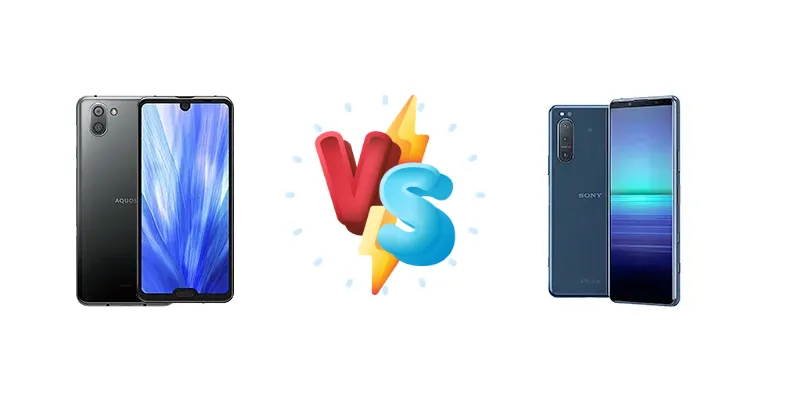
The smartphone market is brimming with options, but the Sharp Aquos R3 and Sony Xperia 5 II stand out as compelling choices for discerning users. Both offer premium features and performance, but cater to slightly different needs. Let's dive into a detailed comparison to help you decide which one deserves your attention.
🏆 Quick Verdict
The Xperia 5 II edges out the Aquos R3 thanks to its newer Snapdragon 865 chipset, faster charging, and consistently excellent camera performance. While the R3 boasts a stunning display, the Xperia 5 II provides a more well-rounded flagship experience, especially for photography enthusiasts.
| Network |
|---|
| 2G bands | GSM 850 / 900 / 1800 / 1900 | GSM 850 / 900 / 1800 / 1900 |
| 3G bands | HSDPA 900 / 2100 | HSDPA 800 / 850 / 900 / 1700(AWS) / 1900 / 2100 |
| 4G bands | 1, 3, 7, 8, 28, 38 | 1, 2, 3, 4, 5, 7, 8, 12, 13, 17, 19, 20, 25, 26, 28, 29, 32, 34, 38, 39, 40, 41, 46, 48, 66 |
| 5G bands | - | 1, 3, 8, 28, 77, 78 SA/NSA |
| Speed | HSPA 42.2/5.76 Mbps, LTE (3CA) Cat15 1024/50 Mbps | HSPA 42.2/5.76 Mbps, LTE Cat18 1200/150 Mbps, 5G |
| Technology | GSM / HSPA / LTE | GSM / HSPA / LTE / 5G |
| Launch |
|---|
| Announced | 2019, August. Released 2019, August | 2020, September 17 |
| Status | Discontinued | Available. Released 2020, October 12 |
| Body |
|---|
| Build | - | Glass front (Gorilla Glass 6), glass back (Gorilla Glass 6), aluminum frame |
| Dimensions | 156 x 74 x 8.9 mm (6.14 x 2.91 x 0.35 in) | 158 x 68 x 8 mm (6.22 x 2.68 x 0.31 in) |
| SIM | Nano-SIM + Nano-SIM | · Nano-SIM· Nano-SIM + Nano-SIM |
| Weight | 185 g (6.53 oz) | 163 g (5.75 oz) |
| | IPX5/IP6X/IPX8 water/dust resistant (up to 1.5m for 30 min) | IP65/IP68 dust/water resistant (up to 1.5m for 30 mins) |
| Display |
|---|
| Protection | Corning Gorilla Glass 5 | Corning Gorilla Glass 6 |
| Resolution | 1440 x 3120 pixels, 19.5:9 ratio (~554 ppi density) | 1080 x 2520 pixels, 21:9 ratio (~449 ppi density) |
| Size | 6.2 inches, 94.4 cm2 (~81.7% screen-to-body ratio) | 6.1 inches, 86.9 cm2 (~80.9% screen-to-body ratio) |
| Type | IGZO IPS LCD, 1B colors, 120Hz, HDR10, Dolby Vision | OLED, 120Hz, HDR BT.2020 |
| | - | Triluminos display
X-Reality Engine |
| Platform |
|---|
| CPU | Octa-core (1x2.84 GHz Kryo 485 & 3x2.42 GHz Kryo 485 & 4x1.78 GHz Kryo 485) | Octa-core (1x2.84 GHz Cortex-A77 & 3x2.42 GHz Cortex-A77 & 4x1.80 GHz Cortex-A55) |
| Chipset | Qualcomm SM8150 Snapdragon 855 (7 nm) | Qualcomm SM8250 Snapdragon 865 5G (7 nm+) |
| GPU | Adreno 640 | Adreno 650 |
| OS | Android 9.0 (Pie), upgradable to Android 10 | Android 10, upgradable to Android 12 |
| Memory |
|---|
| Card slot | microSDXC (uses shared SIM slot) | microSDXC (uses shared SIM slot) |
| Internal | 128GB 6GB RAM | 128GB 8GB RAM, 256GB 8GB RAM |
| | UFS | UFS 3.0 |
| Main Camera |
|---|
| Dual | 12.2 MP, f/1.7, (wide), 1/2.55", 1.4µm, dual pixel PDAF, OIS
20 MP, f/2.4, 125˚ (ultrawide), AF, OIS | - |
| Features | Dual-LED flash, HDR, panorama | Zeiss optics, color spectrum sensor, LED flash, panorama, HDR, eye tracking |
| Triple | - | 12 MP, f/1.7, 24mm (wide), 1/1.7", 1.8µm, dual pixel PDAF, OIS
12 MP, f/2.4, 70mm (telephoto), 1/3.4", 1.0µm, PDAF, 3x optical zoom, OIS
12 MP, f/2.2, 124˚, 16mm (ultrawide), 1/2.55", dual pixel PDAF |
| Video | 1080p@30fps | 4K@24/30/60/120fps HDR, 1080p, 5-axis gyro-EIS, OIS |
| Selfie camera |
|---|
| Features | - | HDR |
| Single | 16 MP, f/2.0 | 8 MP, f/2.0, 24mm (wide), 1/4.0", 1.12µm |
| Video | 1080p@30fps | 1080p@30fps, 5-axis gyro-EIS |
| Sound |
|---|
| 3.5mm jack | Yes | Yes |
| 35mm jack | Yes | Yes |
| Loudspeaker | Yes, with stereo speakers | Yes, with stereo speakers |
| | 24-bit/192kHz audio | 24-bit/192kHz audio
Dynamic vibration system |
| Comms |
|---|
| Bluetooth | 5.0, A2DP, LE | 5.1, A2DP, aptX HD, LE |
| NFC | Yes | Yes |
| Positioning | GPS, GLONASS | GPS, GLONASS, BDS, GALILEO, QZSS |
| Radio | No | No |
| USB | USB Type-C 3.0 | USB Type-C 3.1, OTG |
| WLAN | Wi-Fi 802.11 a/b/g/n/ac, dual-band, Wi-Fi Direct | Wi-Fi 802.11 a/b/g/n/ac/6, dual-band, Wi-Fi Direct, DLNA |
| Features |
|---|
| Sensors | Fingerprint (front-mounted), accelerometer, gyro, proximity, compass | Fingerprint (side-mounted), accelerometer, gyro, proximity, barometer, compass |
| Battery |
|---|
| Charging | Wired, PD
Wireless | 21W wired, PD3.0, 50% in 30 min |
| Type | Li-Po 3200 mAh | Li-Ion 4000 mAh |
| Misc |
|---|
| Colors | Classic Black | Black, Grey, Blue, Pink |
| Models | - | SO-52A, XQ-AS52, XQ-AS62, XQ-AS72, A002SO, SOG02 |
| Price | About 750 EUR | About 650 EUR |
| Pricing |
|---|
| 128GB 8GB RAM | - | $ 695.00 |
| RENEWED | - | £ 239.00 |
| Tests |
|---|
| Battery life | - |
Endurance rating 102h
|
| Camera | - |
Photo / Video |
| Display | - |
Contrast ratio: Infinite (nominal) |
| Loudspeaker | - |
-28.3 LUFS (Average)
|
| Performance | - |
AnTuTu: 532655 (v8)
GeekBench: 3301 (v5.1)
GFXBench: 41fps (ES 3.1 onscreen) |
Sharp Aquos R3
- Exceptional IGZO display
- Compact and ergonomic design
- Good performance
- Older Snapdragon 855 chipset
- Charging speed could be faster
- Camera not as versatile as Xperia 5 II
Sony Xperia 5 II
- Powerful Snapdragon 865 chipset
- Excellent camera system
- Long battery life
- Fast charging (PD3.0)
- Design can feel a bit dated
- Display brightness not as high as Aquos R3
- Pricey
Display Comparison
The Aquos R3's standout feature is its 6.5-inch IGZO display, known for its incredible brightness and color accuracy. While the Xperia 5 II has a respectable 6.1-inch OLED display with a high contrast ratio, the R3's sheer brightness and color reproduction give it a noticeable edge. The Xperia 5 II's display is still excellent, but the R3 takes the crown here.
Camera Comparison
Both phones offer capable camera systems, but the Xperia 5 II consistently delivers superior image quality. Its advanced processing and versatile lens options provide more creative control. The Aquos R3's camera is good, but the Xperia 5 II's consistently excellent results make it the winner in this category.
Performance
The Xperia 5 II's Snapdragon 865 offers a performance boost over the Aquos R3's Snapdragon 855. While both phones are capable of handling demanding tasks, the 865 provides smoother multitasking and slightly faster gaming performance. The Xperia 5 II's 5G capabilities also give it a future-proof advantage.
Battery Life
The Xperia 5 II boasts an impressive endurance rating of 102h, suggesting excellent battery life. While the Aquos R3's battery capacity isn't explicitly stated, the Xperia 5 II's longevity is a significant advantage. The Xperia 5 II also supports faster charging with PD3.0.
Buying Guide
The Sharp Aquos R3 is ideal for users prioritizing a truly exceptional display and a compact form factor. The Sony Xperia 5 II is a better choice for those who value a powerful processor, a versatile camera system, and reliable battery life, particularly if you're a photography enthusiast.
Frequently Asked Questions
❓ Which phone is better for gaming?
The Sony Xperia 5 II's Snapdragon 865 generally provides a smoother and more responsive gaming experience due to its newer architecture and slightly higher clock speeds.
❓ Is the Aquos R3's display worth the extra cost?
If you prioritize display quality above all else, the Aquos R3's IGZO panel is truly exceptional. However, the Xperia 5 II's OLED display is still excellent and offers other advantages like faster charging and a better camera.