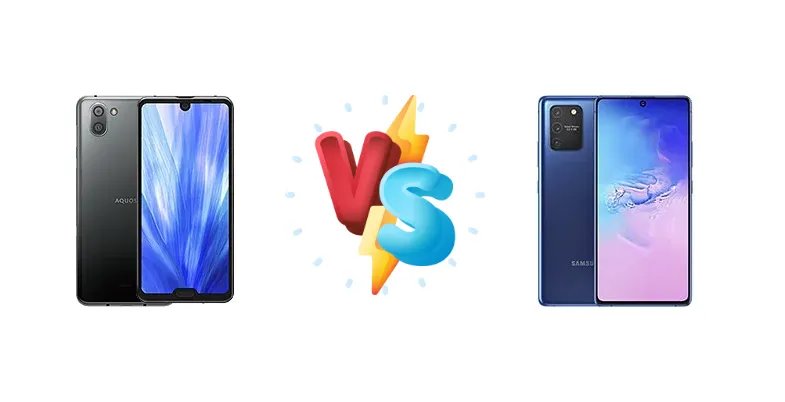
The Sharp Aquos R3 and Samsung Galaxy S10 Lite represent interesting points in the flagship lifecycle. The R3, released with cutting-edge features, faced limited global availability. The S10 Lite, arriving later, aimed to bring flagship performance to a more accessible price point. Both are powered by the Qualcomm Snapdragon 855, but diverge significantly in areas like charging, display technology, and overall design philosophy.
🏆 Quick Verdict
For the average user prioritizing fast charging and a brighter display, the Samsung Galaxy S10 Lite is the better choice. Its 45W charging significantly reduces downtime, and the 705 nit display offers superior visibility in bright conditions. However, the Aquos R3’s inclusion of both wired and wireless charging provides added convenience.
| Network |
|---|
| 2G bands | GSM 850 / 900 / 1800 / 1900 | GSM 850 / 900 / 1800 / 1900 |
| 3G bands | HSDPA 900 / 2100 | HSDPA 850 / 900 / 1700(AWS) / 1900 / 2100 |
| 4G bands | 1, 3, 7, 8, 28, 38 | 1, 2, 3, 4, 5, 7, 8, 12, 13, 17, 20, 26, 28, 38, 40, 41, 66 |
| Speed | HSPA 42.2/5.76 Mbps, LTE (3CA) Cat15 1024/50 Mbps | HSPA, LTE |
| Technology | GSM / HSPA / LTE | GSM / HSPA / LTE |
| Launch |
|---|
| Announced | 2019, August. Released 2019, August | 2020, January 03 |
| Status | Discontinued | Available. Released 2020, February 03 |
| Body |
|---|
| Build | - | Glass front (Gorilla Glass 3+), aluminum frame, plastic back |
| Dimensions | 156 x 74 x 8.9 mm (6.14 x 2.91 x 0.35 in) | 162.5 x 75.6 x 8.1 mm (6.40 x 2.98 x 0.32 in) |
| SIM | Nano-SIM + Nano-SIM | · Nano-SIM· Nano-SIM + Nano-SIM |
| Weight | 185 g (6.53 oz) | 186 g (6.56 oz) |
| | IPX5/IP6X/IPX8 water/dust resistant (up to 1.5m for 30 min) | - |
| Display |
|---|
| Protection | Corning Gorilla Glass 5 | Corning Gorilla Glass 3+ |
| Resolution | 1440 x 3120 pixels, 19.5:9 ratio (~554 ppi density) | 1080 x 2400 pixels, 20:9 ratio (~394 ppi density) |
| Size | 6.2 inches, 94.4 cm2 (~81.7% screen-to-body ratio) | 6.7 inches, 107.8 cm2 (~87.8% screen-to-body ratio) |
| Type | IGZO IPS LCD, 1B colors, 120Hz, HDR10, Dolby Vision | Super AMOLED Plus, HDR10+ |
| | - | Always-on display |
| Platform |
|---|
| CPU | Octa-core (1x2.84 GHz Kryo 485 & 3x2.42 GHz Kryo 485 & 4x1.78 GHz Kryo 485) | Octa-core (1x2.84 GHz Kryo 485 & 3x2.42 GHz Kryo 485 & 4x1.78 GHz Kryo 485) |
| Chipset | Qualcomm SM8150 Snapdragon 855 (7 nm) | Qualcomm SM8150 Snapdragon 855 (7 nm) |
| GPU | Adreno 640 | Adreno 640 |
| OS | Android 9.0 (Pie), upgradable to Android 10 | Android 10, upgradable to Android 13, One UI 5 |
| Memory |
|---|
| Card slot | microSDXC (uses shared SIM slot) | microSDXC (uses shared SIM slot) |
| Internal | 128GB 6GB RAM | 128GB 6GB RAM, 128GB 8GB RAM, 512GB 8GB RAM |
| | UFS | UFS 2.1 |
| Main Camera |
|---|
| Dual | 12.2 MP, f/1.7, (wide), 1/2.55", 1.4µm, dual pixel PDAF, OIS
20 MP, f/2.4, 125˚ (ultrawide), AF, OIS | - |
| Features | Dual-LED flash, HDR, panorama | LED flash, panorama, HDR |
| Triple | - | 48 MP, f/2.0, 26mm (wide), 1/2.0", 0.8µm, PDAF, Super Steady OIS
12 MP, f/2.2, 12mm (ultrawide)
5 MP (macro) |
| Video | 1080p@30fps | 4K@30/60fps, 1080p@30/60/240fps; gyro-EIS |
| Selfie camera |
|---|
| Features | - | HDR |
| Single | 16 MP, f/2.0 | 32 MP, f/2.2, 25mm (wide), 1/2.8", 0.8µm |
| Video | 1080p@30fps | 1080p@30fps |
| Sound |
|---|
| 3.5mm jack | Yes | No |
| 35mm jack | Yes | No |
| Loudspeaker | Yes, with stereo speakers | Yes |
| | 24-bit/192kHz audio | - |
| Comms |
|---|
| Bluetooth | 5.0, A2DP, LE | 5.0, A2DP, LE |
| NFC | Yes | Yes |
| Positioning | GPS, GLONASS | GPS, GLONASS, GALILEO, BDS |
| Radio | No | FM radio (market/region dependent) |
| USB | USB Type-C 3.0 | USB Type-C 2.0 |
| WLAN | Wi-Fi 802.11 a/b/g/n/ac, dual-band, Wi-Fi Direct | Wi-Fi 802.11 a/b/g/n/ac, dual-band, Wi-Fi Direct |
| Features |
|---|
| Sensors | Fingerprint (front-mounted), accelerometer, gyro, proximity, compass | Fingerprint (under display, optical), accelerometer, gyro, proximity, compass |
| | - | ANT+ |
| Battery |
|---|
| Charging | Wired, PD
Wireless | 45W wired |
| Type | Li-Po 3200 mAh | Li-Po 4500 mAh, non-removable |
| Misc |
|---|
| Colors | Classic Black | Prism White, Prism Black, Prism Blue |
| Models | - | SM-G770F, SM-G770F/DS, SM-G770F/DSM, SM-G770U1 |
| Price | About 750 EUR | About 380 EUR |
| SAR | - | 0.69 W/kg (head) 0.93 W/kg (body) |
| SAR EU | - | 0.49 W/kg (head) 1.52 W/kg (body) |
| Tests |
|---|
| Audio quality | - |
Noise -93.7dB / Crosstalk -94.7dB |
| Battery life | - | Endurance rating 110h |
| Camera | - |
Photo / Video |
| Display | - |
Contrast ratio: Infinite (nominal) |
| Loudspeaker | - |
-27.2 LUFS (Good) |
| Performance | - |
AnTuTu: 370751 (v7), 459497 (v8)
GeekBench: 11151 (v4.4), 2732 (v5.1)
GFXBench: 56fps (ES 3.1 onscreen) |
Sharp Aquos R3
- Wireless charging support adds convenience.
- PD charging compatibility offers versatility.
- Potentially more unique design (depending on preference).
- Limited global availability.
- Display brightness likely lower than S10 Lite.
- Camera specifications are unknown.
Samsung Galaxy S10 Lite
- 45W fast charging significantly reduces charging time.
- Brighter display (705 nits) for better outdoor visibility.
- Wider availability and established brand support.
- Lacks wireless charging.
- May exhibit more throttling under sustained load (requires further testing).
- Design may be considered less distinctive.
Display Comparison
The Samsung Galaxy S10 Lite boasts a measured peak brightness of 705 nits, a substantial advantage over the unmeasured brightness of the Aquos R3’s display. This difference translates to significantly better outdoor visibility. While both utilize AMOLED technology, the S10 Lite’s ‘Infinite’ contrast ratio (nominal) suggests a more aggressive dynamic contrast implementation. The Aquos R3’s display specifications are less detailed, leaving questions about its color accuracy and PWM dimming rate unanswered, potentially impacting users sensitive to flicker.
Camera Comparison
Both the Aquos R3 and Galaxy S10 Lite feature photo and video capabilities, but detailed sensor information is lacking. Without knowing sensor sizes, apertures, or OIS implementation, a direct comparison is difficult. The S10 Lite’s camera system likely benefits from Samsung’s established image processing algorithms, potentially delivering more consistent results. The absence of specific details regarding the Aquos R3’s camera suggests it may not be a primary selling point, and relying on megapixel counts alone would be misleading.
Performance
Both devices are equipped with the Qualcomm SM8150 Snapdragon 855 (7 nm) chipset, featuring an octa-core CPU configuration identical in clock speeds (1x2.84 GHz Kryo 485, 3x2.42 GHz Kryo 485, 4x1.78 GHz Kryo 485). Performance will be largely comparable in CPU-bound tasks. However, thermal management could differ due to variations in internal design and cooling solutions. The S10 Lite’s larger market presence means more independent thermal testing data is available, potentially revealing throttling behavior under sustained load. RAM specifications are not provided for either device, but both likely utilize LPDDR4X, common for the Snapdragon 855 era.
Battery Life
The Galaxy S10 Lite is reported to have an endurance rating of 110 hours, indicating respectable battery life. Crucially, it supports 45W wired charging, allowing for significantly faster replenishment compared to the Aquos R3’s PD-compatible wired and wireless charging. While the R3 offers the convenience of wireless charging, the S10 Lite’s 45W charging will likely result in a much shorter 0-100% charge time, a significant advantage for users who frequently need to top up their battery.
Buying Guide
Buy the Sharp Aquos R3 if you prioritize wireless charging and are comfortable with potentially sourcing the device from international markets. Its focus on a complete feature set, including wireless power transfer, appeals to users who value convenience. Buy the Samsung Galaxy S10 Lite if you need a readily available flagship experience with exceptionally fast wired charging and a brighter, more visible display, making it ideal for outdoor use and power users.
Frequently Asked Questions
❓ Does the Aquos R3's wireless charging support Qi standard, or is it proprietary?
The Aquos R3 supports Qi wireless charging, ensuring compatibility with a wide range of wireless chargers. However, its implementation of Power Delivery (PD) for wired charging may require a compatible PD charger to achieve optimal charging speeds.
❓ Is the 45W charging on the Galaxy S10 Lite compatible with all USB-C chargers, or does it require a specific charger?
To achieve the full 45W charging speed on the Galaxy S10 Lite, you'll need a USB-C Power Delivery (PD) charger that supports the PPS (Programmable Power Supply) standard. Standard USB-C chargers will still charge the phone, but at a slower rate.
❓ Given both phones have the Snapdragon 855, will I notice a difference in gaming performance?
While the core processing power is identical, sustained gaming performance could differ. The Galaxy S10 Lite’s larger thermal dissipation area *may* allow it to maintain peak clock speeds for longer periods, reducing throttling. However, this requires independent testing to confirm.
❓ Is the Aquos R3's software experience significantly different from Samsung's One UI?
Yes. The Aquos R3 runs a near-stock Android experience with minimal customizations, while the Galaxy S10 Lite features Samsung's One UI, which includes a wealth of features and customizations. This difference in software experience is a key factor for users who prefer a cleaner Android interface versus a feature-rich one.