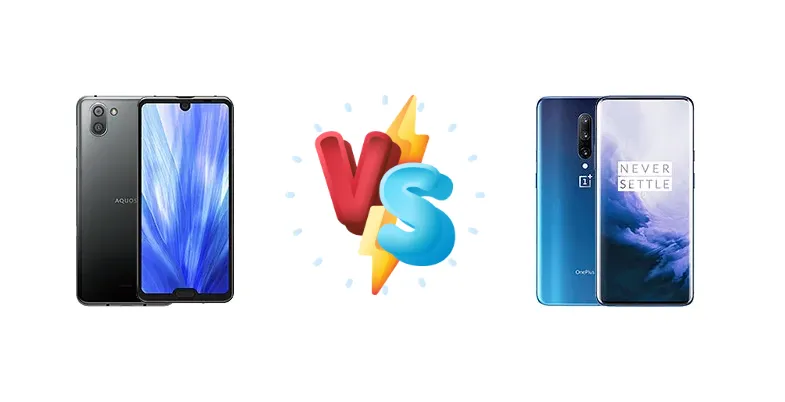
Released in different markets and with distinct approaches to the flagship experience, the Sharp Aquos R3 and the OnePlus 7 Pro 5G both center around Qualcomm’s Snapdragon 855. This comparison dissects their differences, focusing on charging capabilities, potential software experiences, and how these translate to real-world user benefits.
🏆 Quick Verdict
For the average user prioritizing rapid charging and a polished software experience, the OnePlus 7 Pro 5G is the stronger choice. Its 30W charging significantly reduces downtime. However, the Aquos R3’s inclusion of both wired PD and wireless charging offers flexibility, appealing to users who value convenience.
| Network |
|---|
| 2G bands | GSM 850 / 900 / 1800 / 1900 | GSM 850 / 900 / 1800 / 1900 |
| 3G bands | HSDPA 900 / 2100 | HSDPA 800 / 850 / 900 / 1700(AWS) / 1800 / 1900 / 2100 |
| 4G bands | 1, 3, 7, 8, 28, 38 | 1, 2, 3, 4, 5, 7, 8, 12, 13, 17, 18, 19, 20, 25, 26, 28, 29, 32, 34, 38, 39, 40, 41, 66 |
| 5G bands | - | 41 NSA/Sub6/mmWave |
| Speed | HSPA 42.2/5.76 Mbps, LTE (3CA) Cat15 1024/50 Mbps | HSPA 42.2/5.76 Mbps, LTE (5CA) Cat18 1200/150 Mbps, 5G (2+ Gbps DL) |
| Technology | GSM / HSPA / LTE | GSM / HSPA / LTE / 5G |
| Launch |
|---|
| Announced | 2019, August. Released 2019, August | 2019, May 14. Released 2019, September 06 |
| Status | Discontinued | Discontinued |
| Body |
|---|
| Build | - | Glass front (Gorilla Glass 5), glass back (Gorilla Glass 5), aluminum frame |
| Dimensions | 156 x 74 x 8.9 mm (6.14 x 2.91 x 0.35 in) | 162.6 x 75.9 x 8.8 mm (6.40 x 2.99 x 0.35 in) |
| SIM | Nano-SIM + Nano-SIM | Nano-SIM + Nano-SIM |
| Weight | 185 g (6.53 oz) | 206 g (7.27 oz) |
| | IPX5/IP6X/IPX8 water/dust resistant (up to 1.5m for 30 min) | - |
| Display |
|---|
| Protection | Corning Gorilla Glass 5 | Corning Gorilla Glass 5 |
| Resolution | 1440 x 3120 pixels, 19.5:9 ratio (~554 ppi density) | 1440 x 3120 pixels, 19.5:9 ratio (~515 ppi density) |
| Size | 6.2 inches, 94.4 cm2 (~81.7% screen-to-body ratio) | 6.67 inches, 109.2 cm2 (~88.5% screen-to-body ratio) |
| Type | IGZO IPS LCD, 1B colors, 120Hz, HDR10, Dolby Vision | Fluid AMOLED, 90Hz, HDR10+ |
| Platform |
|---|
| CPU | Octa-core (1x2.84 GHz Kryo 485 & 3x2.42 GHz Kryo 485 & 4x1.78 GHz Kryo 485) | Octa-core (1x2.84 GHz Kryo 485 & 3x2.42 GHz Kryo 485 & 4x1.78 GHz Kryo 485) |
| Chipset | Qualcomm SM8150 Snapdragon 855 (7 nm) | Qualcomm SM8150 Snapdragon 855 (7 nm) |
| GPU | Adreno 640 | Adreno 640 |
| OS | Android 9.0 (Pie), upgradable to Android 10 | Android 9.0 (Pie), upgradable to Android 10, OxygenOS 10.0.4 |
| Memory |
|---|
| Card slot | microSDXC (uses shared SIM slot) | No |
| Internal | 128GB 6GB RAM | 128GB 6GB RAM, 256GB 8GB RAM, 256GB 12GB RAM |
| | UFS | UFS 3.0 |
| Main Camera |
|---|
| Dual | 12.2 MP, f/1.7, (wide), 1/2.55", 1.4µm, dual pixel PDAF, OIS
20 MP, f/2.4, 125˚ (ultrawide), AF, OIS | - |
| Features | Dual-LED flash, HDR, panorama | Laser AF, Dual-LED dual-tone flash, panorama, HDR |
| Triple | - | 48 MP, f/1.6, (wide), 1/2.0", 0.8µm, PDAF, OIS
8 MP, f/2.4, 78mm (telephoto), 3x zoom, PDAF, OIS
16 MP, f/2.2, 13mm (ultrawide) |
| Video | 1080p@30fps | 4K@30/60fps, 1080p@30/60/240fps, 720p@480fps, Auto HDR, gyro-EIS, no video rec. with ultrawide camera |
| Selfie camera |
|---|
| Features | - | HDR |
| Single | 16 MP, f/2.0 | Motorized pop-up 16 MP, f/2.0, 25mm (wide), 1/3.06", 1.0µm |
| Video | 1080p@30fps | 1080p@30fps, gyro-EIS |
| Sound |
|---|
| 3.5mm jack | Yes | No |
| 35mm jack | Yes | No |
| Loudspeaker | Yes, with stereo speakers | Yes, with stereo speakers |
| | 24-bit/192kHz audio | - |
| Comms |
|---|
| Bluetooth | 5.0, A2DP, LE | 5.0, A2DP, LE, aptX HD |
| NFC | Yes | Yes |
| Positioning | GPS, GLONASS | GPS (L1+L5), GLONASS (G1), BDS (B1), GALILEO (E1+E5a) |
| Radio | No | No |
| USB | USB Type-C 3.0 | USB Type-C 3.1, OTG |
| WLAN | Wi-Fi 802.11 a/b/g/n/ac, dual-band, Wi-Fi Direct | Wi-Fi 802.11 a/b/g/n/ac, dual-band, Wi-Fi Direct, DLNA |
| Features |
|---|
| Sensors | Fingerprint (front-mounted), accelerometer, gyro, proximity, compass | Fingerprint (under display, optical), accelerometer, gyro, proximity, compass |
| Battery |
|---|
| Charging | Wired, PD
Wireless | 30W wired |
| Type | Li-Po 3200 mAh | Li-Po 4000 mAh, non-removable |
| Misc |
|---|
| Colors | Classic Black | Mirror Grey, Almond, Nebula Blue |
| Models | - | GM1925 |
| Price | About 750 EUR | About 800 EUR |
Sharp Aquos R3
- Wired Power Delivery (PD) charging for compatibility.
- Wireless charging for added convenience.
- Potential for highly accurate color calibration.
- Likely slower wired charging compared to OnePlus.
- Potentially limited software updates and global support.
OnePlus 7 Pro 5G
- 30W fast charging for rapid power-ups.
- OxygenOS provides a smooth and refined user experience.
- Wider 5G band support for broader network compatibility.
- Lacks wireless charging.
- May prioritize vibrant colors over natural accuracy.
Display Comparison
While both devices likely feature high-quality displays, specific details like panel type (OLED vs LCD), resolution, and refresh rate are missing. However, the Aquos R3’s brand history suggests a focus on color accuracy, potentially offering a more calibrated viewing experience. The OnePlus 7 Pro 5G is known for its 90Hz Fluid AMOLED display, which, if present, would provide a smoother scrolling experience than a standard 60Hz panel. Bezels are likely comparable given the flagship positioning of both devices.
Camera Comparison
Without detailed camera specifications, a direct comparison is limited. However, the market positioning suggests the OnePlus 7 Pro 5G likely features a more versatile camera system, potentially including an ultrawide lens and telephoto lens alongside the main sensor. The Aquos R3 may prioritize image processing geared towards natural colors, a common trait in Japanese smartphone brands. Sensor size and aperture are critical factors, and without that data, it’s difficult to assess low-light performance. Ignoring the likely inclusion of low-resolution auxiliary sensors on both devices, the main sensor quality will be the deciding factor.
Performance
Both the Sharp Aquos R3 and the OnePlus 7 Pro 5G are powered by the Qualcomm SM8150 Snapdragon 855 (7 nm) chipset, featuring the same octa-core CPU configuration. This means raw processing power will be nearly identical for tasks like app launching and general navigation. The key differentiator lies in thermal management and sustained performance. OnePlus’s reputation for optimized software could lead to more consistent performance under prolonged load, minimizing throttling. RAM configurations, not specified, would also play a role, with LPDDR4X being the likely standard for both.
Battery Life
The Aquos R3 supports both wired Power Delivery (PD) and wireless charging, offering flexibility. The OnePlus 7 Pro 5G, however, boasts 30W wired charging, a significant advantage. While the Aquos R3’s PD charging will be faster than standard charging, it’s unlikely to match the 30W speed of the OnePlus. Battery capacity is unknown for both, but the faster charging of the OnePlus 7 Pro 5G mitigates the impact of a potentially smaller battery, allowing for quicker top-ups throughout the day.
Buying Guide
Buy the Sharp Aquos R3 if you prioritize charging versatility – benefiting from both Power Delivery (PD) wired and wireless options – and are comfortable with a potentially less globally-optimized software experience. Buy the OnePlus 7 Pro 5G if you value consistently fast 30W charging, a refined OxygenOS interface, and broader 5G network compatibility, making it ideal for users heavily invested in mobile data.
Frequently Asked Questions
❓ Does the Aquos R3's Power Delivery charging work with all USB-C chargers?
The Aquos R3's PD charging is compatible with most USB-C chargers that support the Power Delivery standard. However, to achieve the fastest charging speeds, you'll need a charger specifically rated for PD with sufficient wattage (likely around 18W or higher).
❓ Is the OnePlus 7 Pro 5G's 5G functionality useful if my carrier doesn't have widespread 5G coverage?
The 5G modem in the OnePlus 7 Pro 5G will automatically fall back to 4G LTE when 5G coverage is unavailable. While the 5G capability isn't immediately beneficial without coverage, it future-proofs the device for when 5G networks expand in your area.
❓ Will the Aquos R3 receive frequent software updates like the OnePlus 7 Pro 5G?
Historically, Sharp has not been known for providing the same level of consistent software updates as OnePlus. The OnePlus 7 Pro 5G, with its OxygenOS, typically receives more frequent security patches and feature updates.