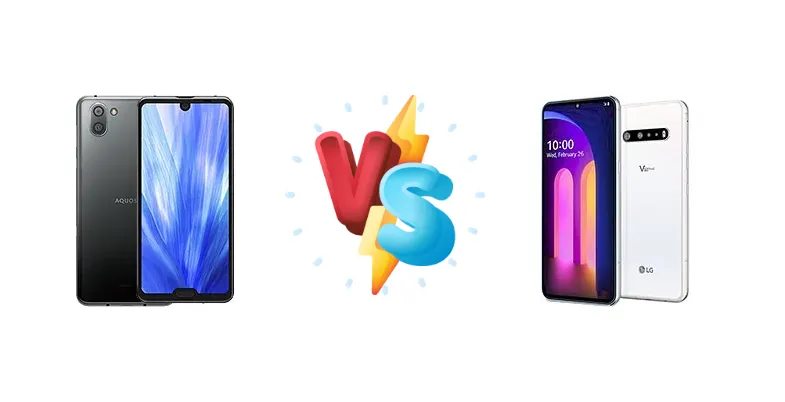
The Sharp Aquos R3 and LG V60 ThinQ 5G represent different eras of flagship smartphone design. The R3 prioritizes a stunning display and compact form factor, while the V60 emphasizes battery life and a versatile camera system. Let's dive into a head-to-head comparison to see which phone emerges victorious.
🏆 Quick Verdict
The LG V60 ThinQ 5G edges out the Aquos R3 thanks to its superior chipset (Snapdragon 865 vs 855), longer software support potential, and exceptional battery endurance. While the R3 boasts a phenomenal display, the V60 offers a more well-rounded package.
| Network |
|---|
| 2G bands | GSM 850 / 900 / 1800 / 1900 | GSM 850 / 900 / 1800 / 1900 |
| 3G bands | HSDPA 900 / 2100 | HSDPA 850 / 900 / 1700(AWS) / 1900 / 2100 |
| 4G bands | 1, 3, 7, 8, 28, 38 | 2, 4, 5, 12, 25, 26, 41, 46, 48, 66, 71 - USA |
| 5G bands | - | 2, 25, 41, 66, 71 SA/NSA/Sub6 |
| Speed | HSPA 42.2/5.76 Mbps, LTE (3CA) Cat15 1024/50 Mbps | HSPA 42.2/5.76 Mbps, LTE (7CA) Cat22, 5G |
| Technology | GSM / HSPA / LTE | GSM / CDMA / HSPA / EVDO / LTE / 5G |
| | - | CDMA2000 1xEV-DO |
| Launch |
|---|
| Announced | 2019, August. Released 2019, August | 2020, February 26. Released 2020, March 20 |
| Status | Discontinued | Discontinued |
| Body |
|---|
| Build | - | Glass front (Gorilla Glass 5), glass back (Gorilla Glass 6), aluminum frame |
| Dimensions | 156 x 74 x 8.9 mm (6.14 x 2.91 x 0.35 in) | 169.3 x 77.6 x 8.9 mm (6.67 x 3.06 x 0.35 in) |
| SIM | Nano-SIM + Nano-SIM | · Nano-SIM· Nano-SIM + Nano-SIM |
| Weight | 185 g (6.53 oz) | 213 g (Global)/ 218 g (Verizon) (7.51 oz) |
| | IPX5/IP6X/IPX8 water/dust resistant (up to 1.5m for 30 min) | IP68 dust/water resistant (up to 1.5m for 30 min)
MIL-STD-810G compliant*
Method 516.6, Procedure IV "Transit Drop"
*does not guarantee ruggedness or use in extreme conditions |
| Display |
|---|
| Protection | Corning Gorilla Glass 5 | Corning Gorilla Glass 5 |
| Resolution | 1440 x 3120 pixels, 19.5:9 ratio (~554 ppi density) | 1080 x 2460 pixels (~395 ppi density) |
| Size | 6.2 inches, 94.4 cm2 (~81.7% screen-to-body ratio) | 6.8 inches, 109.8 cm2 (~83.6% screen-to-body ratio) |
| Type | IGZO IPS LCD, 1B colors, 120Hz, HDR10, Dolby Vision | P-OLED, HDR10+ |
| | - | Always-on display |
| Platform |
|---|
| CPU | Octa-core (1x2.84 GHz Kryo 485 & 3x2.42 GHz Kryo 485 & 4x1.78 GHz Kryo 485) | Octa-core (1x2.84 GHz Cortex-A77 & 3x2.42 GHz Cortex-A77 & 4x1.80 GHz Cortex-A55) |
| Chipset | Qualcomm SM8150 Snapdragon 855 (7 nm) | Qualcomm SM8250 Snapdragon 865 5G (7 nm+) |
| GPU | Adreno 640 | Adreno 650 |
| OS | Android 9.0 (Pie), upgradable to Android 10 | Android 10, upgradable to Android 13 |
| Memory |
|---|
| Card slot | microSDXC (uses shared SIM slot) | microSDXC (uses shared SIM slot) - dual-SIM model |
| Internal | 128GB 6GB RAM | 128GB 8GB RAM, 256GB 8GB RAM |
| | UFS | UFS 2.1 |
| Main Camera |
|---|
| Dual | 12.2 MP, f/1.7, (wide), 1/2.55", 1.4µm, dual pixel PDAF, OIS
20 MP, f/2.4, 125˚ (ultrawide), AF, OIS | 64 MP, f/1.8, 27mm (standard), 1/1.72", 0.8µm, dual pixel PDAF, OIS
13 MP, f/1.9, 12mm (ultrawide), 1/3.4", 1.0µm
0.3 MP, TOF 3D, f/1.4, (depth) |
| Features | Dual-LED flash, HDR, panorama | Dual-LED dual-tone flash, HDR, panorama |
| Video | 1080p@30fps | 8K@30fps, 4K@30/60fps, 1080p, HDR10+, 24-bit/192kHz stereo sound rec., gyro-EIS |
| Selfie camera |
|---|
| Features | - | HDR |
| Single | 16 MP, f/2.0 | 10 MP, f/1.9, 30mm (standard), 1/3.1", 1.22µm |
| Video | 1080p@30fps | 4K@30fps, gyro-EIS |
| Sound |
|---|
| 3.5mm jack | Yes | Yes |
| 35mm jack | Yes | Yes |
| Loudspeaker | Yes, with stereo speakers | Yes, with stereo speakers |
| | 24-bit/192kHz audio | 32-bit/192kHz audio
24-bit/192kHz audio recording |
| Comms |
|---|
| Bluetooth | 5.0, A2DP, LE | 5.1, A2DP, LE, aptX HD |
| NFC | Yes | Yes |
| Positioning | GPS, GLONASS | GPS, GLONASS, GALILEO, BDS |
| Radio | No | FM radio (USA model only) |
| USB | USB Type-C 3.0 | USB Type-C 3.1, OTG |
| WLAN | Wi-Fi 802.11 a/b/g/n/ac, dual-band, Wi-Fi Direct | Wi-Fi 802.11 a/b/g/n/ac/6, dual-band, Wi-Fi Direct, DLNA |
| Features |
|---|
| Sensors | Fingerprint (front-mounted), accelerometer, gyro, proximity, compass | Fingerprint (under display, optical), accelerometer, gyro, proximity, compass, barometer |
| Battery |
|---|
| Charging | Wired, PD
Wireless | Wired, PD2.0, QC4
Wireless |
| Type | Li-Po 3200 mAh | Li-Po 5000 mAh |
| Misc |
|---|
| Colors | Classic Black | Classy Blue, Classy White |
| Models | - | LM-V600, A001LG |
| Price | About 750 EUR | About 700 EUR |
| Tests |
|---|
| Battery life | - |
Endurance rating 103h
|
Sharp Aquos R3
- Stunning IGZO display
- Compact size
- 120Hz refresh rate
- Bright and accurate colors
- Older Snapdragon 855 chipset
- Limited software update support
- Less versatile camera system
- Availability limited outside Japan
LG V60 ThinQ 5G
- Snapdragon 865 chipset
- Excellent battery life
- Versatile camera system
- Longer software support potential
- Headphone jack
- Design feels dated
- OLED display not as bright as R3
- Large size may not suit everyone
Display Comparison
The Sharp Aquos R3's standout feature is its 6.5-inch IGZO display with a 20:9 aspect ratio and a 120Hz refresh rate. It's known for its exceptional brightness, color accuracy, and low power consumption. The LG V60 ThinQ 5G has a 6.8-inch OLED display with a 20:9 aspect ratio and a 120Hz refresh rate. While vibrant, it doesn't quite match the R3's peak brightness and color accuracy. The R3 wins here.
Camera Comparison
The LG V60 ThinQ 5G features a triple-lens rear camera system: a 64MP main lens, a 13MP ultrawide lens, and a 2MP depth sensor. It offers excellent versatility and image quality. The Aquos R3 has a 12MP main camera. While the R3's camera is capable, the V60's wider lens options and overall image processing provide a more compelling experience. The V60 wins.
Performance
The LG V60 ThinQ 5G holds a clear advantage with its Snapdragon 865 chipset, offering a noticeable performance boost over the Aquos R3's Snapdragon 855. The 865 also supports 5G connectivity more efficiently. While both phones handle everyday tasks with ease, the V60 excels in demanding games and multitasking. The V60 wins.
Battery Life
Both phones are reported to have excellent battery life, with endurance ratings of 103 hours. However, the V60's more efficient Snapdragon 865 and slightly larger battery capacity give it a slight edge in real-world usage. The V60 wins.
Buying Guide
The Sharp Aquos R3 is ideal for users who prioritize a compact phone with an absolutely gorgeous display and don't mind potentially shorter software update support. The LG V60 ThinQ 5G is a better choice for those needing long battery life, a versatile camera system, and a more mainstream Android experience with likely longer software support.
Frequently Asked Questions
❓ Is the Sharp Aquos R3 worth buying in 2024?
If you prioritize a compact phone with an exceptional display and can overlook the older chipset and limited software support, the Aquos R3 can still be a compelling option. However, newer phones offer better overall value.
❓ Does the LG V60 ThinQ 5G still receive software updates?
LG has officially ended software support for the V60 ThinQ 5G. However, some custom ROMs may still be available.