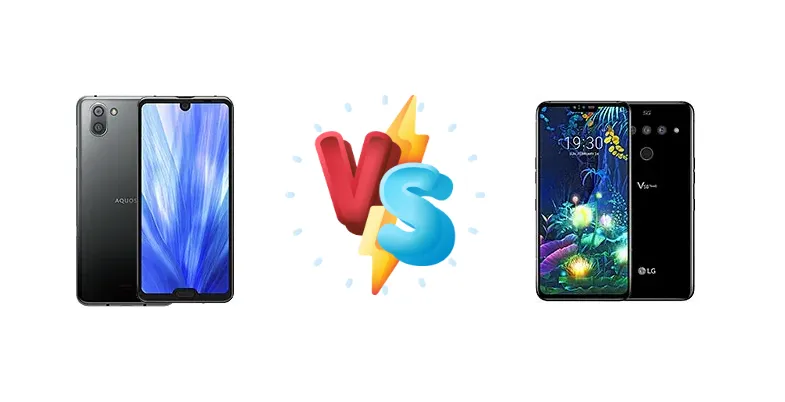
The Sharp Aquos R3 and LG V50 ThinQ 5G were both flagship contenders, boasting powerful processors and aiming for top-tier camera performance. But with different strengths and weaknesses, which phone ultimately delivers the better experience? Let's dive into a comprehensive comparison to help you decide.
🏆 Quick Verdict
The LG V50 ThinQ 5G edges out the Aquos R3 due to its exceptional battery life and versatile camera features. While the Aquos R3 might offer a slightly more modern design and potentially a better display, the V50's longevity and feature set make it the more compelling choice for most users.
| Network |
|---|
| 2G bands | GSM 850 / 900 / 1800 / 1900 | GSM 850 / 900 / 1800 / 1900 |
| 3G bands | HSDPA 900 / 2100 | HSDPA 850 / 900 / 1700(AWS) / 1900 / 2100 - USA |
| 4G bands | 1, 3, 7, 8, 28, 38 | 1, 2, 3, 4, 5, 7, 8, 12, 13, 17, 20, 25, 26, 28, 40, 41, 46, 66, 71 - USA |
| 5G bands | - | 41, 260, 261 NSA |
| Speed | HSPA 42.2/5.76 Mbps, LTE (3CA) Cat15 1024/50 Mbps | HSPA 42.2/5.76 Mbps, LTE (6CA) Cat18 1200/75 Mbps, 5G (2+ Gbps DL) |
| Technology | GSM / HSPA / LTE | GSM / CDMA / HSPA / EVDO / LTE / 5G |
| | - | CDMA2000 1xEV-DO |
| Launch |
|---|
| Announced | 2019, August. Released 2019, August | 2019, February 24. Released 2019, April 19 |
| Status | Discontinued | Discontinued |
| Body |
|---|
| Build | - | Glass front (Gorilla Glass 5), glass back (Gorilla Glass 6), aluminum frame |
| Dimensions | 156 x 74 x 8.9 mm (6.14 x 2.91 x 0.35 in) | 159.2 x 76.1 x 8.3 mm (6.27 x 3.00 x 0.33 in) |
| SIM | Nano-SIM + Nano-SIM | · Nano-SIM· Nano-SIM + Nano-SIM |
| Weight | 185 g (6.53 oz) | 183 g (6.46 oz) |
| | IPX5/IP6X/IPX8 water/dust resistant (up to 1.5m for 30 min) | IP68 dust/water resistant (up to 1.5m for 30 min)
MIL-STD-810G compliant*
*does not guarantee ruggedness or use in extreme conditions |
| Display |
|---|
| Protection | Corning Gorilla Glass 5 | Corning Gorilla Glass 5 |
| Resolution | 1440 x 3120 pixels, 19.5:9 ratio (~554 ppi density) | 1440 x 3120 pixels, 19.5:9 ratio (~538 ppi density) |
| Size | 6.2 inches, 94.4 cm2 (~81.7% screen-to-body ratio) | 6.4 inches, 100.2 cm2 (~82.7% screen-to-body ratio) |
| Type | IGZO IPS LCD, 1B colors, 120Hz, HDR10, Dolby Vision | P-OLED, HDR10 |
| | - | Always-on display |
| Platform |
|---|
| CPU | Octa-core (1x2.84 GHz Kryo 485 & 3x2.42 GHz Kryo 485 & 4x1.78 GHz Kryo 485) | Octa-core (1x2.84 GHz Kryo 485 & 3x2.42 GHz Kryo 485 & 4x1.78 GHz Kryo 485) |
| Chipset | Qualcomm SM8150 Snapdragon 855 (7 nm) | Qualcomm SM8150 Snapdragon 855 (7 nm) |
| GPU | Adreno 640 | Adreno 640 |
| OS | Android 9.0 (Pie), upgradable to Android 10 | Android 9.0 (Pie), upgradable to Android 11 |
| Memory |
|---|
| Card slot | microSDXC (uses shared SIM slot) | microSDXC (dedicated slot) |
| Internal | 128GB 6GB RAM | 128GB 6GB RAM |
| | UFS | UFS 2.1 |
| Main Camera |
|---|
| Dual | 12.2 MP, f/1.7, (wide), 1/2.55", 1.4µm, dual pixel PDAF, OIS
20 MP, f/2.4, 125˚ (ultrawide), AF, OIS | - |
| Features | Dual-LED flash, HDR, panorama | LED flash, HDR, panorama |
| Triple | - | 12 MP, 27mm (wide), f/1.5, 1/2.55", 1.4µm, dual pixel PDAF, 3-axis OIS
12 MP, 52mm (telephoto), f/2.4, 1/3.4", 1.0µm, 2x optical zoom, PDAF, OIS
16 MP, 16mm (ultrawide), f/1.9, 1/3.1", 1.0µm, no AF |
| Video | 1080p@30fps | 4K@30/60fps, 1080p@30/60/240fps, 24-bit/192kHz stereo sound rec., HDR10 video, gyro-EIS |
| Selfie camera |
|---|
| Dual | - | 8 MP, f/1.9, 26mm (wide), 1/4.0", 1.12µm
5 MP, 21mm (wide), f/2.2, 1/5.0", 1.12µm |
| Features | - | HDR |
| Single | 16 MP, f/2.0 | - |
| Video | 1080p@30fps | 1080p@60fps |
| Sound |
|---|
| 3.5mm jack | Yes | Yes |
| 35mm jack | Yes | Yes |
| Loudspeaker | Yes, with stereo speakers | Yes, with stereo speakers |
| | 24-bit/192kHz audio | 32-bit/192kHz audio
24-bit/192kHz audio recording
Tuned with Meridian Audio |
| Comms |
|---|
| Bluetooth | 5.0, A2DP, LE | 5.0, A2DP, LE, aptX HD |
| NFC | Yes | Yes |
| Positioning | GPS, GLONASS | GPS, GLONASS, GALILEO |
| Radio | No | FM radio |
| USB | USB Type-C 3.0 | USB Type-C 3.1 |
| WLAN | Wi-Fi 802.11 a/b/g/n/ac, dual-band, Wi-Fi Direct | Wi-Fi 802.11 a/b/g/n/ac, dual-band, Wi-Fi Direct, DLNA |
| Features |
|---|
| Sensors | Fingerprint (front-mounted), accelerometer, gyro, proximity, compass | Fingerprint (rear-mounted), accelerometer, gyro, proximity, compass, barometer |
| Battery |
|---|
| Charging | Wired, PD
Wireless | 18W wired, PD2.0, QC3, 50% in 36 min
10W wireless (Qi) |
| Type | Li-Po 3200 mAh | Li-Po 4000 mAh, non-removable |
| Misc |
|---|
| Colors | Classic Black | New Aurora Black |
| Models | - | LM-V500, LM-V500N, LM-V500EM, LM-V500XM, LM-V450PM, LM-V450 |
| Price | About 750 EUR | About 550 EUR |
| Tests |
|---|
| Audio quality | - |
Noise -92.5dB / Crosstalk -92.6dB |
| Battery life | - |
Endurance rating 96h
|
| Camera | - |
Photo / Video |
| Display | - |
Contrast ratio: 194000:1 (nominal) |
| Loudspeaker | - |
-25.2 LUFS (Very good)
|
| Performance | - |
AnTuTu: 343758 (v7), 421934 (v8)
GeekBench: 10928 (v4.4), 2672 (v5.1)
GFXBench: 22fps (ES 3.1 onscreen) |
Sharp Aquos R3
- Compact design
- Potentially brighter display
- Modern aesthetics
- PD Charging
- Limited availability
- Less versatile camera
- Battery life not as impressive
- Specs less documented
LG V50 ThinQ 5G
- Exceptional battery life
- Versatile camera system
- High contrast ratio display
- Feature-rich software
- 5G Connectivity
- Older design
- Slower charging compared to newer flagships
- LG's exit from the smartphone market (potential support concerns)
Display Comparison
Both phones feature a Snapdragon 855, but the Aquos R3 is known for its high brightness and potentially more vibrant colors, though specific measurements are scarce. The LG V50 ThinQ 5G boasts an impressive contrast ratio of 194000:1, suggesting deep blacks and excellent image quality. The Aquos R3's display is likely to be more visually striking in bright conditions, while the V50 excels in overall image depth.
Camera Comparison
The LG V50 ThinQ 5G is known for its versatile camera system, often praised for its photo and video capabilities. While the Aquos R3's camera is capable, it lacks the same level of detail and features found in the V50. The V50's camera often included features like Cine Mode and various shooting options.
Performance
Powered by the same Snapdragon 855 chipset and Octa-core CPU, both phones offer flagship-level performance. Expect smooth multitasking, responsive gaming, and effortless handling of demanding applications. Real-world performance differences are likely to be minimal, depending on software optimization.
Battery Life
This is where the LG V50 ThinQ 5G truly shines. Its endurance rating of 96 hours is exceptional, significantly outperforming the Aquos R3. While the Aquos R3 supports PD charging, the V50's charging speeds are competitive and offer both wired and wireless options.
Buying Guide
The Sharp Aquos R3 is ideal for users prioritizing a compact form factor and a potentially brighter display. The LG V50 ThinQ 5G is best suited for those who demand long battery life, a versatile camera system, and appreciate a more feature-rich experience.
Frequently Asked Questions
❓ Is the Sharp Aquos R3 still worth buying?
It depends. If you prioritize a compact size and a potentially brighter display, and can find one at a good price, it might be. However, availability is limited, and support may be an issue.
❓ What is the biggest advantage of the LG V50 ThinQ 5G?
Its exceptional battery life is the standout feature, providing days of use on a single charge.