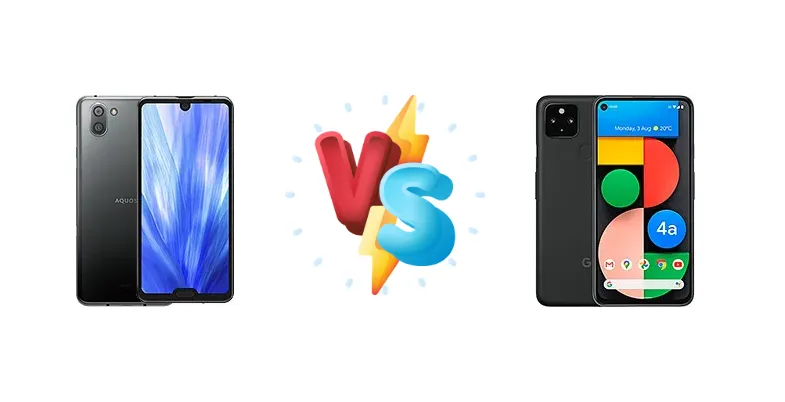
The Sharp Aquos R3, released as a compact flagship, now finds itself competing with newer mid-range offerings like the Google Pixel 4a 5G. This comparison examines whether the R3’s older, more powerful chipset still holds up against the Pixel’s 5G connectivity and Google’s renowned software experience, especially considering the price differences that have emerged since their respective launches.
🏆 Quick Verdict
For the average user prioritizing 5G connectivity and a streamlined software experience, the Google Pixel 4a 5G is the better choice. However, users demanding maximum raw performance and willing to manage potential software quirks will find the Aquos R3 a compelling option, particularly at a significantly lower price point.
| Network |
|---|
| 2G bands | GSM 850 / 900 / 1800 / 1900 | GSM 850 / 900 / 1800 / 1900 |
| 3G bands | HSDPA 900 / 2100 | HSDPA 850 / 900 / 1700(AWS) / 1900 / 2100 |
| 4G bands | 1, 3, 7, 8, 28, 38 | 1, 2, 3, 4, 5, 7, 8, 12, 13, 14, 17, 18, 19, 20, 25, 26, 28, 29, 30, 32, 38, 39, 40, 41, 42, 46, 48, 66, 71 |
| 5G bands | - | 1, 2, 3, 5, 7, 8, 12, 28, 41, 66, 71, 77, 78 Sub6, mmWave (market dependant) |
| Speed | HSPA 42.2/5.76 Mbps, LTE (3CA) Cat15 1024/50 Mbps | HSPA, LTE, 5G |
| Technology | GSM / HSPA / LTE | GSM / HSPA / LTE / 5G |
| Launch |
|---|
| Announced | 2019, August. Released 2019, August | 2020, September 30 |
| Status | Discontinued | Available. Released 2020, November 05 |
| Body |
|---|
| Build | - | Glass front (Gorilla Glass 3), plastic back, plastic frame |
| Dimensions | 156 x 74 x 8.9 mm (6.14 x 2.91 x 0.35 in) | 153.9 x 74 x 8.2 mm (Sub-6) or 8.5 mm (Sub-6 and mmWave) |
| SIM | Nano-SIM + Nano-SIM | Nano-SIM + eSIM |
| Weight | 185 g (6.53 oz) | 168 g (5G Sub-6); 171 g ( 5G Sub-6 and mmWave) (5.93 oz) |
| | IPX5/IP6X/IPX8 water/dust resistant (up to 1.5m for 30 min) | - |
| Display |
|---|
| Protection | Corning Gorilla Glass 5 | Corning Gorilla Glass 3 |
| Resolution | 1440 x 3120 pixels, 19.5:9 ratio (~554 ppi density) | 1080 x 2340 pixels, 19.5:9 ratio (~413 ppi density) |
| Size | 6.2 inches, 94.4 cm2 (~81.7% screen-to-body ratio) | 6.2 inches, 95.7 cm2 (~84.1% screen-to-body ratio) |
| Type | IGZO IPS LCD, 1B colors, 120Hz, HDR10, Dolby Vision | OLED, HDR |
| | - | Always-on display |
| Platform |
|---|
| CPU | Octa-core (1x2.84 GHz Kryo 485 & 3x2.42 GHz Kryo 485 & 4x1.78 GHz Kryo 485) | Octa-core (1x2.4 GHz Kryo 475 Prime & 1x2.2 GHz Kryo 475 Gold & 6x1.8 GHz Kryo 475 Silver) |
| Chipset | Qualcomm SM8150 Snapdragon 855 (7 nm) | Qualcomm SM7250 Snapdragon 765G 5G (7 nm) |
| GPU | Adreno 640 | Adreno 620 |
| OS | Android 9.0 (Pie), upgradable to Android 10 | Android 11, upgradable to Android 14 |
| Memory |
|---|
| Card slot | microSDXC (uses shared SIM slot) | No |
| Internal | 128GB 6GB RAM | 128GB 6GB RAM |
| | UFS | UFS 2.1 |
| Main Camera |
|---|
| Dual | 12.2 MP, f/1.7, (wide), 1/2.55", 1.4µm, dual pixel PDAF, OIS
20 MP, f/2.4, 125˚ (ultrawide), AF, OIS | 12.2 MP, f/1.7, 27mm (wide), 1/2.55", 1.4µm, dual pixel PDAF, OIS
16 MP, f/2.2, 107˚ (ultrawide), 1.0µm |
| Features | Dual-LED flash, HDR, panorama | LED flash, Pixel Shift, Auto-HDR, panorama |
| Video | 1080p@30fps | 4K@30/60fps, 1080p@30/60/120/240fps; gyro-EIS |
| Selfie camera |
|---|
| Features | - | HDR |
| Single | 16 MP, f/2.0 | 8 MP, f/2.0, 24mm (wide), 1/4.0", 1.12µm |
| Video | 1080p@30fps | 1080p@30fps |
| Sound |
|---|
| 3.5mm jack | Yes | Yes |
| 35mm jack | Yes | Yes |
| Loudspeaker | Yes, with stereo speakers | Yes, with stereo speakers |
| | 24-bit/192kHz audio | - |
| Comms |
|---|
| Bluetooth | 5.0, A2DP, LE | 5.0, A2DP, LE, aptX HD |
| NFC | Yes | Yes |
| Positioning | GPS, GLONASS | GPS, GLONASS, GALILEO, QZSS, BDS |
| Radio | No | No |
| USB | USB Type-C 3.0 | USB Type-C 3.1 |
| WLAN | Wi-Fi 802.11 a/b/g/n/ac, dual-band, Wi-Fi Direct | Wi-Fi 802.11 a/b/g/n/ac, dual-band, Wi-Fi Direct |
| Features |
|---|
| Sensors | Fingerprint (front-mounted), accelerometer, gyro, proximity, compass | Fingerprint (rear-mounted), accelerometer, gyro, proximity, compass, barometer |
| Battery |
|---|
| Charging | Wired, PD
Wireless | 18W wired, PD2.0 |
| Type | Li-Po 3200 mAh | Li-Po 3885 mAh |
| Misc |
|---|
| Colors | Classic Black | Just Black, Clearly White |
| Models | - | GD1YQ, G025I, G025E, G025H, G6QU3 |
| Price | About 750 EUR | About 140 EUR |
Sharp Aquos R3
- Superior raw performance with Snapdragon 855
- Wireless charging support
- Potentially higher quality display (based on brand history)
- No 5G connectivity
- Potential for thermal throttling
- Likely less frequent software updates
Google Pixel 4a 5G
- Integrated 5G modem for faster data speeds
- Clean Android experience with guaranteed updates
- Excellent camera performance through computational photography
- Less powerful chipset compared to Snapdragon 855
- Slower charging speed (18W)
- May lack the display refinements of a flagship
Display Comparison
While specific display specs for the Aquos R3 are unavailable, Sharp historically prioritizes display quality. The Pixel 4a 5G features a 6.7-inch FHD+ OLED display. The Aquos R3 likely boasts a comparable or superior panel, potentially with a higher refresh rate, given its flagship positioning. However, the Pixel 4a 5G benefits from modern OLED technology, offering excellent contrast and color accuracy. The absence of high refresh rate information for the R3 is a drawback, as it impacts smoothness during scrolling and gaming.
Camera Comparison
The Pixel 4a 5G is renowned for its computational photography, leveraging Google’s software algorithms to produce excellent images, even with a relatively modest sensor. The Aquos R3’s camera specs are unknown, but as a flagship, it likely featured a larger sensor and more advanced optics. However, raw hardware isn’t everything; the Pixel’s image processing excels in dynamic range and low-light performance. Without specific details on the R3’s camera, it’s difficult to definitively declare a winner, but the Pixel 4a 5G’s consistent image quality is a strong advantage.
Performance
The core difference lies in the chipsets: the Aquos R3 utilizes the Qualcomm Snapdragon 855 (7nm) versus the Pixel 4a 5G’s Snapdragon 765G (7nm). The 855, with its Kryo 485 cores clocked up to 2.84 GHz, offers significantly higher peak CPU and GPU performance. The 765G, while efficient, is designed for a balance of performance and power efficiency. The 855’s Adreno 640 GPU will outperform the 765G’s Adreno 620 in graphically intensive tasks. However, the 765G integrates a 5G modem, a feature absent in the R3. The R3’s performance advantage may be limited by thermal throttling during sustained loads, a common issue with the 855.
Battery Life
Battery capacity for both devices is unknown. The Pixel 4a 5G supports 18W wired charging with PD2.0, offering a reasonable charging speed. The Aquos R3 supports both wired PD and wireless charging, providing greater convenience. However, the Snapdragon 855 is known to be more power-hungry than the 765G. Therefore, the Pixel 4a 5G may offer better real-world battery life despite potentially having a smaller capacity, due to the more efficient chipset. The R3’s wireless charging is a notable advantage for users who prefer that method.
Buying Guide
Buy the Sharp Aquos R3 if you need uncompromising performance for demanding tasks like gaming or video editing and are comfortable with potentially less frequent software updates. Buy the Google Pixel 4a 5G if you prioritize 5G connectivity, a clean Android experience with guaranteed updates, and a reliable camera system with Google’s computational photography prowess.
Frequently Asked Questions
❓ Does the Snapdragon 855 in the Aquos R3 overheat during prolonged gaming sessions?
The Snapdragon 855 is known to generate significant heat under sustained load. While the Aquos R3 likely has thermal management solutions, users should expect some degree of throttling during extended gaming, potentially impacting performance over time. The Pixel 4a 5G’s 765G is more efficient and less prone to overheating.
❓ How does the 5G connectivity of the Pixel 4a 5G impact real-world download speeds compared to 4G on the Aquos R3?
The Pixel 4a 5G’s 5G modem offers significantly faster download speeds than the Aquos R3’s 4G connectivity, *assuming* 5G coverage is available. In ideal conditions, 5G can provide speeds several times faster than 4G, enabling quicker downloads, smoother streaming, and lower latency for online gaming.
❓ Is the lack of software update guarantees on the Aquos R3 a significant concern?
Yes, the Aquos R3 is unlikely to receive the same level of ongoing software support as the Pixel 4a 5G. Google guarantees several years of Android updates and security patches for the Pixel, ensuring continued functionality and security. The R3 may become vulnerable to security threats over time due to a lack of updates.