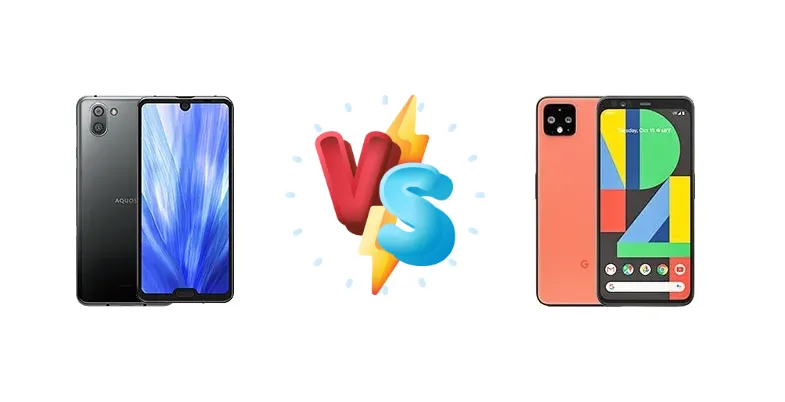
The Sharp Aquos R3 and Google Pixel 4 XL represent interesting points in the flagship Android timeline. The R3, released in 2019, offered a unique form factor and aggressive pricing. The Pixel 4 XL, also from 2019, focused on Google’s computational photography and a clean software experience. Now, with the Pixel 4 XL seeing significant price drops, a direct comparison is more relevant than ever, especially given both devices share the same Qualcomm Snapdragon 855 chipset.
🏆 Quick Verdict
For the average user prioritizing camera quality and guaranteed software updates, the Google Pixel 4 XL is the better choice, despite its higher initial cost. However, budget-conscious users who value a potentially unique form factor and don't mind a shorter software support lifespan will find the Aquos R3 a compelling alternative.
| Network |
|---|
| 2G bands | GSM 850 / 900 / 1800 / 1900 | GSM 850 / 900 / 1800 / 1900 |
| 3G bands | HSDPA 900 / 2100 | HSDPA 850 / 900 / 1700(AWS) / 1900 / 2100 |
| 4G bands | 1, 3, 7, 8, 28, 38 | 1, 2, 3, 4, 5, 7, 8, 12, 13, 17, 20, 25, 26, 28, 32, 38, 39, 40, 41, 66, 71 - Global |
| Speed | HSPA 42.2/5.76 Mbps, LTE (3CA) Cat15 1024/50 Mbps | HSPA 42.2/5.76 Mbps, LTE (5CA) Cat18 1200/150 Mbps |
| Technology | GSM / HSPA / LTE | GSM / CDMA / HSPA / EVDO / LTE |
| | - | 1, 2, 3, 4, 5, 7, 8, 12, 13, 14, 17, 18, 19, 20, 25, 26, 28, 29, 30, 38, 39, 40, 41, 46, 48, 66, 71 - USA |
| Launch |
|---|
| Announced | 2019, August. Released 2019, August | 2019, October 15 |
| Status | Discontinued | Available. Released 2019, October 22 |
| Body |
|---|
| Build | - | Glass front (Gorilla Glass 5), glass back (Gorilla Glass 5), aluminum frame |
| Dimensions | 156 x 74 x 8.9 mm (6.14 x 2.91 x 0.35 in) | 160.4 x 75.1 x 8.2 mm (6.31 x 2.96 x 0.32 in) |
| SIM | Nano-SIM + Nano-SIM | Nano-SIM + eSIM |
| Weight | 185 g (6.53 oz) | 193 g (6.81 oz) |
| | IPX5/IP6X/IPX8 water/dust resistant (up to 1.5m for 30 min) | IP68 dust/water resistant (up to 1.5m for 30 min) |
| Display |
|---|
| Protection | Corning Gorilla Glass 5 | Corning Gorilla Glass 5 |
| Resolution | 1440 x 3120 pixels, 19.5:9 ratio (~554 ppi density) | 1440 x 3040 pixels, 19:9 ratio (~537 ppi density) |
| Size | 6.2 inches, 94.4 cm2 (~81.7% screen-to-body ratio) | 6.3 inches, 98.0 cm2 (~81.3% screen-to-body ratio) |
| Type | IGZO IPS LCD, 1B colors, 120Hz, HDR10, Dolby Vision | P-OLED, 90Hz, HDR |
| | - | Always-on display |
| Platform |
|---|
| CPU | Octa-core (1x2.84 GHz Kryo 485 & 3x2.42 GHz Kryo 485 & 4x1.78 GHz Kryo 485) | Octa-core (1x2.84 GHz Kryo 485 & 3x2.42 GHz Kryo 485 & 4x1.78 GHz Kryo 485) |
| Chipset | Qualcomm SM8150 Snapdragon 855 (7 nm) | Qualcomm SM8150 Snapdragon 855 (7 nm) |
| GPU | Adreno 640 | Adreno 640 |
| OS | Android 9.0 (Pie), upgradable to Android 10 | Android 10, upgradable to Android 13 |
| Memory |
|---|
| Card slot | microSDXC (uses shared SIM slot) | No |
| Internal | 128GB 6GB RAM | 64GB 6GB RAM, 128GB 6GB RAM |
| | UFS | UFS 2.1 |
| Main Camera |
|---|
| Dual | 12.2 MP, f/1.7, (wide), 1/2.55", 1.4µm, dual pixel PDAF, OIS
20 MP, f/2.4, 125˚ (ultrawide), AF, OIS | 12.2 MP, f/1.7, 27mm (wide), 1/2.55", 1.4µm, dual pixel PDAF, OIS
16 MP, f/2.4, 50mm (telephoto), 1/3.6", 1.0µm, PDAF, OIS, 2x optical zoom |
| Features | Dual-LED flash, HDR, panorama | Dual-LED flash, Pixel Shift, Auto-HDR, panorama |
| Video | 1080p@30fps | 4K@30fps, 1080p@30/60/120fps, 1080p@30fps (gyro-EIS) |
| Selfie camera |
|---|
| Features | - | HDR |
| Single | 16 MP, f/2.0 | 8 MP, f/2.0, 22mm (wide), 1.22µm, no AF
TOF 3D, (depth/biometrics sensor) |
| Video | 1080p@30fps | 1080p@30fps |
| Sound |
|---|
| 3.5mm jack | Yes | No |
| 35mm jack | Yes | No |
| Loudspeaker | Yes, with stereo speakers | Yes, with stereo speakers |
| | 24-bit/192kHz audio | - |
| Comms |
|---|
| Bluetooth | 5.0, A2DP, LE | 5.0, A2DP, LE, aptX HD |
| NFC | Yes | Yes |
| Positioning | GPS, GLONASS | GPS, GLONASS, BDS, GALILEO |
| Radio | No | No |
| USB | USB Type-C 3.0 | USB Type-C 3.1 |
| WLAN | Wi-Fi 802.11 a/b/g/n/ac, dual-band, Wi-Fi Direct | Wi-Fi 802.11 a/b/g/n/ac, dual-band, Wi-Fi Direct, DLNA |
| Features |
|---|
| Sensors | Fingerprint (front-mounted), accelerometer, gyro, proximity, compass | Face ID, accelerometer, gyro, proximity, compass, barometer |
| Battery |
|---|
| Charging | Wired, PD
Wireless | 18W wired, PD2.0
Wireless |
| Type | Li-Po 3200 mAh | Li-Po 3700 mAh, non-removable |
| Misc |
|---|
| Colors | Classic Black | Clearly White, Just Black, Oh So Orange |
| Models | - | G020P, G020, GA01181-US, GA01182-US, GA01180-US |
| Price | About 750 EUR | About 180 EUR |
| Pricing |
|---|
| 128GB 6GB RAM | - | $ 364.52 |
| 64GB 6GB RAM | - | $ 274.99 |
| RENEWED | - | $ 149.00 |
| Tests |
|---|
| Audio quality | - |
Noise -93.9 / Crosstalk -94.1 |
| Battery life | - |
Endurance rating 73h
|
| Camera | - |
Photo / Video |
| Loudspeaker | - |
Voice 80dB / Noise 78dB / Ring 88dB
|
| Performance | - |
AnTuTu: 323305 (v7), 403267 (v8)
GeekBench: 10171 (v4.4), 2267 (v5.1)
GFXBench: 21fps (ES 3.1 onscreen) |
Sharp Aquos R3
- Potentially lower price point
- Unique form factor (details unavailable)
- Snapdragon 855 performance
- Limited software support
- Less detailed camera specifications
- Uncertain display quality
Google Pixel 4 XL
- Exceptional camera quality
- Guaranteed software updates
- 90Hz QHD+ display
- Higher initial cost
- Battery life can be average
- Larger size may not suit all users
Display Comparison
Both devices utilize OLED panels, but detailed display specifications for the Aquos R3 are scarce. The Pixel 4 XL is known for its 6.3-inch QHD+ (3040 x 1440) OLED display with a 90Hz refresh rate, contributing to a smoother visual experience. While the R3 likely offers a vibrant image, the Pixel 4 XL’s higher resolution and refresh rate provide a demonstrably superior viewing experience. The Pixel 4 XL also benefits from Google’s color calibration, ensuring accurate color reproduction, a detail often overlooked in more budget-focused devices like the R3.
Camera Comparison
The Pixel 4 XL’s camera is its defining feature. While both phones are listed as having 'Photo / Video' capabilities, the Pixel 4 XL leverages Google’s renowned computational photography algorithms, including HDR+, Night Sight, and Portrait Mode. The Pixel 4 XL’s camera excels in low-light conditions and delivers consistently excellent image quality. The Aquos R3’s camera specifications are less detailed, making a direct comparison difficult. The Pixel 4 XL’s focus on software processing provides a significant advantage, particularly for users who prioritize ease of use and consistently high-quality results. The R3 likely relies more heavily on hardware, which may struggle to match the Pixel’s software prowess.
Performance
Both the Sharp Aquos R3 and Google Pixel 4 XL are powered by the Qualcomm Snapdragon 855 (7nm) chipset, featuring an octa-core CPU configuration (1x2.84 GHz Kryo 485, 3x2.42 GHz Kryo 485, and 4x1.78 GHz Kryo 485). This means raw processing power will be very similar. However, the Pixel 4 XL’s 6GB of RAM (available in both 64GB and 128GB storage configurations) is standard, while the R3’s RAM configuration is less frequently specified. Thermal management is a potential differentiator; the Pixel 4 XL’s larger chassis may allow for more effective heat dissipation, potentially preventing throttling during sustained workloads. Both support PD charging, but the Pixel 4 XL’s PD2.0 implementation may offer slightly faster charging speeds.
Battery Life
Both devices share an endurance rating of 73 hours, according to the provided data. However, this metric doesn’t tell the whole story. The Pixel 4 XL supports 18W wired charging with PD2.0 and wireless charging, offering flexibility. The Aquos R3 also supports wired and wireless charging, but specific wattage details are missing. While the endurance rating is identical, the Pixel 4 XL’s faster charging and wireless capabilities provide a more convenient user experience. The R3’s battery performance will be heavily influenced by its software optimization and power management, areas where Google typically excels.
Buying Guide
Buy the Sharp Aquos R3 if you need a functional flagship experience on a very tight budget and are comfortable with potentially limited software updates and a less-established brand ecosystem. Buy the Google Pixel 4 XL if you prioritize a best-in-class camera, a smooth and consistently updated Android experience, and long-term software support, even if it means spending more upfront.
Frequently Asked Questions
❓ Is the Aquos R3's software still supported with security updates?
Sharp's software support for the Aquos R3 is limited. While it launched with Android 9, updates beyond Android 10 are unlikely. This poses a security risk compared to the Pixel 4 XL, which continues to receive regular security patches and feature drops.
❓ How does the Pixel 4 XL's camera perform in very low-light conditions compared to other phones?
The Pixel 4 XL's Night Sight mode is exceptional, consistently ranking among the best in low-light photography. It uses computational photography to brighten images, reduce noise, and retain detail, often surpassing the capabilities of phones with larger sensors but less sophisticated software.
❓ Does the Snapdragon 855 in either phone struggle with demanding games like Genshin Impact?
While the Snapdragon 855 is capable, demanding games like Genshin Impact may require reduced graphics settings on both the Aquos R3 and Pixel 4 XL to maintain a stable frame rate. The Pixel 4 XL’s potentially better thermal management might offer slightly more sustained performance.
❓ What is the long-term availability of replacement parts for the Aquos R3?
Replacement parts for the Sharp Aquos R3 are becoming increasingly difficult to find, and repair options are limited compared to the more widely supported Google Pixel 4 XL. This is a significant consideration for long-term ownership.