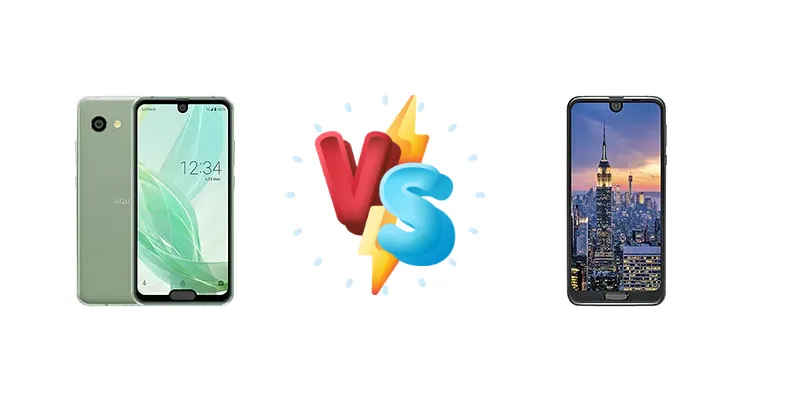
The Sharp Aquos R2 and R2 Compact represent an interesting period in flagship design – a time when truly compact, high-performance phones were still viable. Both devices leverage the Qualcomm Snapdragon 845, but diverge significantly in size and charging capabilities. This comparison dissects those differences to determine which Aquos R2 variant offers the best experience for today’s user.
🏆 Quick Verdict
For most users, the Sharp Aquos R2 Compact is the superior choice. While both phones share the same Snapdragon 845 chipset, the Compact’s smaller form factor and faster 18W PD2.0 charging provide a more convenient and modern experience, outweighing the slightly larger screen of the standard R2.
| Network |
|---|
| 2G bands | GSM 850 / 900 / 1800 / 1900 | GSM 850 / 900 / 1800 / 1900 |
| 3G bands | HSDPA 800 / 850 / 900 / 2100 | HSDPA 850 / 900 / 1900 / 2100 |
| 4G bands | 1, 3, 5, 8, 11, 12, 17, 19, 26, 28, 41, 42 | 1, 3, 5, 8, 11, 12, 17, 19, 26, 28, 41, 42 |
| Speed | HSPA, LTE | HSPA, LTE |
| Technology | GSM / HSPA / LTE | GSM / CDMA / HSPA / LTE |
| | - | CDMA 800 & TD-SCDMA |
| Launch |
|---|
| Announced | 2018, November. Released 2019, January | 2018, May. Released 2018, May |
| Status | Discontinued | Discontinued |
| Body |
|---|
| Build | Glass front (Gorilla Glass 3), plastic back, aluminum frame | - |
| Dimensions | 131 x 64 x 9.3 mm (5.16 x 2.52 x 0.37 in) | 156 x 74 x 9 mm (6.14 x 2.91 x 0.35 in) |
| SIM | Nano-SIM | Nano-SIM + Nano-SIM |
| Weight | 135 g (4.76 oz) | 181 g (6.38 oz) |
| | IP68 dust/water resistant (up to 1.5m for 30 mins) | IPX5/IPX8/IP6X |
| Display |
|---|
| Protection | Corning Gorilla Glass 3 | - |
| Resolution | 1080 x 2280 pixels, 19:9 ratio (~485 ppi density) | 1440 x 3040 pixels, 19:9 ratio (~561 ppi density) |
| Size | 5.2 inches, 67.5 cm2 (~80.5% screen-to-body ratio) | 6.0 inches, 89.9 cm2 (~77.8% screen-to-body ratio) |
| Type | IGZO IPS LCD, 120Hz, HDR10 | IGZO IPS LCD |
| Platform |
|---|
| CPU | Octa-core (4x2.6 GHz Kryo 385 Gold & 4x1.7 GHz Kryo 385 Silver) | Octa-core (4x2.6 GHz Kryo 385 Gold & 4x1.7 GHz Kryo 385 Silver) |
| Chipset | Qualcomm SDM845 Snapdragon 845 (10 nm) | Qualcomm SDM845 Snapdragon 845 (10 nm) |
| GPU | Adreno 630 | Adreno 630 |
| OS | Android 9.0 (Pie) | Android 8.0 (Oreo), upgradable to Android 10 |
| Memory |
|---|
| Card slot | microSDXC (dedicated slot) | microSDXC (uses shared SIM slot) |
| Internal | 64GB 4GB RAM | 64GB 4GB RAM |
| Main Camera |
|---|
| Dual | - | 22.6 MP, PDAF
16.3 MP, PDAF (for video recording only) |
| Features | LED flash, HDR, panorama | LED flash, HDR, panorama |
| Single | 22.6 MP, f/1.9, 22 mm, PDAF, OIS | - |
| Video | 4K@30fps, 1080p@30/60fps (gyro-EIS) | 4K@30fps (dedicated video camera) |
| Selfie camera |
|---|
| Single | 8 MP, f/2.2, 23 mm | 16.3 MP |
| Video | 1080p@30fps | - |
| Sound |
|---|
| 3.5mm jack | Yes | Yes |
| 35mm jack | Yes | Yes |
| Loudspeaker | Yes | Yes |
| |
24-bit/192kHz audio | - |
| Comms |
|---|
| Bluetooth | 5.0, A2DP, LE | 5.0, A2DP, LE |
| NFC | Yes | Yes |
| Positioning | GPS, GLONASS, GALILEO, QZSS | GPS, GLONASS |
| Radio | No | No |
| USB | USB Type-C 2.0 | USB Type-C 2.0 |
| WLAN | Wi-Fi 802.11 a/b/g/n/ac, dual-band, Wi-Fi Direct | Wi-Fi 802.11 a/b/g/n/ac, dual-band, Wi-Fi Direct |
| Features |
|---|
| Sensors | Fingerprint (front-mounted), accelerometer, gyro, proximity, compass | Fingerprint (front-mounted), accelerometer, gyro, proximity, compass |
| Battery |
|---|
| Charging | 18W wired, PD2.0 | 10W wired |
| Type | Li-Ion 2500 mAh, non-removable | Li-Ion 3130 mAh, non-removable |
| Misc |
|---|
| Colors | Smokey Green, Deep White, Pure Black | Black, White |
| Models | SH-M09 | 706SH, SHV42 |
| Price | - | About 350 EUR |
Sharp Aquos R2 compact
- Faster 18W PD2.0 charging
- More compact and pocketable design
- Identical Snapdragon 845 performance
- Potentially smaller display size
- May have slightly more thermal throttling (unconfirmed)
Sharp Aquos R2
- Larger display for immersive viewing
- Identical Snapdragon 845 performance
- Potentially better heat dissipation due to larger size
- Slower 10W charging
- Less convenient for one-handed use
- Bulkier form factor
Display Comparison
Both the Aquos R2 and R2 Compact feature displays built around the Snapdragon 845’s capabilities, but differ in size. While specific display specs like resolution and panel type aren't provided, the R2’s larger size suggests a more immersive viewing experience. However, the Compact’s smaller footprint is a significant advantage for users prioritizing one-handed operation. The absence of information regarding refresh rates or HDR support limits a deeper analysis, but the focus here is clearly on size as the primary differentiator.
Camera Comparison
Without detailed camera specifications, a direct comparison is limited. Both phones likely utilize the Snapdragon 845’s image signal processor (ISP) for image processing. The absence of sensor size or aperture information prevents a definitive assessment of image quality. It’s reasonable to assume both devices offer competent camera performance for their time, but the R2’s larger body *could* accommodate a slightly larger sensor, potentially improving low-light performance. However, this is speculative.
Performance
Both devices are powered by the Qualcomm Snapdragon 845 (10nm), featuring an octa-core CPU configuration with 4x2.6 GHz Kryo 385 Gold and 4x1.7 GHz Kryo 385 Silver cores. This means raw processing power is identical. Performance will be virtually indistinguishable in day-to-day tasks and demanding applications. Thermal management, however, *could* differ due to the Compact’s smaller chassis potentially limiting heat dissipation, though this isn't confirmed without testing. The shared chipset ensures a smooth Android experience on both devices.
Battery Life
The key difference lies in charging. The Aquos R2 Compact supports 18W wired charging with PD2.0, a significantly faster standard than the R2’s 10W wired charging. While battery capacity isn’t specified, the faster charging on the Compact translates to considerably quicker top-ups. This is a major convenience factor, especially for users who frequently find themselves needing to recharge throughout the day. The 10W charging on the R2 feels dated by comparison, requiring a much longer time to reach a full charge.
Buying Guide
Buy the Sharp Aquos R2 Compact if you prioritize portability and fast charging. Its smaller size makes it ideal for one-handed use and slipping into pockets, while the 18W PD2.0 charging significantly reduces downtime. Buy the Sharp Aquos R2 if you specifically desire a larger display and are less concerned with charging speed or pocketability. The standard R2 caters to users who value screen real estate above all else.
Frequently Asked Questions
❓ Does the Aquos R2 Compact's smaller size significantly impact gaming performance compared to the R2?
No. Both devices utilize the same Snapdragon 845 chipset, meaning raw gaming performance will be nearly identical. While the Compact's smaller chassis *could* lead to slightly more thermal throttling under sustained load, the difference is unlikely to be noticeable for most users. The Snapdragon 845 is well-equipped to handle demanding games on both devices.
❓ Is the 18W PD2.0 charging on the Aquos R2 Compact compatible with all USB-C chargers?
The Aquos R2 Compact's 18W PD2.0 charging requires a USB-C charger that supports the Power Delivery 2.0 standard. While most modern USB-C chargers are compatible, older or lower-powered chargers may only deliver slower charging speeds. Using a PD2.0-compatible charger is recommended to achieve the full 18W charging rate.
❓ Given the age of these phones, what is the likely software support situation?
Software support for both the Aquos R2 and R2 Compact is likely limited or non-existent at this point. Sharp typically doesn't provide long-term software updates for its devices. Users should expect to be running an older version of Android, and security updates are unlikely to be available.